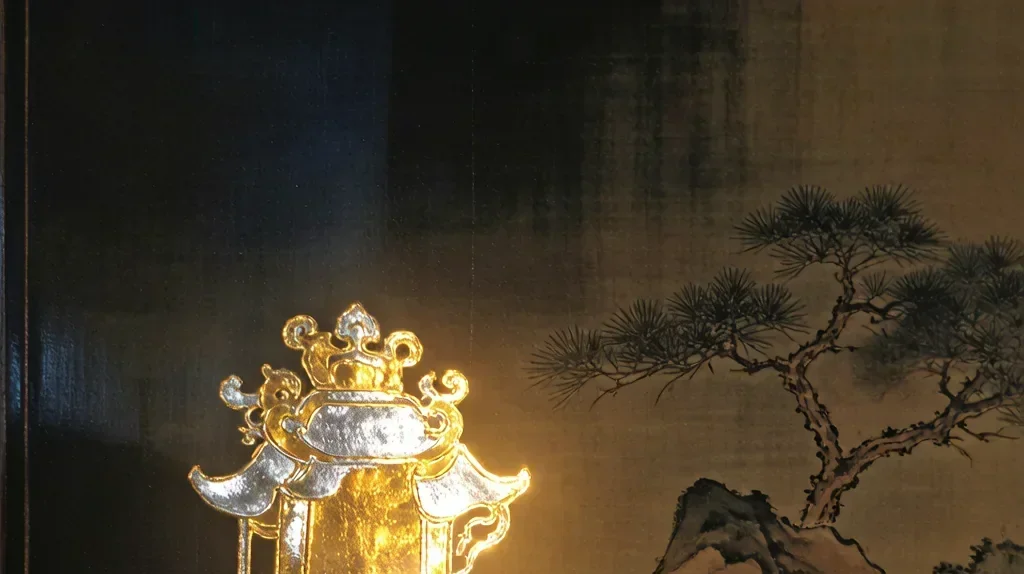
Gold and silver painting (jin yin hua, 金银画) refers to the use of genuine gold and silver pigments and leaf in Chinese painting, a luxurious practice most associated with the Tang dynasty court and with Buddhist and Daoist art. Gold could be applied as thin sheets (jin bo), as powdered pigment mixed with glue (jin fen), or as a "floating color" over a prepared ground; silver was used similarly, though it tarnishes and survives less often. These metals lent images a radiant, imperishable quality suited to sacred icons, imperial portraits, and the splendid blue-green landscapes whose outlines were picked out in gold. Though later literati taste favored plain ink, the gold-and-silver tradition never died, surviving in temple murals, court screens, and the decorative "gold-outline" manner of later ages.
Why Use Metal in Painting
Gold and silver are not merely pretty; they carry meaning. Gold signals the sacred and the imperial, evoking light, permanence, and the unworldly. In Buddhist art a gold halo marks a figure as enlightened; in court art, gold trim speaks of wealth and authority. Silver, cooler and rarer, was used for moonlight, water, or armor, and for elegant contrast.
Technically, metal pigments also solve a problem: they do not fade. While organic dyes lose their color, beaten gold keeps its glow for centuries, which is why so much that survives from early Chinese painting is precisely the gilded part.
Tang Dynasty Splendor
The Tang (618–907) was the great age of gold and silver in painting. Court ladies' portraits, Buddhist paradises, and Daoist immortals were set off with gold; the "gold-and-green" (jin bi) manner combined mineral blue-green with gold outlines to make landscapes shimmer. Tang records describe screens and temple walls ablaze with metal leaf.
Buddhism fueled the taste: the cave-temples of Dunhuang preserve Tang and later banners and murals where gold outlines halos, jewels, and cloud bands. Even when the painted color has dulled, the gold remains, letting us glimpse the original brilliance.
Gold-Blue-Green Landscape
A special branch is "gold-blue-green landscape" (jin bi shanshui), in which the azurite and malachite of a blue-green scene are reinforced with gold contour lines and highlights. The effect is sumptuous and architectural, more like a jeweled map of the cosmos than a quiet retreat.
This manner is often linked to the Tang masters Li Sixun and his son Li Zhaodao, who are credited with formalizing the blue-green, gold-accented landscape. Later painters returned to it for imperial commissions and festive screens, valuing its monumentality.
Methods of Application
Artists used several gold techniques. "Stuck-on gold" (tie jin) lays sheets of leaf onto a glue size. "Scattered gold" (sao jin) sprinkles powder. "Drawn gold" (gou jin) uses a fine brush charged with gold paste to trace lines and patterns. "Floating gold" (feng jin) applies gold over a raised white ground so it catches light.
Silver followed the same methods but was riskier: exposed silver oxidizes to black, so silver passages were often lacquered or kept under varnish. This is why silver is rarer in surviving works than gold.
Buddhist and Daoist Uses
Religious painting relied heavily on gold. Sutra fronts, mandorlas, and the robes of bodhisattvas were gilded; entire "golden scripts" were written with gold ink on dark blue paper. Daoist heavens and the costumes of immortals likewise shone with metal, tying the image to the light of the divine realm.
In the caves and temples, the gilded icon was also a focus for devotion—gold literally drew the eye and, by extension, the mind, toward the sacred. The material and the spiritual reinforced each other.
Court and Decorative Roles
Beyond religion, gold-and-silver painting served the palace. Imperial portraits, festival scrolls, and screen paintings for halls used metal to display majesty. The Yuan and Ming courts commissioned gold-outlined landscapes and flower screens, and the technique passed into the decorative arts—lacquer, textiles, and cloisonné—where it is most visible today.
Such works were made by professional workshops, not by scholar-amateurs. Their splendor fit public and ceremonial spaces rather than the private studio, marking a clear social boundary within Chinese art.
Literati Reserve and Later Survival
From the Song onward, rising literati taste privileged ink and "natural" color, and openly scorned heavy gilding as vulgar or merely craft. Yet the tradition persisted in temples, on court screens, and in popular prints, and individual literati occasionally used restrained "running gold" (yun jin) for accents.
In the Qing, the court at Beijing and the regional workshops of Suzhou kept gold painting alive for festivals and exports, and the export trade carried gilded Chinese screens to Europe. Thus a Tang luxury became a continuing, if secondary, strand of the painting craft.
Modern and Conservation Notes
Today gold and silver appear in revived court-style works, in contemporary "heavy-color" (zhong cai) painting, and in restoration of temple murals. Conservators must handle silver with care because of tarnish, and gold leaf work demands a still hand and the right humidity.
For viewers, gold-and-silver painting is a reminder that Chinese art was not always ink-monochrome. The "black-and-white" image of Chinese painting is a literati invention; the full tradition is also a tradition of color, light, and metal.
The technique also traveled into daily luxury: gold-decorated lacquer, gilded bronze mirrors, and gold-outlined textiles carried the same love of radiance into objects everyone could use. In this sense gold painting was never isolated in temples and palaces; it flowed into the decorative arts that surrounded ordinary life, making the sacred shimmer a part of the everyday as well.
❓ Frequently Asked Questions
What is gold-and-silver painting?
It is the use of real gold and silver as leaf or pigment in Chinese painting, a luxury practice for sacred, imperial, and decorative images.
When was it most popular?
The Tang dynasty was its great age, especially in Buddhist and Daoist art and in gold-outlined blue-green landscapes.
How was gold applied?
Methods included sticking on gold leaf, sprinkling gold powder, drawing fine gold lines with paste, and floating gold over a raised ground.
Why use silver if it tarnishes?
Silver gave cool, elegant tones for moonlight and water, but it was kept under varnish because exposed silver oxidizes to black.
What is gold-blue-green landscape?
It is a blue-green mineral landscape whose contours and highlights are picked out in gold, associated with the Tang masters Li Sixun and Li Zhaodao.
Did literati painters use gold?
They mostly preferred plain ink, but the tradition survived in temples, courts, and popular art, with occasional restrained "running gold" accents.