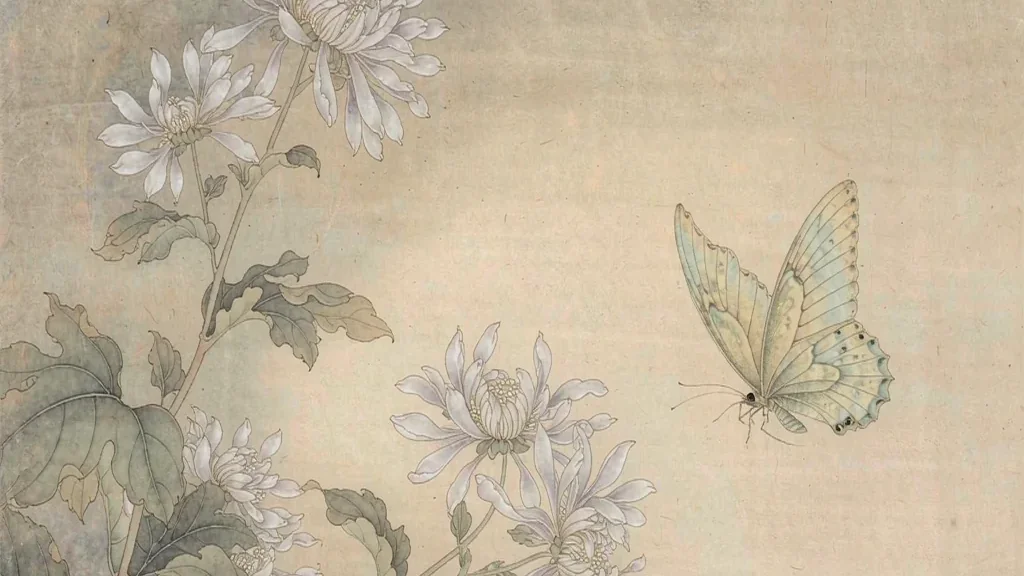
Boneless painting (mogu hua, 没骨画) is a Chinese flower-and-bird technique in which forms are built directly from washes and layers of color or ink without first drawing the ink outlines that normally define an image. The name means literally "without bone," where "bone" (gu) is the drafted contour line that usually underpins a picture. By skipping the outline and letting overlapping tones shape petals, leaves, and wings, the painter achieves a soft, luminous, almost watercolor-like effect. Perfected as a literati idiom by the Qing master Yun Shouping (恽寿平, 1633–1690), the boneless method became one of the most beloved ways to paint blossoms and birds, prized for its freshness and for the disciplined control of moisture it demands.
What "Boneless" Means
In Chinese painting theory, the "bone" (gu) is the structural line—the contour that gives a form its skeleton. Most gongbi (fine-brush) pictures begin with a meticulous ink outline that is then filled with color. "Boneless" painting omits that initial skeleton: the artist places color directly, and the edges of the color themselves become the form.
This does not mean the result is formless. On the contrary, the painter must control exactly where each wash stops, how tones blend, and how one leaf overlaps another, because there is no line to correct or hide mistakes. The "absence of bone" is thus a higher discipline, not an easier one.
Early History
The boneless idea has old roots. Later writers attributed an outline-free manner to the painter Yang Sheng of the Five Dynasties, and the technique appears in connection with certain Song academy flower studies that relied on subtle modeling. The Tang court's taste for rich mineral and gold pigments also prefigured the color-forward look.
What was scattered practice became a self-conscious method only later. The key turn came in the early Qing, when Yun Shouping raised boneless flower painting to a refined literati art and gathered followers, fixing its place in the canon alongside outline-based styles.
Yun Shouping and the Qing Revival
Yun Shouping (also called Yun Nantian) was a poet, calligrapher, and painter who, according to a famous story, gave up landscape to a friend and instead devoted himself to reviving the neglected boneless manner for flowers. His "boneless" blossoms—peonies, lotuses, camellias—are celebrated for their translucency, their restraint of color, and their scholarly poise.
Yun's approach joined careful observation of nature with a literati sense of suggestion. He used pale, layered washes so that petals seem lit from within, and he balanced botanical truth with elegant arrangement. His success made boneless painting a respectable, even prestigious, amateur idiom.
Technique and Materials
Boneless painting is usually done on sized (shuan) xuan paper or silk, surfaces that do not bleed wildly and thus allow controlled washes. The painter loads a soft brush with diluted pigment and lays tone directly, often building from light to deeper layers, letting the overlaps create shading. A touch of ink may be used at the base of a leaf for weight, but no enclosing contour is drawn.
Mastery of water is everything. Too much moisture and forms merge into mud; too little and the surface looks dry and hard. Yun Shouping's followers practiced for years to learn the exact "flying white" and graduated tones that make the method sing.
Subjects
The classic boneless subjects are flowers—peony, lotus, plum, camellia, narcissus—and the birds, butterflies, and insects that accompany them. Because the method excels at delicate graded color, it suits petals and wings better than, say, rugged rocks or architecture, though skilled painters extended it to fruits and vegetables.
Many boneless albums carry poems and seals, completing the literati "three perfections" object. The flowers are rarely merely decorative; they carry the seasonal and moral associations familiar from the "Four Gentlemen" tradition, now rendered in a softerkey.
Boneless Versus Fine-Brush
Compared with gongbi, boneless painting is quicker, airier, and more overtly "painterly." Gongbi encloses every form in a precise line and fills it with even color; boneless lets tone do the defining and keeps an atmospheric softness. The two are sometimes combined—a boneless flower with a few ink outlines added for stems—but pure mogu avoids the contour altogether.
Neither is superior; they answer different temperaments. Gongbi shows patience and exactness; boneless shows breath and control of water. Collectors through the Qing valued both, and many painters kept both methods ready.
The "Changzhou" Line
Yun Shouping was from Changzhou (in Jiangsu), and his boneless manner is sometimes called the "Changzhou School" (Changzhou pai) of flower painting. His son and a stream of followers—Ma Yuanyu, Yun's pupils, and later Qing painters—carried the style into the eighteenth century and beyond, keeping it a living workshop tradition.
The Changzhou line influenced the popular Yangzhou and Shanghai schools, where boneless flowers merged with bolder color for a wider market. In this way a refined literati technique fed the colorful, saleable painting of the late empire.
Modern Continuity
Boneless painting remains a standard part of Chinese brush-painting training today, especially in flower-and-bird courses. Modern masters have pushed its color range and scale, but the core principle—shape by wash, not by line—is unchanged. It is also the Chinese manner closest to Western watercolor, which helps explain its appeal to international learners.
In an age of new materials and mixed media, mogu endures because it captures something essential about Chinese aesthetics: the belief that softness, restraint, and the controlled accident of water can reveal a flower's true life better than a hard outline can.
❓ Frequently Asked Questions
What is boneless painting?
Boneless (mogu) painting builds forms directly from washes of color or ink without first drawing the contour outlines that normally define a picture.
Why is it called "boneless"?
"Bone" (gu) refers to the structural outline line; "boneless" means the picture is made without that skeleton, letting tone shape the form.
Who perfected the boneless method?
The Qing master Yun Shouping (1633–1690), also called Yun Nantian, raised it to a refined literati flower-painting idiom.
How is it different from gongbi?
Gongbi encloses forms in precise ink lines and fills them with even color; boneless lets graded washes define the form and keeps a softer look.
What subjects suit boneless painting?
It excels at flowers, birds, butterflies, and insects—anything needing delicate graded color—though fruits and vegetables are also painted.
Is boneless painting still practiced?
Yes. It remains a standard flower-and-bird training method in Chinese brush painting and is popular with international learners for its watercolor-like quality.