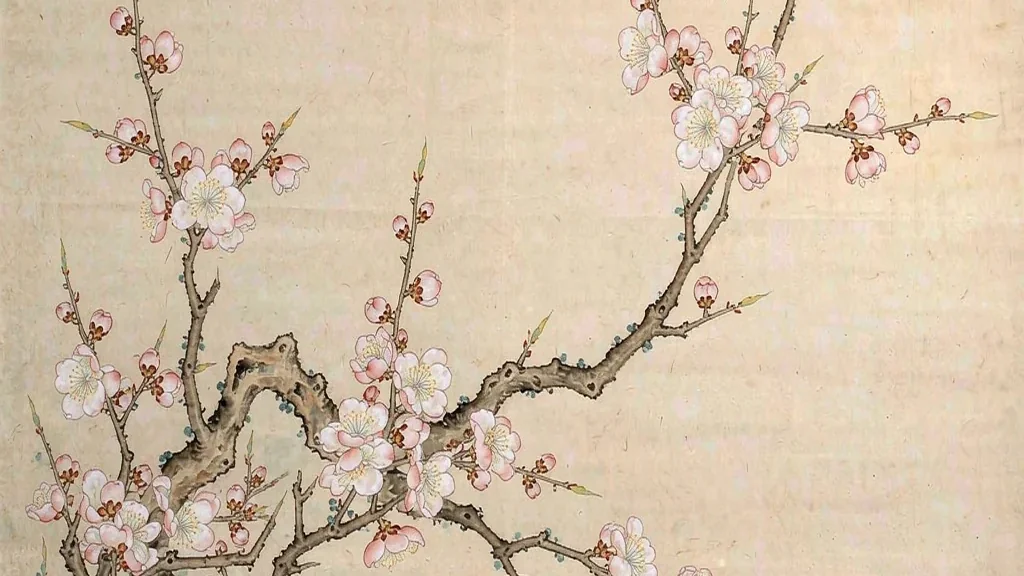
The plum blossom (梅花, méihuā) is one of the most cherished subjects in Chinese painting and a charter member of both the "Four Gentlemen" (四君子) and the "Three Friends of Winter" (岁寒三友, alongside pine and bamboo). It earns its place by blooming in the cold, often on bare branches dusted with snow, long before spring's warmth arrives. For a culture that prized endurance through hardship, the plum became the flower of resilience, hope, and renewed virtue—painted in ink or in pale color, as a single branch or a whole grove, and endlessly reinvented by both court and literati hands.
The Plum as Emblem of Resilience
Unlike the chrysanthemum, which blooms in autumn's calm, the plum bursts into flower in deepest winter, sometimes while snow still lies on the branches. This timing made it a natural symbol of courage and early renewal.
The "Three Friends of Winter"—pine, bamboo, and plum—group plants that stay green or bloom despite the cold, a clustered image of steadfast friendship and character under pressure.
Within the Four Gentlemen, the plum carries the lesson of resilience: the gentleman, like the blossom, keeps his integrity when circumstances are harshest.
The Five Petals and Their Meaning
A plum blossom has five petals, and popular symbolism reads them as the "five blessings" (五福, wǔfú): longevity, wealth, health, love of virtue, and a natural death. This made plum imagery auspicious as well as moral.
Painters often hint at the five petals with small circles or dots, so even an abstract ink plum carries this buried wish for good fortune. The flower thus bridges ethics and popular blessing.
The contrast of dark branch and pale flower also let artists play light against dark, a visual rhyme for the triumph of warmth over cold.
Technique: Ink Circles and Bare Branches
Ink plum is built from two elements: the branch, drawn as a twisting,结节 (node) -marked line, and the blossoms, usually rendered as small open circles with a few dots for stamens. The "boneless" color version fills petals with washes.
The branch must look old and gnarled yet alive—a hard-won balance that tests the painter's control of the flexible brush. A good branch "walks" across the paper with its own momentum.
Wang Mian (王冕, 1287–1359) is celebrated for ink plum in which the blossoms are crisp circles and the branches lean with disciplined energy, a manner copied for centuries.
Wang Mian and the Ink Plum Tradition
Wang Mian, a Yuan-dynasty scholar who lived in retirement, is the name most attached to plum painting. He reportedly painted plum on his own window paper to study its form, and his circular-petal method became canonical.
His plum often carried loyalist or self-possessed feeling, appropriate to a man who declined office. Later painters treated his style as both a technical and a moral model.
The "ink plum" (墨梅, mòméi) remains a distinct sub-genre, taught as a unit alongside the other gentlemen and practiced by amateurs worldwide.
The Plum in Poetry and Inscription
As with the other gentlemen, a plum painting was rarely complete without a poem and seal. Lines about "a branch in the snow" or "fragrance from afar" bound the image to a long literary stream.
Su Shi and other Song writers praised the plum's quiet strength, and the flower appears throughout classical poetry as a friend to the lonely traveler or the steadfast official.
The union of image, verse, and seal made the plum a compact statement of the painter's learning as much as his skill.
Court and Literati Treatments
The court manner favored fuller, brighter plum—dense blossoms, white or pink, sometimes with birds—decorative and celebratory. The literati favored sparse ink plum, valuing restraint and the trace of the hand.
Both shared the flower's core meaning, so a viewer could read "plum" instantly whether the work was a palace screen or a scholar's album leaf. The subject crossed class lines with ease.
In albums, plum often opens the year's cycle of flowers, paired with the other gentlemen to mark the seasons of virtue.
Role in the Scholar's Self-Cultivation
For the literatus, painting plum was a winter discipline: a way to keep company with resilience during the cold months and to rehearse composure. The controlled branch and five-petal blossom demanded patience.
Exchanged as gifts, plum scrolls carried wishes for fortitude and good fortune to friends facing difficulty. The flower was encouragement rendered as art.
In the studio it functioned like the other gentlemen—a small, repeatable lesson in the values a gentleman was meant to embody.
Modern Practice and Festive Use
The plum remains a staple of ink training and a favorite Lunar New Year image, when its promise of renewal fits the season of hope. "Plum blossoms announce spring" is a common festive phrase.
Contemporary painters still work in Wang Mian's ink manner and in new color styles, and the flower appears on everything from scrolls to porcelain and paper-cuts.
Its double identity—moral emblem and bearer of the five blessings—ensures the plum a secure place in both serious art and popular celebration.
❓ Frequently Asked Questions
Why is the plum blossom important in Chinese painting?
It blooms in winter, so it symbolizes resilience and renewal. It is both one of the Four Gentlemen and one of the Three Friends of Winter, making it a core moral and seasonal subject.
What do the plum's five petals mean?
They are read as the "five blessings" (wufu): longevity, wealth, health, love of virtue, and a natural death—so the flower carries an auspicious wish as well as a moral one.
Who was the famous plum painter?
Wang Mian (1287–1359), a Yuan scholar who lived in retirement, made the ink plum with circular petals and disciplined branches into a canonical style copied for centuries.
How is a plum branch painted?
The old, gnarled branch is drawn as a twisting, node-marked line, and the blossoms as small circles with a few stamen dots. The boneless method fills petals with color washes.
How do court and literati plum differ?
The court manner is fuller and brighter, often with birds; the literati favor sparse ink plum valuing restraint and the trace of the hand. Both share the flower's core meaning.
Is the plum still painted today?
Yes. It remains basic ink training and a popular Lunar New Year image of renewal, and it appears in both traditional ink and contemporary color styles.