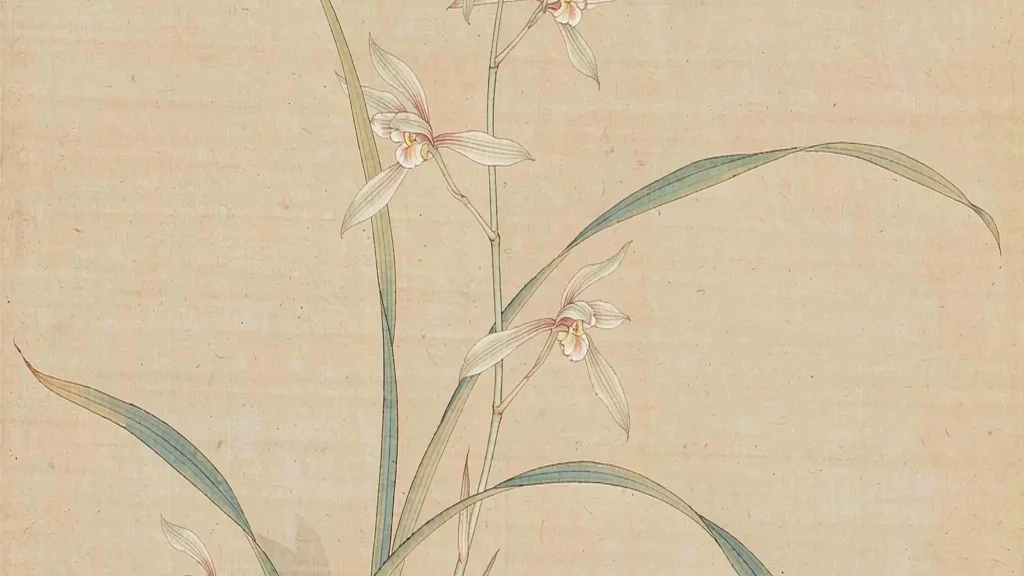
The orchid (兰花, lánhuā) holds a special, quiet place in Chinese painting as one of the "Four Gentlemen" (四君子) and a favorite subject of the literati. Unlike the showy peony or the regal chrysanthemum, the orchid is prized for its subtle fragrance and its habit of growing unnoticed in deep valleys—qualities that made it a perfect emblem of the gentleman whose virtue is known without self-promotion. Painted almost always in ink, with a few swift, calligraphic strokes, the orchid became a test of a painter's breathing control and a medium for expressing restraint, refinement, and noble withdrawal.
The Orchid as a Symbol of Hidden Virtue
Chinese writers long compared the orchid to the worthy person who cultivates character far from the court's noise. The philosopher Confucius is credited in later tradition with praising the orchid's fragrance that spreads without effort, a figure for moral influence that needs no office or audience.
Because the orchid blooms without drawing attention, it suited a scholar who valued inner worth over reputation. A painting of orchids could quietly declare integrity without the boastfulness of a more obvious emblem.
This modesty is why the orchid opens, alongside plum, bamboo, and chrysanthemum, the canonical "Four Gentlemen" set that became the ABC of Chinese brush training.
Place Among the Four Gentlemen
In the Four Gentlemen grouping, the orchid represents humility and the "hidden fragrance" of true character; the plum stands for resilience, the bamboo for integrity, and the chrysanthemum for retired ease. Each plant was thought to teach a different lesson.
The orchid's role as the gentle one made it the natural choice for painters who wanted to signal refinement rather than force. Its long, curved leaves also gave the brush a chance to show flowing, rhythmic line.
Albums often presented the four together, but a single leaf of orchids could stand alone as a complete moral and aesthetic statement, which helped the subject proliferate in scholars' studios.
Technique: The Calligraphic Line
Orchid painting is almost purely a matter of line. The leaves are drawn with a flexible brush in one continuous, tapering stroke, the wrist turning to give each blade its characteristic arc and slight droop. A broken or hesitant line is immediately visible, so control matters more than in many other subjects.
The blossoms are small clusters of dots and short strokes, usually in pale ink, suggesting rather than detailing the flower. The roots and the shallow pot or rock may be indicated with a few darker accents.
Because so little is depicted, the relationship of void to stroke is everything: the empty paper is the valley air around the plant, and the composition's balance rests on the play of a handful of arcs.
Why the Orchid Suits Ink Alone
Color would overwhelm the orchid's message. Painted in ink, the plant reads as pure gesture and temperament, in keeping with the literati preference for suggestion over display.
The monochrome also links the orchid to calligraphy, the scholar's daily discipline. Many orchid painters described their leaves as "running-script" or "cursive-script" brushwork, blurring the line between writing and painting.
In this way the orchid became a kind of bridge subject: easy to begin, endlessly hard to master, and constantly referring back to the painter's handwriting and therefore to his or her character.
Famous Orchid Painters
The Qing-dynasty Yangzhou eccentric Zheng Xie (郑燮, better known as Zheng Banqiao) is the name most associated with orchids in the popular imagination. He painted them with angular, bony leaves and paired them with plainspoken poems about integrity and official corruption.
Earlier, Yuan and Ming literati had already made the orchid a vehicle for loyalist feeling, especially after the fall of the Song, when painting "wild orchids" without a pot could hint at rootlessness and lost country.
Many wenren painters, less famous by name, filled album leaves with orchids as gifts and practice, so the surviving corpus is vast even if only a few masters are widely remembered.
The Orchid and the Scholar's Self-Image
To paint orchids was, for the literatus, a way of rehearsing an ideal self. The steady hand, the composed breath, the refusal to overstate—all were cultivated at the brush as much as in conduct.
Orchid albums were exchanged among friends as tokens of shared values, and an inscription could turn a simple plant into a pointed comment on politics or friendship. The flower carried social as well as solitary meaning.
In rooms where officials received guests, a hanging orchid scroll signaled that the host prized quiet virtue—a small but legible piece of self-presentation.
Cultural Meaning of "Hidden Fragrance"
The phrase "hidden fragrance" (幽香, yōuxiāng) captures the orchid's appeal: a scent you notice only by drawing near, unlike the peony's loud display. It became a metaphor for influence that works through character rather than power.
This idea runs through poetry as well as painting. To be "an orchid in an empty valley" (空谷幽兰) is to be a person of worth unnoticed by the world—a condition lamented but also quietly honored.
Painters leaned on this literary baggage so that even a minimal ink orchid spoke volumes to any educated viewer who caught the allusion.
Regional and Modern Continuity
Different regions emphasized different orchid manners—some tighter and more decorative, others looser and more personal—but the core vocabulary of leaf and blossom stayed stable across China.
In art education the orchid remains one of the first "gentlemen" a student learns, right after basic bamboo or plum strokes, because it teaches control of the line. Amateur clubs worldwide still practice it.
Contemporary ink artists sometimes rework the orchid with new materials or abstraction, yet its identity as the flower of unassuming virtue endures, a rare case where a painting subject has changed so little in meaning over a millennium.
❓ Frequently Asked Questions
What does the orchid symbolize in Chinese painting?
The orchid stands for humility and "hidden fragrance"—virtue known without self-promotion. As one of the Four Gentlemen, it represents the gentleman whose character influences others quietly, like a scent noticed only up close.
Why is the orchid painted only in ink?
Color would blunt its message of restraint. Ink alone links the image to calligraphy and keeps the focus on the breathing quality of the line, which the literati valued above display.
How do you paint an orchid?
The leaves are drawn as single, tapering, curved strokes with a flexible brush; the blossoms are small pale clusters of dots and short strokes. Empty paper stands for the valley air, so composition balances a few arcs against void.
Who was the famous orchid painter?
The Qing-dynasty Yangzhou painter Zheng Xie, known as Zheng Banqiao, is most associated with orchids, which he painted with bony leaves and plainspoken poems about integrity.
What is "an orchid in an empty valley"?
It is a phrase for a person of worth who goes unnoticed by the world. Painters drew on this literary image so a minimal ink orchid could imply loyal or unrecognized virtue.
Is the orchid still taught today?
Yes. It remains among the first Four Gentlemen subjects taught to ink students because it trains line control, and it is practiced by amateur painters in China and abroad.