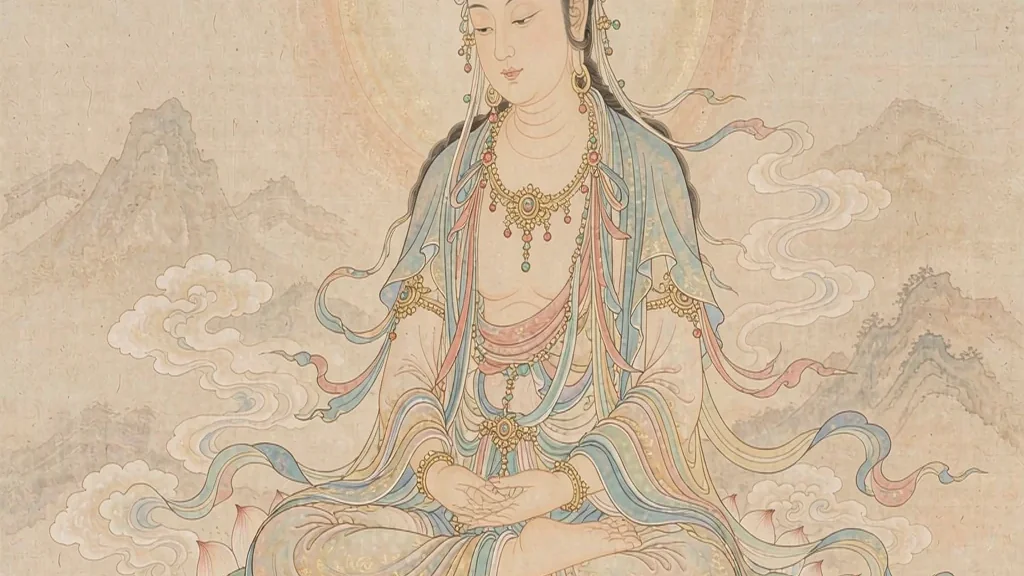
When Buddhism traveled the Silk Road from India to China in the early centuries of the Common Era, it brought not only scriptures and philosophies but a rich visual language that would transform Chinese painting forever. The first Buddhist images in China were not Chinese at all — they followed Indian and Central Asian conventions, showing the Buddha with Hellenistic features and draped in monastic robes. But within a few centuries, Chinese artists had indigenized Buddhist iconography, creating a distinctive tradition that blended Indian sacred imagery with Chinese aesthetic sensibilities, producing some of the most magnificent religious art in human history.
The Dunhuang Legacy: Buddhist Painting at the Mogao Caves
The Mogao Caves near Dunhuang, in western China, contain the world's richest repository of Buddhist painting, with more than 45,000 square meters of murals created over a millennium from the fourth to the fourteenth centuries. These cave temples were funded by merchants, monks, and local rulers who traveled the Silk Road, and their paintings reflect a remarkable fusion of Chinese, Indian, Persian, and Central Asian styles. The earliest caves show Indian-inspired Buddha images with foreign facial features, while later murals become increasingly Chinese in their linework, composition, and color palette.
The Dunhuang murals depict scenes from the Jataka tales (stories of the Buddha's previous lives), the Pure Land of Amitabha, and the complex pantheon of Mahayana Buddhism. Flying apsaras (天人, tiānrén) — celestial musicians and dancers — float across the ceilings, their billowing scarves flowing in patterns that Chinese artists would later adapt for Daoist and secular painting. The murals also provide invaluable records of medieval Chinese daily life: architecture, clothing, musical instruments, and courtly entertainments are all meticulously depicted.
Tang Dynasty Buddhist Painting: The Golden Age
The Tang dynasty (618–907) was the high point of Buddhist painting in China. Great masters like Wu Daozi (吴道子, 685–758) became legendary for their powerful depictions of Buddhist deities. Wu Daozi, often called the 'Sage of Painting,' was renowned for the dynamic energy of his brushwork, especially in depicting the wind-swept robes and fiery halos of heavenly beings. His murals in the capital Chang'an drew crowds of thousands, though none survive today except in later copies.
Tang Buddhist painting reached its most magnificent expression in Pure Land imagery, which depicted the Western Paradise of Amitabha Buddha as a celestial palace with gem-studded lotus ponds, pavilions floating on clouds, and a host of bodhisattvas attending the central Buddha. These radiant compositions gave worshippers a visual preview of the bliss that awaited faithful devotees, and they remain among the most spectacular achievements of Chinese religious art.
Chan (Zen) Painting: The Monochrome Revolution
From the Tang dynasty onward, the Chan (Zen) school of Buddhism developed a radically different visual aesthetic. Where Pure Land painting was colorful and elaborate, Chan painting was sparse, monochrome, and deliberately rough. Chan artists believed that enlightenment could not be captured in detailed representation but might be glimpsed in a single, spontaneous brushstroke. Paintings of the legendary Chan patriarch Bodhidharma, arhats (Luohan), and eccentric Chan masters became a distinctive genre.
Chan painting reached its peak during the Song dynasty (960–1279), particularly through artists like Liang Kai (梁楷) and Muqi (牧溪). Liang Kai's 'The Sixth Patriarch Cutting Bamboo' shows Huineng in a moment of sudden enlightenment, rendered with just a few swift ink strokes. The power of the image lies not in its detail but in the raw energy of the brush, which itself embodies the Chan ideal of spontaneous, unmediated action.
Esoteric Buddhist Painting: Mantras and Mandalas
During the Tang and Yuan dynasties, Esoteric (Vajrayana) Buddhism introduced complex mandala paintings and wrathful deity images to China. These works were highly schematic, following strict iconometric rules that dictated every proportion, color, and hand gesture. Mandalas served as visualization aids for meditation, with each element carrying precise symbolic meaning. The wrathful deities, with multiple heads and arms, represented the fierce compassion that destroys ignorance.
The Qing dynasty court, particularly under the Qianlong Emperor, was a major patron of Tibetan Buddhist painting. The imperial workshops at Beijing produced thousands of thangkas — scroll paintings on cotton or silk — that combined Tibetan iconography with Chinese painting techniques. These works demonstrate the continued vitality of Buddhist painting in China long after its decline in the central plains.
Decline and Revival of Buddhist Painting
Buddhist painting declined in China after the Tang dynasty, particularly following state-sponsored persecutions of Buddhism in 842–845 under Emperor Wuzong. Many temples and their murals were destroyed. During the Song and later dynasties, Buddhist painting survived primarily in remote temples and cave sites, while literati painters turned increasingly to secular subjects. Chan painting continued but became more closely associated with the scholar-amateur tradition.
In the twentieth century, Buddhist painting experienced a revival as part of the broader renewal of Chinese religious culture. Contemporary artists like Xia Jingxing have reinterpreted traditional Buddhist themes using modern techniques, while the Dunhuang Academy continues to study and restore the magnificent murals of the Mogao Caves. The Buddhist painting tradition in China, spanning nearly two thousand years, remains one of the world's great artistic legacies.
Indian and Central Asian Roots
Buddhist painting reached China with the faith itself, carried by monks and merchants along the Silk Road from the first centuries of the common era. The earliest images followed Indian and Gandharan models, with rounded bodies, haloed figures, and heavy outlines, visible at Central Asian sites such as Kizil before the tradition reached Dunhuang. As Chinese painters absorbed these forms they softened the contour and loosened the symmetry, producing a distinctly local look by the Tang. This layered inheritance, foreign in subject yet increasingly Chinese in hand, makes Buddhist wall painting a rare visual record of exchange across the deserts, and at Dunhuang one can read the whole arc from stiff western apsaras to graceful flying figures drawn with a purely Chinese brush.
Materials and Pigments of Cave Painting
The cave painters worked on a prepared earthen ground, layering clay, lime, and fiber over the rock before applying color. Their palette leaned on mineral pigments: bright azurite and malachite for greens and blues, cinnabar and lead for reds, and gold for haloes and highlights. These materials were costly and had to be ground, washed, and bound with glue before use, so the most precious blues were reserved for central holy figures. Over centuries some pigments darkened or flaked, which is why a mural today may look different from its original glow. The dry cave climate, however, preserved both the ground and the color far better than most temple walls exposed to weather and smoke, and study of the layers reveals earlier compositions hidden beneath later repainting.
Buddhist Painting in the Museum Age
From the early twentieth century, Dunhuang and other sites drew explorers and scholars who removed or documented thousands of paintings, scattering them across museums in Europe, Japan, and China. This upheaval made Buddhist wall and scroll painting a subject of global study even as it cost the caves many works. Today major collections display sutras, banner paintings, and rubbings of murals, while digital projects let viewers survey whole caves online. Conservators now stabilize flaking surfaces and control light and humidity to slow decay. The result is a shift from devotional object to world heritage, even as monasteries in China and Tibet continue to commission new Buddhist painting in the old modes, so the tradition lives both as living practice and as a protected chapter of art history.
❓ Frequently Asked Questions
📝 Chinese Vocabulary
敦煌壁画 — : Dunhuang murals; the Buddhist cave paintings of the Mogao Caves
飞天 — : apsara; flying celestial being in Buddhist art
壁画 — : mural; wall painting
禅画 — : Chan painting; Zen-inspired ink painting
曼荼罗 — : mandala; a cosmic diagram used in Esoteric Buddhist meditation
经变画 — : Jingbian, illustrated sutra narratives depicting Buddhist paradises and miracles.
罗汉 — : Luohan, an arhat or enlightened disciple frequently painted in sets.
水陆画 — : Shuilu paintings, large ritual charts of deities used in salvation ceremonies.
🎉 Fun Facts
- Wu Daozi was so respected that Tang dynasty poets claimed the figures in his murals would 'step down from the wall and walk away.'
- The Dunhuang Library Cave (Cave 17) contained more than 50,000 manuscripts, including the world's oldest printed book, the Diamond Sutra of 868 CE.
- Liang Kai was a court painter who retired to a Chan monastery and began painting deliberately rough, anti-realistic works that shocked conventional critics.
- The Mogao caves preserve wall paintings covering tens of thousands of square meters, among the largest continuous Buddhist painting cycles on earth.
- Tang imperial workshops employed teams of painters on temple commissions, making Buddhist image-making a major state-sponsored craft.
- Buddhist painters formed guilds with their own patron deities, showing how central the craft was to monastic and city life.