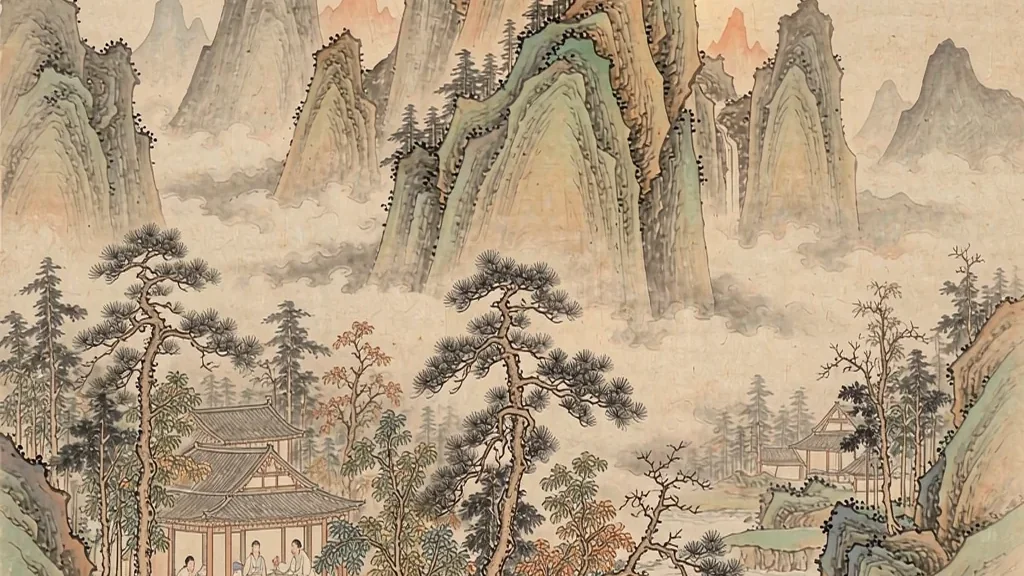
Ink-wash landscape—shuǐmò shānshuǐ (水墨山水) in Chinese—is the tradition most people picture when they think of Chinese painting: misty mountains dissolving into void, a few strokes of black ink suggesting vast distance, and empty paper doing as much work as the brush. More than a technique, it is a way of seeing in which the goal is not to copy a view but to capture its spirit (qìyùn, 气韵). Developed over more than a thousand years, ink-wash landscape became the supreme literary art of the scholar class and a profound expression of how Chinese culture understood nature, space, and the place of the human being within it.
What "Ink-Wash Landscape" Means
The term combines shuǐ (water), mò (ink), shān (mountain), and shuǐ (again, here "rivers/landscape"), so "ink-wash landscape" literally pairs the material—water-based ink—with the subject—mountains and waters. The defining feature is that form is built from gradations of a single black ink rather than from many colors.
This restraint is not poverty but discipline. By limiting the palette, the painter directs attention to brush rhythm, tonal depth, and the relationship between presence and absence on the paper. A great ink landscape can feel more "real" in atmosphere than a colored one.
The tradition sits within the broader category of shān shuǐ ("mountains and waters"), the Chinese name for landscape painting, which also includes colorfully painted blue-green and courtly styles.
Early History: From Tang to the Literati Ideal
Although landscape elements appear in Han and earlier art, landscape as an independent, ambitious genre matured during the Tang dynasty. The poet-painter Wang Wei (王维) is traditionally credited with early ink landscapes, and later critics praised his works for poetically fused word and image.
The Five Dynasties and Ten Kingdoms period and the subsequent Northern Song saw the first great monumental landscapes, when artists such as those of the Li-Guo lineage painted towering peaks that embodied cosmic order. These were often in ink with light color.
By the Southern Song, under court patronage, landscape turned more lyrical and intimate, using angled compositions and broad empty spaces—an early, refined stage of the "ink-wash" sensibility that would flower among literati.
The Song Achievement and Monuments of Ink
Northern Song landscape is famous for its grand, structured visions of mountain and river. Painters surveyed nature with a kind of geological patience, building rocks from layered "axe-cut" and "rainbow" texturing strokes and placing tiny human figures to measure the scale of the world.
Works in this mode convey both observation and cosmology: the mountain is a stable axis of the universe, the mist a breathing boundary between matter and void. Ink alone could carry this weight because tonal contrast expressed depth and atmosphere without needing local color.
Handscrolls designed to be unrolled a section at a time turned the viewing into a slow journey, a format perfectly suited to ink's ability to suggest continuous, shifting space.
Principles of Composition and Space
Ink-wash landscape rarely uses a single fixed perspective. Instead it employs "moving perspective," in which the eye travels up a mountain and across a valley as the scroll opens, assembling space from many viewpoints rather than one.
Empty paper is never "nothing." The unpainted areas are mist, water, sky, or distance; they give the painted strokes room to breathe. This positive use of emptiness is one of the tradition's most distinctive ideas.
Compositions are commonly organized into near, middle, and far distances using "the angle of the mountain and the face of the stone," with tonal recession—darker in front, lighter behind—standing in for atmospheric perspective.
Brush, Ink, and the Search for Spirit-Resonance
The classic sixth-century critic Xiě Hè listed "spirit-resonance" (qìyùn shēngdòng, 气韵生动) as the first of his Six Principles of painting. In ink landscape this meant the work should pulse with life, not merely resemble a place.
Achieving it depended on mastering the "bone-method" of brushwork (gǔfǎ, 骨法)—the controlled strength of each line—and on the living modulation of ink from wet to dry, dark to pale. The same ink had to suggest rock, water, foliage, and fog.
Literati theorists came to prize the trace of the artist's hand and mind over fine finish, so that a seemingly casual stroke could be the most valued thing on the paper.
The Literati Turn: Amateurs and Expression
From the Yuan dynasty onward, scholar-officials increasingly painted for themselves and their friends rather than for court or market. Ink landscape became their preferred medium, a vehicle for personal feeling and literary identity.
Masters such as the Four Yuan Masters simplified forms, favored dry, calligraphic brushwork, and left more emptiness, pushing the art toward abstraction and self-expression. The union of poetry, calligraphy, and painting on one surface became the ideal.
This "literati" (wénrén) approach valued the painter's character and learning above technical polish, reshaping what excellence meant in Chinese art for centuries.
Famous Painters and Enduring Works
Beyond Wang Wei and the Song monumentalists, the tradition honors names like Ni Zan, with his sparse riverside trees; Huang Gongwang, author of the long handscroll "Dwelling in the Fuchun Mountains"; and Dong Qichang, who later systematized landscape into Northern and Southern schools.
The Yuan and Ming periods produced countless album leaves and handscrolls in pure ink, many preserved in palace and temple collections and later in museums worldwide. These works set the standard by which later painters measured themselves.
In the Qing era, both the "Orthodox" masters who codified old methods and the "Individualists" who broke them kept ink landscape central, proving the form's flexibility across temperaments.
Ink-Wash and Chinese Philosophy of Nature
Ink landscape is inseparable from a worldview in which nature is not a resource to be dominated but a teacher and a home for the spirit. The tiny pavilion or fisherman in a vast scene expresses the human scale within a larger order.
Daoist and Chan (Zen) influences are often read into the emptiness and spontaneity of the best works: the mist that hides as much as it reveals, the suggestion over the statement. Yet the art also served Confucian self-cultivation, a disciplined practice of attention.
In this sense a landscape scroll is both a picture and a posture—an invitation to dwell mentally in mountains one may never physically visit.
Legacy and the Modern World
Ink-wash landscape remains the backbone of Chinese painting practice. It is taught as foundational training, and its vocabulary of strokes and compositional formulae is still learned by students today.
Modern and contemporary artists have both upheld and challenged the tradition, some working in pure monochrome and others mixing ink with new subjects, abstraction, or Western media, while still reckoning with its standards of breath and space.
Its influence also reached beyond China, shaping Korean and Japanese ink landscape and, in the modern era, informing global understandings of what a "painting" can be when less is deliberately left unsaid.
❓ Frequently Asked Questions
What is ink-wash landscape?
It is Chinese landscape painting built from black ink diluted with water to create tonal gradations, usually without local color. The aim is to capture the spirit of mountains and water rather than to copy a specific view.
Why is empty space so important?
Unpainted paper is used as positive space representing mist, water, sky, or distance. It gives the ink strokes room to breathe and lets the viewer's imagination complete the scene, a core idea in the tradition.
Who were the early masters?
The Tang poet-painter Wang Wei is traditionally linked to early ink landscapes, and Northern Song painters developed the grand monumental style. Later Yuan literati such as Ni Zan and Huang Gongwang shaped its expressive, calligraphic form.
What does "spirit-resonance" mean?
"Spirit-resonance" (qiyun) is the first of Xie He's Six Principles. It means a painting should feel alive and convey the inner vitality of its subject, more than mere likeness.
How is it different from Western landscape?
It generally avoids a single fixed viewpoint and uses "moving perspective," building space from many angles across a scroll, and it treats emptiness as meaningful rather than filling the frame.
Is ink-wash landscape still practiced?
Yes. It remains foundational training in Chinese painting and continues in both traditional and experimental contemporary forms, and it shaped ink landscape across East Asia.