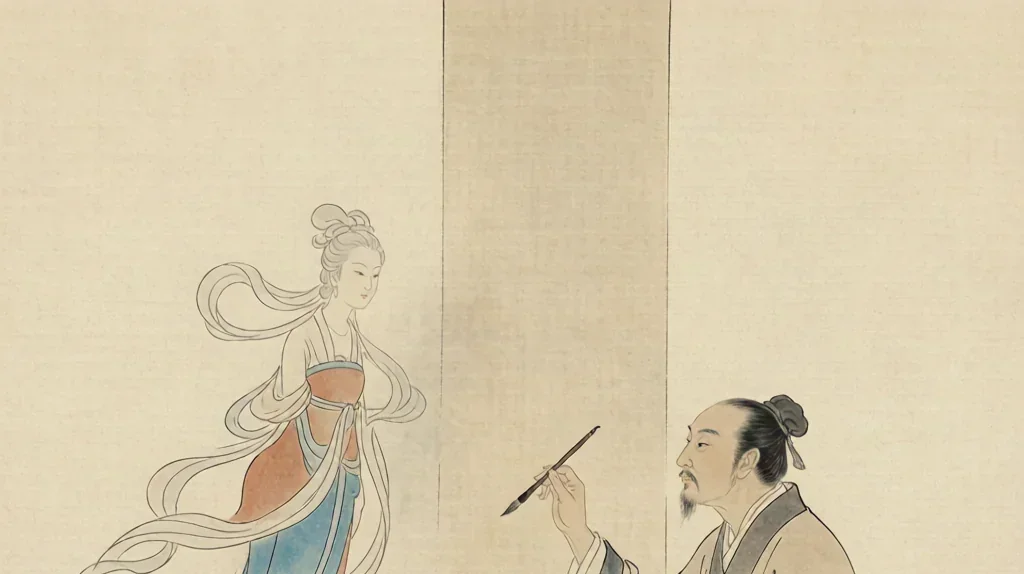
Almost every tradition has a founder, and Chinese figure painting has one in Gu Kaizhi (顾恺之, Gù Kǎizhī, c. 345–406). A poet, calligrapher, and wit of the Eastern Jin court, Gu is the earliest Chinese painter we can meet as a person — through anecdotes, through his own writings on art, and through scroll copies that still breathe his elegance. He is called the 『Father of Figure Painting』 not because he was first to draw people, but because he was the first to say, clearly and lastingly, what a portrait is for: to catch the spirit that lives behind the face.
Life at a Divided Court
Gu Kaizhi was born in Wuxi, in the south, during the Eastern Jin dynasty (317–420), when China was split and the Han elite had fled south across the Yangtze. He served as a retainer to the general Huan Wen and later at court, but his reputation rested on his genius with the brush and his eccentric charm. Tales describe him forgetting to eat while painting, and once painting a portrait whose sitter's portrait he then 『completed』 only by dotting in the pupils — at which the likeness suddenly came alive.
He was also a man of letters. His poetry and his three essays on painting — on the painting of clouds and terraces, on the spirit of figures, and on mounting — are the earliest Chinese art criticism we have. In them the old craft of decorating walls becomes a deliberate art of the mind.
The Doctrine of Capturing the Spirit
Gu's central idea was chuanshen (传神, chuán shén), 『transmitting the spirit.』 He insisted that a portrait's worth lay not in exact features but in the inner vitality it conveyed, and that this vitality gathered in the eyes. His famous line — 『the spirit of the four limbs has nothing to do with the likeness; the crucial point of capturing the spirit lies in the pupils』 — made the gaze the soul of the image.
He also taught that form exists only to carry spirit: yǐ xíng xiě shén (以形写神), 『use form to write the spirit.』 This phrase became the charter of Chinese portraiture and echoes in every later discussion of figure painting. Where a Western painter might model a cheek with light, Gu used a single flowing contour and let the eyes do the work.
Masterworks (in Copy)
Three works survive as later imperial copies and define his legacy:
Admonitions of the Instructress to the Court Ladies (女史箴图, Nǚ shǐ zhēn tú). Based on a Han moral poem, this handscroll shows palace women warned against vanity, jealousy, and indiscretion through scenes of daily court life. The Tang copy, in the British Museum, is a miracle of fine line and floating silk; its figures are slender, calm, and psychologically present.
Nymph of the Luo River (洛神赋图, Luò shén fù tú). Illustrating a love poem by Cao Zhi about a river goddess, this is one of the earliest narrative handscrolls in China — a long, wandering sequence of meeting and parting that taught later painters how to tell a story across space and time.
Portraits of Exemplary Women (列女仁智图, Liè nǚ rén zhì tú). A moral gallery of worthy women from antiquity, showing Gu's use of figure painting as a Confucian teaching tool.
Style and Influence
Gu's manner — the 『spring-water』 line (春蚕吐丝, chūn cán tǔ sī, 『silkworm spinning』), even, unbroken, and seemingly endless — gave figures a serene, otherworldly poise. His elongated bodies and small heads became the classical type for centuries. The Tang master Wu Daozi and the Song academies all looked back to him as progenitor, and the very category of 『figure painting』 (人物画) was shaped by the standards he set.
His blend of literature, calligraphy, and image also prefigured the literati ideal that the painter should first be a scholar — a linkage that would define Chinese art's highest ambition.
Legacy
No original Gu Kaizhi survives; the works we treasure are Tang and Song tracings made because later emperors refused to let him be forgotten. That very fact is his monument: a painter so revered that empires copied him to preserve him. His teaching that a portrait must carry the sitter's living spirit remains the first lesson of Chinese figure art, and his name still opens every history of the brush.
Personality, Technique, and the Problem of Copying
Gu was as famous for his character as for his brush. Contemporary anecdotes show a man both vain and absent-minded: he reportedly painted a portrait of a friend and, to 『complete』 it, added a diseased beetle to the sitter's thigh as a private joke, and once grew so absorbed in his work that he forgot a dinner invitation. Such stories hardened his legend as a genius touched by madness — the model later ages would reach for when describing any unworldly artist.
His technique, the 『spring-water thread』 (春蚕吐丝, chūn cán tǔ sī), used an even, continuous contour that never thickened or broke, giving figures a serene, floating calm. Combined with pale, restrained color and great attention to drapery, it set the classical type of the elegant court figure that the Tang masters would later enlarge and the Song academies refine. Because he worked before woodblock printing, his compositions survived only because later emperors had them traced and copied — a painstaking imperial industry that itself testifies to his authority.
The deepest puzzle he left is authenticity. We cannot see his hand at all; we see Tang and Song copies of it, copies made by artists who themselves interpreted him. Yet those copies agree on the essentials — the long, quiet line, the small head, the psychological gaze — and that agreement is why scholars trust them. Gu Kaizhi thus survives less as a body of objects than as a standard: the first named measure against which Chinese figure painting judged itself for fifteen hundred years.
His influence also reached beyond painting into everyday speech. The idea that 『the eyes are the window of the heart』 enters Chinese description of a portrait, a child's drawing, or a photograph through his example, so that a man long dead still shapes how people talk about likeness. Few artists live so quietly inside a language; Gu Kaizhi's doctrine became not just a rule of art but a way of reading another person.