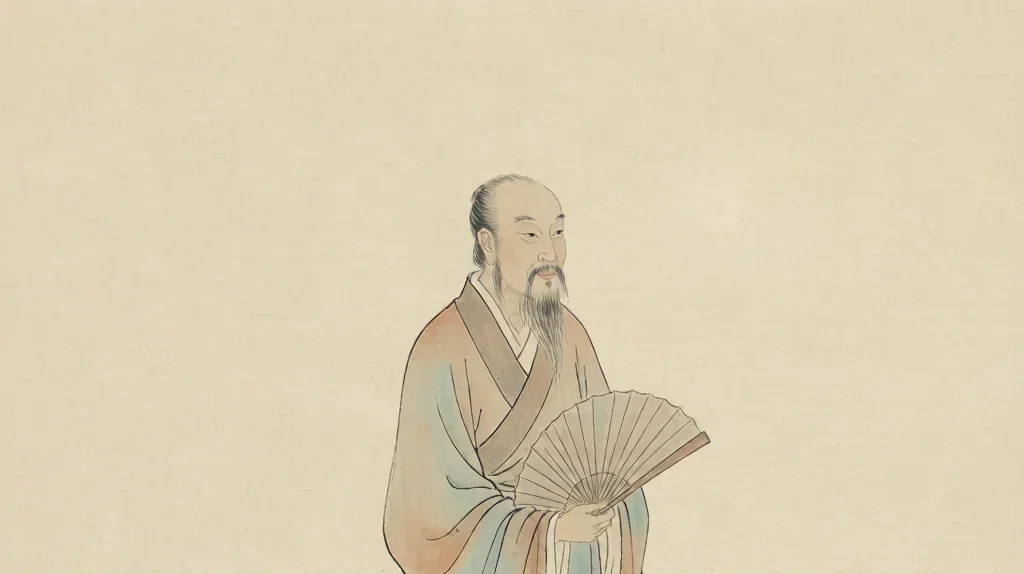
The human figure was the first subject Chinese painters ever set down. Long before artists fell in love with mountains and flowers, they drew people — dancers on Neolithic pots, generals on Han tomb walls, court ladies and philosophers in silk handscrolls. Rennwu hua (人物画, rén wù huà, 『figure painting』) is therefore the oldest branch of the Chinese brush, and for most of history it carried the heaviest duties: to record the face of the emperor, to tell a story from scripture or history, and to embody the Confucian virtues in the appearance of the sage. Its central puzzle was never how to make a body look solid, but how to make a person look alive.
Origins in Tomb and Temple
The earliest figures survive on pottery and in tombs. Han dynasty (206 BCE–220 CE) tomb chambers at sites like Mawangdui were lined with painted banners and murals showing the deceased amid attendants, beasts, and the cosmos — a figure art meant to serve the dead in the next world. These images are flat and frontal, drawn in confident outline, more concerned with rank and ritual than with depth.
By the Wei-Jin and Northern-Southern dynasties, figure painting became a refined court art with a moral aim. Painters illustrated 『exemplary women』 (列女, liè nǚ) and 『wise rulers』 so that viewers might absorb virtue by looking. The historian-artist Gu Kaizhi (顾恺之, c. 345–406) stands at the head of this tradition; his surviving scrolls, copied in later centuries, already show the elongated, elegant figures and the psychological gaze that defined the genre for a thousand years.
Capturing the Spirit
The defining idea of Chinese figure painting is chuanshen (传神, chuán shén), 『transmitting the spirit.』 Gu Kaizhi famously said the spirit of a person resides in the eyes, and that he left the pupils for last, fearing a wrong stroke would kill the likeness. The goal was never photographic resemblance but qiyun (气韵, qì yùn) — the breath or inner vitality unique to the subject. A portrait of a loyal minister should let you feel his loyalty; a portrait of a beauty should let you sense her mood.
This is why Chinese portraits often look 『flat』 to eyes trained on Renaissance shading. The artist used line — the gaugu or 『bone-method』 contour — as the chief conveyor of character. A steady, flowing line spoke of cultivation; a trembling one of age or grief. The face might be left almost unmodeled while the robe's drapery carried the emotion.
The Tang Masters and Wu Daozi
The Tang dynasty (618–907) raised figure painting to spectacle. Court painters depicted plump, majestic ladies (仕女, shì nǚ) strolling among peacocks, and Buddhist and Daoist murals covered monastery walls. The supreme name is Wu Daozi (吴道子, c. 680–760), called the 『Sage of Painting.』 His 『orchid-leaf』 (兰叶, lán yè) robe-lines swept with calligraphic power, and legend says a palace mural he painted seemed to open a real gate onto paradise when he waved his brush. Almost nothing survives in his own hand; we know him through copies and awe.
Tang figure art also absorbed foreign influence along the Silk Road — rounder faces, brighter color, and Central Asian costume — a cosmopolitan mix visible in the Dunhuang murals. The great narrative handscroll Along the River During Qingming belongs to a later, more earthly strand of figure painting that documented city life.
Portraiture and the Later Courts
From the Song through the Qing, imperial portraiture grew formal and hieratic: rows of emperors in frontal pose, gorgeously robed, idealized into majesty. At the same time a more intimate portrait tradition flourished among scholars, who commissioned small likenesses showing them as poets, fishermen, or recluses rather than officials — a link to the literati ideal of self-presentation.
The Qing court also met Europe. Jesuit painters such as Giuseppe Castiglione (郎世宁, Láng Shìníng) introduced Western perspective and shading into court portraiture, producing hybrid images that pleased the Qianlong emperor. This East-West fusion set the stage for the modern transformation.
Modern Transformations
In the 20th century, Xu Beihong (徐悲鸿) and others studied in Europe and brought back anatomy, life drawing, and chiaroscuro, merging them with ink line. Figure painting thus became the chief vehicle for modern Chinese art — laborers, horses, and patriotic themes rendered with new solidity, yet still claiming the old search for spirit. Today the genre spans traditional gongbi ladies, ink freehand portraits, and avant-garde experiment, all heirs to Gu Kaizhi's conviction that the eye is the window of the soul.
Techniques, Materials, and Formats
Like all Chinese painting, figure work draws on two manners. The meticulous gongbi (工笔) style builds a court lady or official with fine outline and layered, jewel-like color, while the xieyi (写意) freehand manner catches a monk, a drunk, or a laughing child in a few bold, wet strokes. Both were made on silk or xuan paper with animal-hair brushes and mineral or plant pigments bound in glue — the very toolkit shared with calligraphy, which explains why the best figure painters were also fine calligraphers.
The image also took different shapes for different occasions. A hanging scroll (立轴, lì zhóu) displayed a single dignified ancestor in the family hall; an album leaf (册页, cè yè) gathered a series of worthies or a set of 『thirty-six gentlemen』; and a handscroll (手卷, shǒu juǎn) could unfold a long narrative, as in the Qingming scroll. Because the painted surface was so often paired with the sitter's own poem and a red seal, the figure picture was rarely a solitary object but a small social event — composed, gifted, inscribed, and read among friends who knew the sitter's story.
Materials themselves carried meaning. White lead and cinnabar signaled festivity and rank; ink alone, reserved for a recluse or a Chan monk, spoke of austerity. The convention of leaving the face almost unmodeled while loading the robe with rhythmic line reached its height in the Tang and never fully left the tradition. In this way the 『flatness』 Western viewers notice was not a limitation but a choice — a decision to let character, not flesh, be the subject of the art.
Even the smallest choices carried ethics. A painter who flattered a corrupt official, or who signed a work he had not truly felt, was said to show 『the air of the marketplace』 (市井气, shì jǐng qì) — the vulgar note that betrayed a mercenary hand. The highest portrait, by contrast, was thought to improve its sitter, fixing his virtue for descendants to imitate. In this moral economy the brush was never neutral; it was a witness.