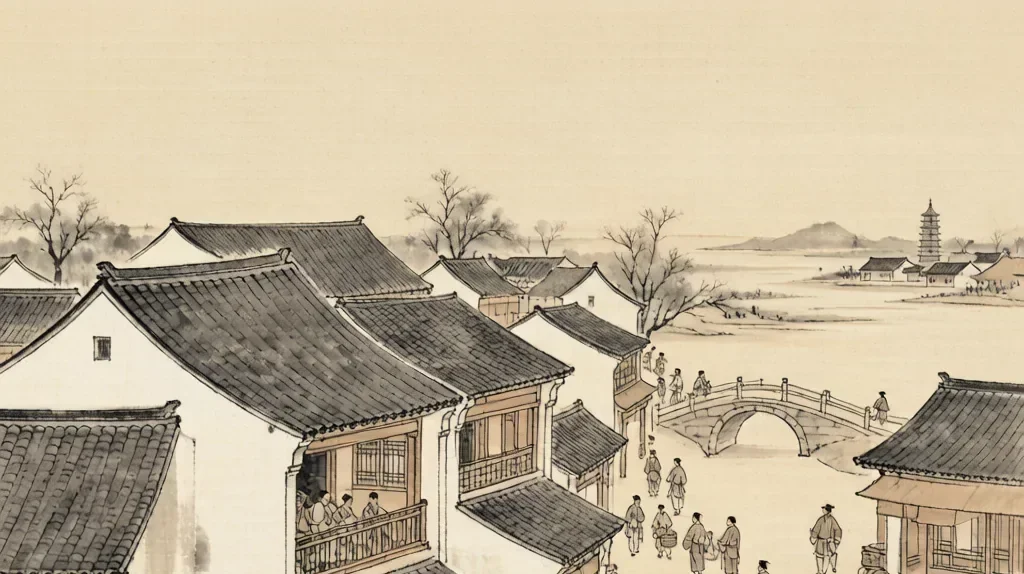
If most Chinese painting turns away from the crowd toward mountain or solitude, one scroll plunges straight into the market. Along the River During Qingming (清明上河图, Qīngmíng shàng hé tú) by Zhang Zeduan (张择端) is the great exception — a five-meter handscroll that walks the viewer through a 12th-century city from a quiet spring suburb to a teeming bridge and a walled metropolis beyond. More than any landscape or portrait, this painting lets us hear the noise of the past: the hawkers, the ferrymen, the overloaded carts, the moment a river boat almost wrecks a bridge. It is China's supreme work of genre and city painting.
The Painter and His Age
Zhang Zeduan lived through the final, richest decades of the Northern Song, when Bianjing (汴京, modern Kaifeng) was perhaps the largest city on earth, home to over a million people. He trained in the Imperial Painting Academy and excelled at jiehua (界画, jiè huà), 『boundary painting』 — the precise rendering of architecture with ruled lines. That discipline shows in every roof beam and shopfront of the scroll. We know little else of his life; the painting is his monument.
He painted around 1120, barely a few years before the Jin invasion of 1127 shattered the dynasty and the city. The scroll thus preserves, almost by accident, the last calm splendor of the Northern Song capital — a reason later collectors treasured it as both art and elegy.
Reading the Scroll
A handscroll is meant to be unrolled a section at a time, read left to right like a slow walk. Zhang's opens in the countryside: willow trees, a string of donkeys, a village inn. It then follows a road and the Bian River into the city. Boats unload grain at the docks; porters haul sacks; teahouses and pharmacies display their signs. The crowd thickens until it reaches the scroll's famous heart.
Scholars count roughly 800 people, more than 60 animals, 30 buildings, 20 boats, and 8 vehicles, each individualized — a scholar on a donkey, a doctor feeling a pulse, a quarreling couple, a laughing child. The art is in the detail: you can read class, trade, and mood from a stance. This is figure painting scaled to a whole society.
The Rainbow Bridge
The climax is the 『rainbow bridge』 (虹桥, hóng qiáo), a graceful wooden arch spanning the river without piers. Beneath it a large grain boat has dropped its mast too late and drifts toward the timbers; passengers shout, a man with a pole pushes off the hull, and onlookers above lean over the rail. The composition tightens like a held breath. Zhang uses the bridge both as engineering marvel and as stage for human comedy — a perfect union of jiehua precision and narrative drama.
Past the bridge the scroll enters the city gate and the main street: restaurants, pawnbrokers, a magistrate's escort clearing the way, a wedding procession. Then, almost abruptly, it ends at a city gateway — the journey complete, the viewer back at the edge of the wall.
Meaning and Debate
The title is famously ambiguous. 『Qingming』 can mean the Tomb-Sweeping festival of early spring, yet the scroll shows no mourners and no clear holiday. Many scholars therefore read 『qingming』 as 『clear and bright』 in the political sense — a well-ordered, peaceful age — and 『shang he』 as 『going up to the river.』 Either way, the painting quietly makes a point: a prosperous city is the fruit of good order, and order is made of a thousand small, ordinary labors.
Some later viewers read a warning in it — the unchecked crowd, the near-disaster at the bridge — as an omen of the coming catastrophe of 1127. Whether or not Zhang intended that, the work became a template for 『prosperity scrolls』 copied and reimagined for six centuries.
Legacy and Copies
The original, now in the Palace Museum in Beijing, spawned countless versions — most famously a monumental Qing-dynasty remake by five court painters showing the same city centuries later. Each copy testifies to the scroll's hold on the Chinese imagination: it is at once documentary, genre masterpiece, and love letter to city life. For anyone studying Chinese painting, it proves that the brush could chronicle the street as powerfully as the summit.
Technique: Boundary Painting and the Handscroll Form
Zhang's accuracy is no accident. As a master of jiehua (界画, jiè huà), he used ruled lines and measuring cords to render roofs, bridges, and city walls with architectural truth — a craft the Song academy prized precisely because it was hard to fake. Over this precise scaffold he laid lively, freehand figures, so the buildings feel engineered and the people feel alive. The result is a rare union of the measured and the spontaneous.
The handscroll form shaped the experience. Unrolled from right to left on a table, the painting controls time: the viewer meets the suburb, then the river, then the crowd, at a walking pace no wall could impose. Zhang exploits this, building from calm to climax at the bridge and relaxing into the city beyond — a rhythm of composition that later 『prosperity scrolls』 deliberately imitated. The format also invited close looking; a face two centimeters high rewards a viewer who leans in.
After Zhang the scroll had a long afterlife. The Southern Song made reduced 『souvenir』 versions; the Ming collected and praised it; and the Qing court commissioned an enormous remake some six meters longer, showing the same city centuries later under Manchu rule. Each copy is a statement about order and prosperity in its own time. The original's survival through dynastic collapse, war, and the last emperor's household is itself a small miracle — proof that a painting of daily life can outlast the empire it quietly praised.
The scroll's realism is, of course, selective. Zhang omits the poor and the soldiers who guarded the peace; his city is prosperous by design. Later viewers wary of flattery read the near-collision at the bridge as a quiet warning that order is fragile. Whether Zhang meant the omen or not, the ambiguity is part of the work's power — a city so alive it seems to teeter even at its height, as if prosperity itself carried the seed of its loss.