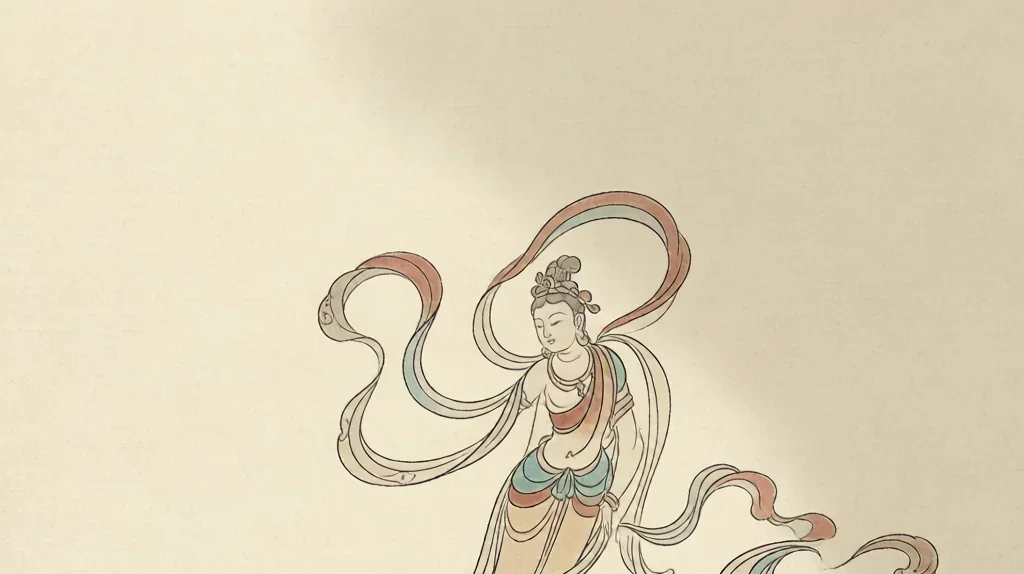
Not every great Chinese painting hangs on a silk scroll. Some covers an entire wall, and some lines a cliff-face cave. Bihua (壁画, bì huà, 『mural painting』) is the oldest and largest-scale tradition in Chinese art, and its two supreme monuments could hardly be more different: the Buddhist cave temples of Dunhuang, glowing with a thousand years of devotion along the Silk Road, and the Daoist Yongle Palace, where a 14th-century wall swells with a silent procession of immortals. Together they show what Chinese painting could do when faith met a wall and a century of calm.
Dunhuang and the Mogao Grottoes
At the edge of the Gobi Desert, where the Silk Road forked, the oasis of Dunhuang drew merchants, monks, and pilgrims. From the 4th to the 14th century they paid artisans to hollow caves into the Mingsha cliffs and paint them. The result, the Mogao Grottoes (莫高窟, Mò gāo kū), is nearly five hundred shrines holding perhaps 45,000 square meters of mural and more than two thousand painted statues. The desert's dry air preserved colors that in wetter lands would have long faded.
The paintings are a visual encyclopedia of Buddhist belief: the jataka tales of the Buddha's former lives, the paradises of Amitabha and Maitreya, wheeling apsaras (flying spirits, 飞天, fēi tiān) who seem to defy gravity, and terrifying judgments of the hells. Donors — local rulers, Central Asian traders, even a wife of a Tibetan king — appear in procession, recording who paid for the merit. The caves thus fused Indian iconography, Chinese line, and Persian and Central Asian color into something wholly Chinese.
Technique and Color at Dunhuang
Dunhuang painters worked fast and in teams. Over a plaster of lime and clay they laid charcoal underdrawings, then filled areas with mineral pigments: azurite and malachite for blues and greens, cinnabar and lead for reds and whites, carbon black for outlines. The famous 『flying apsaras』 are drawn in fluent, weightless lines that anticipate the best of later figure painting. Because the paint bound into the wall, the murals survived looting and time better than most scrolls.
In 1900 a Daoist caretaker found the 『Library Cave,』 sealed with tens of thousands of manuscripts and paintings — a time capsule that revealed Tang daily life, medicine, music, and art to the modern world, though many items were taken abroad.
Yongle Palace and the Daoist Sublime
Centuries later, in the Yuan dynasty, Daoists built Yongle Palace (永乐宫, Yǒnglè Gōng) in Shanxi, honoring Lü Dongbin, one of the Eight Immortals. Its three main halls still bear the finest Daoist mural cycle in China, painted about 1325 by anonymous craftsmen of the 『Southern Song Academy』 lineage. The centerpiece, the Chaoyuan tu (朝元图, 『Homage to the Primordial』), spans roughly 1,000 square meters and pictures some 290 celestial officials, generals, and maidens marching in solemn order toward the supreme deity.
Where Dunhuang feels joyous and crowded, Yongle is grave and grand. The figures stand nearly as tall as a person, robed in sweeping lines of unearthly calm. The anonymous masters achieved a monumentality equal to any landscape, proving that the Daoist wall could rival the Buddhist cave.
Why Murals Mattered
Murals were public, devotional art. For pilgrims who could not read, a wall was a sermon: heaven and hell made visible, the life of the Buddha enacted, the court of the gods convened. Rulers and merchants funded them to earn merit and announce piety; monasteries used them to teach. Because the painters were usually professional workshops, not literary amateurs, mural art followed the meticulous gongbi lineage rather than the literati freehand — yet its best lines pulse with the same vitality.
Preservation and Legacy
In the 1950s, when a reservoir threatened Yongle Palace, the entire mural was cut from its walls in blocks, moved, and re-mounted on a new site — a feat of conservation. Dunhuang, after decades of exposure and tourism, is now carefully climate-controlled, with digital scans sharing its caves worldwide. These walls remind us that Chinese painting was never only a scholar's scroll; it was also the people's cathedral, painted at the scale of faith.
Reading a Wall: Space, Line, and Survival
To read a mural you read space before detail. A Dunhuang cave wraps the viewer in imagery: a monumental Buddha on the back wall, narrative bands along the sides, and a ceiling of constellations and apsaras overhead, so that devotion happens inside a picture. The painter used scale to teach hierarchy — the deity vast, the donor small — rather than perspective to teach depth. The eye is guided by line and repetition, not by a vanishing point, which is why a cave feels less like a window than like a world.
The line itself is the miracle. Dunhuang's flying apsaras are drawn with contours so light and continuous that the body seems to trail off into motion; Yongle's celestial officials stand in robes whose folds sweep with calligraphic confidence across meters of plaster. In both, the wall painting inherits the linear discipline of figure painting while gaining a monumentality no handscroll could hold. Color, laid in flat areas of azurite and malachite, was secondary to the drawing that organized the crowd.
Survival was never assured. Dry desert air preserved Dunhuang, but humidity, smoke from lamps, and later whitewash damaged countless temple walls elsewhere; Yongle itself was nearly lost to a reservoir before its murals were cut away and re-hung. Today both sites are studied with digital photography and climate control, and facsimile caves let visitors feel the original without harming it. The wall, once the people's book, has become the people's archive — still teaching, still glowing, after a thousand years of dust.
Seen together, Dunhuang and Yongle mark the two poles of the Chinese wall. One is Buddhist, joyful, and cosmic; the other Daoist, solemn, and courtly. One speaks in many voices carried along the Silk Road; the other in one grave procession toward the gods. Both remind us that before the scroll and the album, China's painters thought big — in acres of plaster — and that faith, more than fashion, built the largest gallery the tradition ever knew.