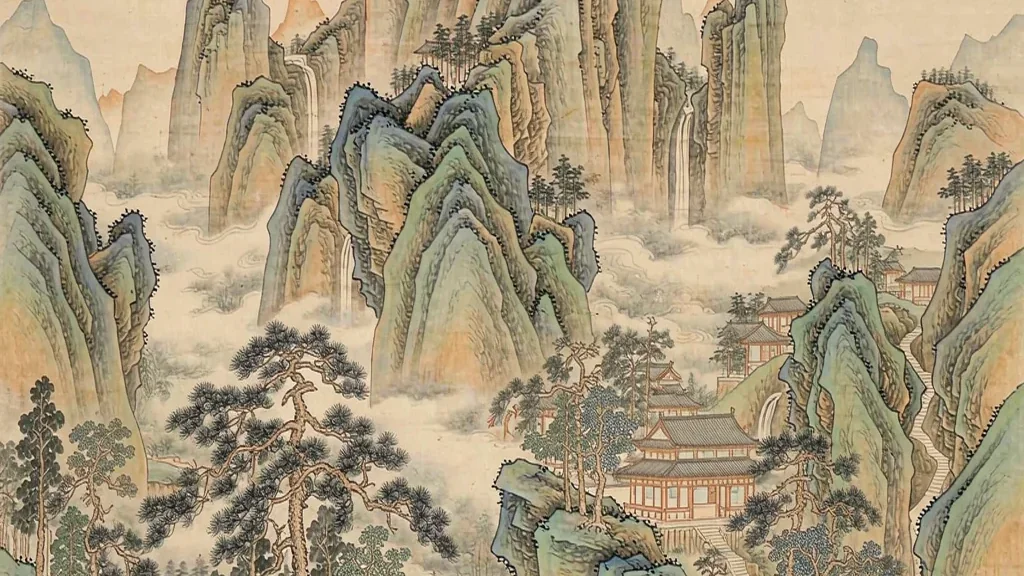
The "Northern School" (北宗, Běi Zōng) of Chinese landscape painting is less a geographic region than a powerful idea. The late-Ming theorist Dong Qichang (董其昌, 1555–1636) invented the label to describe a lineage of professional, richly detailed, often colorfully painted landscapes descended from the Tang masters Li Sixun and Li Zhaodao and running through Song monumentalists such as Li Cheng, Fan Kuan, and Guo Xi to the Southern Song academy painters Ma Yuan and Xia Gui. Dong paired it with a "Southern School" of amateur ink painters, and his judgment—that the Southern, literati way was superior—shaped how China has talked about its own art ever since.
Dong Qichang's Invention of the Divide
Crucially, the Northern/Southern split was a critical construct, not a description of where painters lived. Dong Qichang borrowed the Buddhist terms "Northern" and "Southern" (from a Chan distinction) to sort landscape lineages by temperament and social role.
In Dong's scheme the Northern School was professional, meticulous, and often colored or outlined; the Southern School was amateur, ink-based, and expressive. He ranked the Southern higher because it matched the scholar's ideal of spontaneous, learned ease.
Modern art historians note that the divide is partly artificial—real painters borrowed across it—but its influence on taste, collecting, and teaching was enormous and lasting.
Tang Roots: Li Sixun and the Blue-Green Manner
Dong traced the Northern line to Li Sixun (李思训, 651–716) and his son Li Zhaodao (李昭道), Tang-dynasty aristocrats famed for polished landscapes in mineral blue and green with fine outline and gold accents.
This "blue-green" (青绿, qīnglǜ) manner was courtly and labor-intensive, suiting the professional painter trained in a workshop. It emphasized clarity of contour and brilliant, stable color.
Although Dong's lineage is schematic, the Li family's reputation as founders of a precise, colored landscape gave the "Northern" idea a plausible ancient anchor.
Song Monumentalists: Li Cheng, Fan Kuan, Guo Xi
The Northern School's heart is the Song monumental landscape tradition. Li Cheng (李成, 919–967) painted bare northern trees and distant peaks with refined, icy touches; Fan Kuan (范宽, c. 950–1032) built towering, tactile mountains from dense texturing; Guo Xi (郭熙, c. 1020–1090) theorized the "angle of the mountain" and moving perspective.
These artists worked largely in ink with light color and served court or official circles. Their art is structured, observation-based, and grand in scale—qualities Dong grouped under the Northern banner.
Guo Xi's "Early Spring" and the surviving monumental scrolls show the disciplined, architectonic side that the label celebrates.
The Southern Song Academy: Ma Yuan and Xia Gui
Dong extended the Northern line to the Southern Song court academy, above all Ma Yuan (马远) and Xia Gui (夏圭), whose angled, lyric compositions and broad empty spaces defined the "Ma–Xia" manner.
Though more spontaneous than the Northern Song monumentalists, Ma and Xia were court professionals, which is why Dong classed them as Northern despite their poetic emptiness.
Ma Yuan's habit of placing the main scene in a corner earned the nickname "one-corner Ma," a compositional signature still studied as a hallmark of the academy style.
Style and Technique of the Northern Manner
Northern-school painting tends toward clear contours, careful modeling of rock with texturing strokes (cūnfǎ), and structurally reasoned space. Where color appears, it is often the blue-green palette or tempered mineral tints.
The brush is controlled and the finish high; the goal is a convincing, often awe-inspiring representation of nature's order rather than a personal outpouring. This made it ideal for court walls and official gifts.
Even in ink, Northern works feel "built," with a sense of architectural weight quite different from the airy suggestiveness associated with the Southern ink line.
Northern Versus Southern: What the Contrast Means
The contrast is best understood as professional versus amateur, colored/detailed versus ink/spontaneous, and "craft" versus "self-cultivation." Dong was arguably defending the scholar's way of painting as morally and aesthetically higher.
In practice, many admired both: a literatus might theorize against the Northern manner while owning fine blue-green scrolls. The divide shaped opinion more than production.
Later critics, especially in the Qing, sometimes pushed back, noting that the Northern masters were themselves great; the debate became a permanent feature of Chinese art writing.
The Northern School in Later Centuries
After Dong, the "Zhe school" (浙派) of professional Ming painters was loosely cast as Northern-heir, while the "Wu school" literati were Southern. The labels helped organize a crowded field of regional styles.
In the Qing, the Orthodox masters largely followed the Southern (literati) lineage Dong preferred, which entrenched his ranking in academic and collector taste for generations.
Yet Northern-school techniques—blue-green color, crisp contour, monumental structure—never disappeared and were revived by painters who wanted grandeur and precision.
Why the Distinction Still Matters
Dong Qichang's Northern/Southern framework is still the default map for understanding Chinese landscape history, even though scholars qualify it. It gives students a first handle on why one scroll feels like a court commission and another like a scholar's diary.
The Northern School also preserves the reputation of the great Song monumentalists and the Tang colored landscape, ensuring they are read as a coherent achievement rather than isolated names.
Understanding the label's constructed nature is itself a lesson in how Chinese art criticism works: taxonomy as argument, not just description.
❓ Frequently Asked Questions
What is the Northern School of Chinese painting?
It is the lineage labeled by Dong Qichang to describe professional, detailed, often colored landscapes descended from Tang's Li Sixun through Song monumentalists to the Southern Song academy painters Ma Yuan and Xia Gui.
Is the Northern School from northern China?
No. The name is a critical construct, not a region. Dong Qichang borrowed "Northern/Southern" from Chan Buddhism to contrast professional, polished painting with amateur ink painting.
Who were its key masters?
Traditionally Li Sixun and Li Zhaodao (Tang), then Li Cheng, Fan Kuan, and Guo Xi (Song), and finally Ma Yuan and Xia Gui of the Southern Song court academy.
How does it differ from the Southern School?
The Northern manner is professional, detailed, often colored, and structurally built; the Southern is amateur, ink-based, and expressive. Dong ranked the Southern higher as the scholar's ideal.
Why is the distinction controversial?
Historians note real painters borrowed across both manners, so the split is partly artificial. Yet it shaped centuries of taste, collecting, and teaching, so it remains the standard map of landscape history.
Did the Northern style disappear?
No. Though Dong favored the Southern lineage, Northern techniques—blue-green color, crisp contour, monumental structure—survived and were revived by painters wanting precision and grandeur.