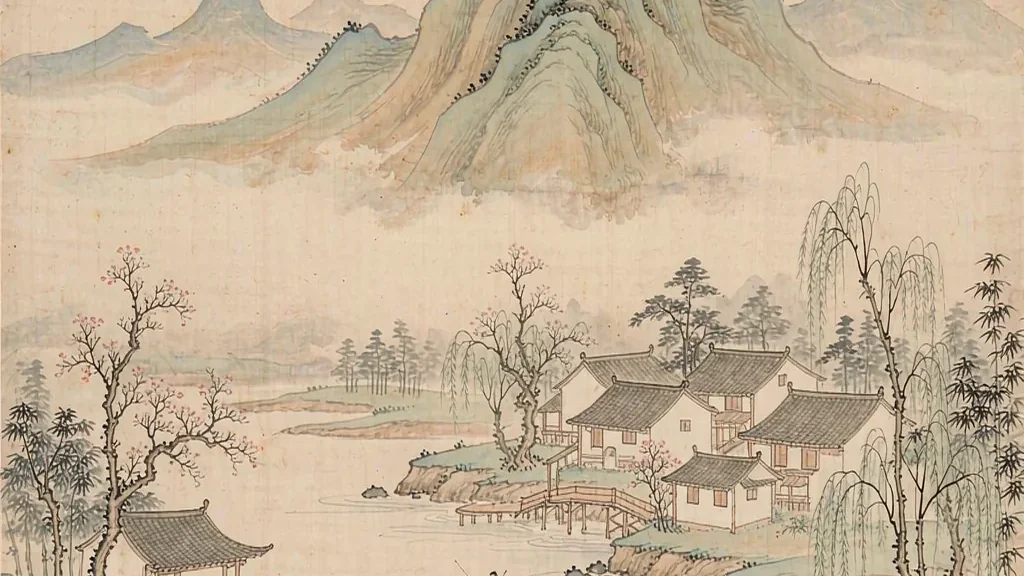
The Southern School (Nan zong) of Chinese painting is a lineage ideal more than a strict geographical movement. Coined by the late-Ming critic Dong Qichang, the term groups together masters who favored spontaneous, literati-style brushwork and personal expression over the polished, colored, and rule-bound manner he assigned to a rival "Northern School." Rooted in the ink landscapes of Wang Wei of the Tang dynasty and matured through Song, Yuan, and Ming scholar-painters, the Southern School became the most prestigious stream of later Chinese art. This article explains its invention, key artists, doctrines, and lasting influence.
The Invention of the Term by Dong Qichang
The Southern/Northern School distinction was formulated in the late 16th and early 17th centuries by the painter-theorist Dong Qichang. Drawing on a metaphor borrowed from Chan (Zen) Buddhism's division into "sudden" and "gradual" enlightenment, Dong split painting history into two lineages. The Southern School he praised as spontaneous, scholarly, and intuitive; the Northern School he criticized as artificial, professional, and studio-bound.
It is important to understand that Dong's scheme was not a neutral historical report. It was a polemical attempt to elevate literati amateur painting above the skilled academic and professional traditions. Later scholars have shown the divide was largely a construct, yet its influence on how Chinese painting was taught and valued was enormous and long-lasting.
Wang Wei and the Legendary Origin
Dong Qichang placed the poet-painter Wang Wei (701–761) at the head of the Southern School. Wang Wei, a Tang dynasty court official and Buddhist devotee, was celebrated for poetic landscapes and was later credited with pioneering ink monochrome over color. Though few works securely attest to his hand, his reputation as a refined, literary painter made him an apt founding figure.
By tracing the Southern School to Wang Wei, Dong gave the literati lineage a venerable Tang ancestry and a Buddhist, meditative color. The move linked scholarly painting not to craft guilds but to poetry, philosophy, and spiritual cultivation—qualities that became central to the school's self-image.
Lineage and Key Masters
After Wang Wei, Dong's Southern School genealogy passes through Zhang Zao and the monk-painter Ju Ran, then to the literati of the Song and Yuan such as Dong Yuan, Juran, Mi Fu, and above all the Four Yuan Masters (Huang Gongwang, Ni Zan, Wang Meng, Wu Zhen). Each was prized for an individual, seemingly effortless brush voice rather than workshop finish.
In the Ming, the lineage continues through Shen Zhou and Wen Zhengming of the Wu School, and in the late Ming through Dong Qichang himself and the so-called "Huating" circle. The Qing dynasty "Orthodox School" (Wang Shimin, Wang Jian, Wang Hui, Wang Yuanqi) explicitly claimed Southern School descent, systematically codifying its methods.
Literati Values and Amateur Ideals
The Southern School prized the painter as a cultivated gentleman who painted for self-cultivation and friendship, not for pay. The ideal was "writing" (xie) rather than "depicting"—brushed, calligraphic marks that revealed character. Technical brilliance was acceptable only when it looked natural and unforced.
This amateur ethos did not mean untrained; Southern School masters were usually highly skilled. Rather, it meant that skill was subordinated to expression and learning. A painting was judged by its brush vitality, its literary resonance, and the moral-aesthetic standing of its maker, not by illusionistic realism.
Brushwork and the Calligraphic Line
Stylistically, Southern School painting favors visible, rhythmic brushstrokes derived from calligraphy. Texture strokes, dotting, and dry-brush effects carry the structure of mountains and trees. Ink is used in graded tones, often with a degree of wetness that gives a soft, breathable quality distinct from hard-edged academic line.
The goal is a lively, "writing" quality in which every stroke reads as a gesture. Southern School theorists taught that one should paint as one writes—with confidence and flow—so that the picture becomes a record of the artist's mind in motion. This calligraphic emphasis became a hallmark distinguishing it, in theory, from professional color painting.
Contrast with the Northern School
In Dong's scheme the Northern School meant the polished, colored, decorative manner associated with professional academy painters and certain Tang masters such as Li Sixun and his blue-green gold style. It was linked to careful finish, bright mineral pigments, and courtly display—qualities Dong deemed "grammatical" and less free.
Modern art history rejects the simple opposition. Many painters mixed modes, and the so-called Northern School included superb artists. Still, the contrast helped later collectors organize the past and reinforced a lasting preference among the scholarly elite for ink over color and spontaneity over finish.
Yuan Literati and the Southern School Core
The Yuan dynasty (1271–1368) is often seen as the true heart of the Southern School spirit. Under Mongol rule, many educated Chinese men withdrew from office and turned to painting as private solace. The Four Yuan Masters produced stark, intensely personal ink landscapes—Ni Zan's empty riverbanks, Huang Gongwang's long handscrolls—that became templates for later literati.
These Yuan works valued restraint, oddness, and refusal of flourish. Their example taught later Southern School painters that a few suggestive strokes could carry more feeling than a fully detailed scene, and that refusal to please a patron was itself a virtue.
Influence Through the Qing and Beyond
The Qing court's favored "Orthodox School" carried Southern School method into a system of learned imitation, studying old masters' structures as a path to one's own style. At the same time, individualist eccentrics (the "Yangzhou Eight Eccentrics," Zhu Da, Shitao) pushed Southern School spontaneity toward bold personal freedom, sometimes rejecting orthodoxy.
In the modern period, the Southern School ideal shaped how Chinese painting met Western art: reformers either defended its literati spirit or attacked its amateurism as backward. Either way, Dong Qichang's two-line genealogy remained the frame through which Chinese painting history was understood well into the 20th century.
Criticism and Modern Reassessment
Twentieth-century scholars criticized Dong's scheme as historically misleading, noting that "Southern" and "Northern" did not map onto real regional schools and that many favored artists crossed the supposed divide. The binary also undervalued professional and court painters who produced great work outside the literati mold.
Yet the Southern School remains a useful lens for understanding how Chinese artists and collectors thought about originality, spontaneity, and the bond between painting, poetry, and calligraphy. Its vocabulary still shapes connoisseurship, even as historians treat Dong's lineage with healthy skepticism.
❓ Frequently Asked Questions
What is the Southern School of Chinese painting?
It is the literati lineage praised by Dong Qichang, favoring spontaneous ink brushwork and personal expression over polished, colored, professional manner.
Who created the Southern School concept?
The late-Ming painter-theorist Dong Qichang invented the Southern/Northern School division, adapting a Chan Buddhist metaphor.
Was the Southern School a real historical group?
Not strictly; it was largely Dong's construct. Many painters crossed the supposed divide, and modern scholars treat the split as misleading.
Who are the key Southern School masters?
Wang Wei (founder by reputation), Dong Yuan, Mi Fu, the Four Yuan Masters, Shen Zhou, Wen Zhengming, and the Qing Orthodox School.
How does it differ from the Northern School?
In Dong's scheme the Northern School meant polished, colored, academic painting, while the Southern favored ink, spontaneity, and literati amateur values.
Why does the Southern School matter today?
It shaped centuries of connoisseurship and the ideal that painting joins poetry and calligraphy, and it remains the frame for understanding Chinese art history.