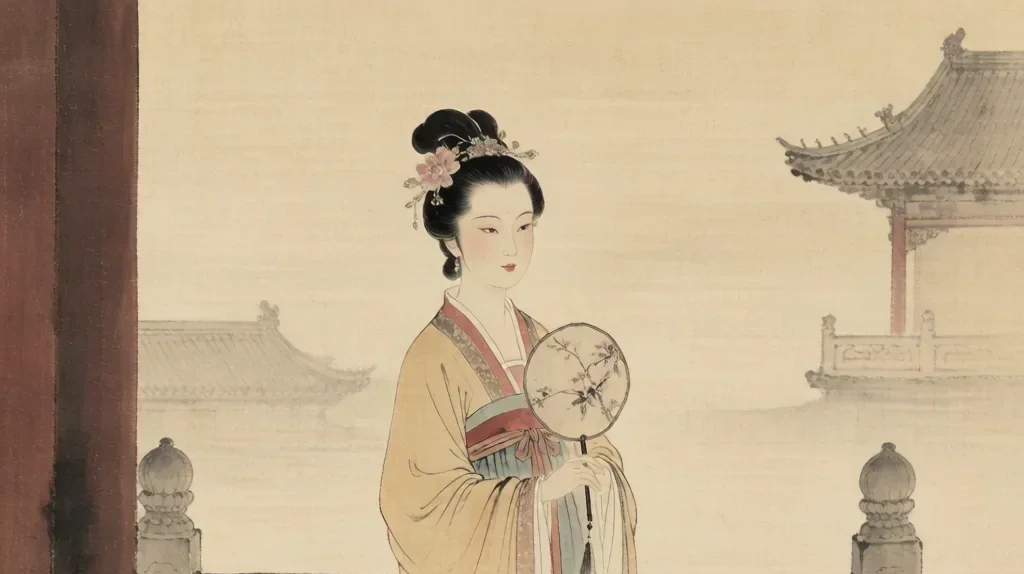
In the secluded inner courts of the Forbidden City and the pleasure pavilions of imperial gardens, a tradition of painting flourished that depicted not the heroic generals and wise ministers of official history but the women of the palace — their beauty, their ennui, their fleeting joys, and their quiet tragedies. Palace beauty painting (仕女画, shìnǚ huà), often translated as 'beautiful women painting,' was one of the most enduring and beloved genres of Chinese figure painting, evolving from didactic illustrations of virtuous ladies to subtle explorations of feminine subjectivity that continue to resonate with viewers today.
Han and Six Dynasties Origins: Virtue and Admonition
The earliest palace beauty paintings were not celebrations of feminine beauty but moral lessons for court women. The most famous early example is Gu Kaizhi's 'Admonitions of the Instructress to the Court Ladies' (女史箴图, Nǚshǐ Zhēn Tú), a handscroll from the 4th century that illustrates a Han dynasty text advising palace women on proper conduct. The painting shows scenes of ladies at their toilette, of the emperor granting audience, and of domestic harmony, each scene accompanied by a text explaining the moral lesson.
The women in these early paintings are elegant but not individualized; they serve as types representing virtues or vices. The linework is fine and flowing, establishing the 'bony method' (骨法, gǔfǎ) of figure painting that later generations would emulate. The didactic purpose of these paintings reflected the Confucian concern that the inner palace must be orderly for the state to be well-governed.
Tang Dynasty: The Golden Age of Feminine Beauty
The Tang dynasty (618–907) produced the most famous palace beauty paintings in Chinese art. Zhang Xuan (张萱) and his follower Zhou Fang (周昉) created iconic images of court ladies at leisure: playing chess, embroidering, walking their dogs, or simply gazing into the distance. These paintings are notable for their full-figured women, who were considered the height of beauty during the Tang — a stark contrast to the slender ideal of later dynasties.
Zhou Fang's 'Court Ladies Wearing Head Ornaments' is a masterpiece of the genre, showing six women and a maid in a garden setting. The ladies' plump faces, elaborate hairstyles, and luxurious robes are rendered with exquisite detail, while their expressions — slightly melancholic, slightly distracted — suggest a world of inner feeling beneath the surface of courtly elegance. Zhou Fang was said to have painted from direct observation of palace life, and his work conveys an intimate understanding of his subjects.
Song Dynasty: Refinement and Lyricism
Song dynasty (960–1279) palace beauty painting became more refined and introspective. The figures became more slender, their robes more flowing, and their settings more carefully composed. Artists like Li Gonglin painted beautiful women with a classical restraint that emphasized grace over sensuality. The genre also expanded to include scenes of women in literature and legend, not just contemporary court life.
Song dynasty album leaves showing 'beauties in the four seasons' became popular, depicting women in seasonal activities — cooling themselves with fans in summer, gazing at plum blossoms in winter. These works often included poems inscribed by the painter or by friends, creating a multi-media work that appealed to the refined sensibilities of the literati class. The lyrical quality of these paintings, with their emphasis on mood and atmosphere, set a new standard for the genre.
Ming and Qing: The Rise of the Erotic and the Sentimental
During the Ming dynasty (1368–1644), palace beauty painting became increasingly sensual. The painter Qiu Ying (仇英) is famous for his meticulous depictions of beautiful women in architectural settings, using the fine-brush (工笔, gōngbǐ) technique to render the textures of silk, jade, and porcelain with extraordinary precision. His album 'Spring Morning in the Han Palace' shows court ladies in various states of undress and relaxation, pushing the boundaries of what was considered acceptable in Chinese painting.
The late Ming and early Qing saw the genre reach new heights of sentimental expression. Chen Hongshou's (陈洪绶) paintings of beautiful women are deliberately archaic in style but psychologically modern, depicting women who seem to look out at the viewer with knowing, melancholy eyes. In his handscroll 'The Goddess of the Luo River,' the divine beauty is shown not as a distant deity but as a woman of profound sadness.
Techniques and Conventions
Palace beauty painting developed specific conventions for depicting feminine beauty. The face was painted in a formulaic manner: oval face, narrow eyes, small cherry-like mouth, and sloping shoulders. Hair was elaborately styled and adorned with flowers, pins, and phoenix-shaped ornaments. Robes were painted in fine lines with detailed patterns, often taking more time to execute than the face itself.
The settings of palace beauty paintings are as important as the figures. Women are shown in gardens, on terraces, or in meticulously rendered interior scenes with painted screens, musical instruments, and incense burners. These settings create a world of refined luxury but also of confinement — the beautiful rooms are also cages, and the viewer is made aware of the gilded captivity of palace women.
Props and the Language of Gesture
Palace beauty painting speaks through objects as much as faces. A long-handled fan, a round mirror, a lute, or a sprig of flower in the hair are never mere props; each frames a gesture and hints at a mood, the fan cooling a bored afternoon, the mirror catching a beauty no one visits. Artists trained in gongbi used the floating-silk line to draw these things with a fine, even contour, so that silk, skin, and leaf share one delicate touch. The pose itself carries meaning: a leaning figure at a rail, a hand resting on a pillar, a gaze turned away from the viewer. By reading prop and posture together, the viewer reconstructs a small drama of longing or restraint without a word of text, and the objects are punctuation marks in a silent sentence about a woman's day.
Palace Beauty and the Inner Court
Most palace beauties are shown within the inner court, the screened women's quarters where imperial consorts and their attendants lived apart from public life. Painters used gardens, lattice windows, and balustrades to suggest that enclosed world without mapping it literally, and the absence of men or event is itself the point. The genre thus reflects a real social fact, the seclusion of high-born women, and turns it into a mood of quiet waiting. Some pictures gently criticize that confinement, while others celebrate the refinement it produced. Either way the inner court is the unseen subject behind every elegant figure, making the paintings a quiet record of how one half of the palace spent its sheltered, watched years, portraits of a space as much as of the women in it.
Later Collecting and Reputation
From the Ming and Qing onward, palace beauty pictures were collected eagerly by merchants and scholars, not only for their charm but as models of fine brushwork, and albums of beauties became a popular format for showing a lady through the seasons or the twelve hours. The taste spread to Japan and, later, to Western collectors curious about Chinese court life. Modern art history has reconsidered the genre, asking what it reveals about gender, patronage, and the male gaze, even as connoisseurs still prize clean lines and luminous silk. Major museums now display shinü hua alongside landscape and literati work, securing its place as a serious branch of Chinese painting rather than a minor decorative one, and its reputation has shifted from pretty picture to rich historical document.
❓ Frequently Asked Questions
📝 Chinese Vocabulary
仕女画 — : palace beauty painting; depictions of elegant court ladies
工笔 — : fine-brush painting; meticulous realism
美女 — : beautiful woman
发饰 — : hair ornament; a key element in palace beauty painting
绫罗绸缎 — : fine silks and satins; the luxurious fabrics depicted in paintings
簪花 — : Zan hua, the hairpin flower, a floral ornament worn by palace ladies in paintings.
游丝描 — : You si miao, 'floating-silk line,' the delicate contour used for robes and faces.
绮罗人物 — : Qi luo ren wu, 'silk-gauze figures,' another name for elegant lady painting.
🎉 Fun Facts
- Tang dynasty beauty standards favored plump women, so palace ladies in Tang paintings are noticeably fuller than those of any other dynasty.
- Some Qing dynasty palace beauty paintings were used as diplomatic gifts to show foreign envoys the refinement of Chinese court culture.
- Chen Hongshou deliberately distorted human anatomy in his paintings, elongating heads and making hands too small, yet his works are considered among the greatest examples of the genre.
- The long-handled fan and the round mirror are recurring props that frame a lady's gesture and hint at her inner mood.
- Ming and Qing beauty pictures often paired a lady with a plant or bird that echoed her situation, like a wilted lotus for lost youth.
- Some album sets followed a lady from dawn to dusk, a gentle narrative of confined palace life.