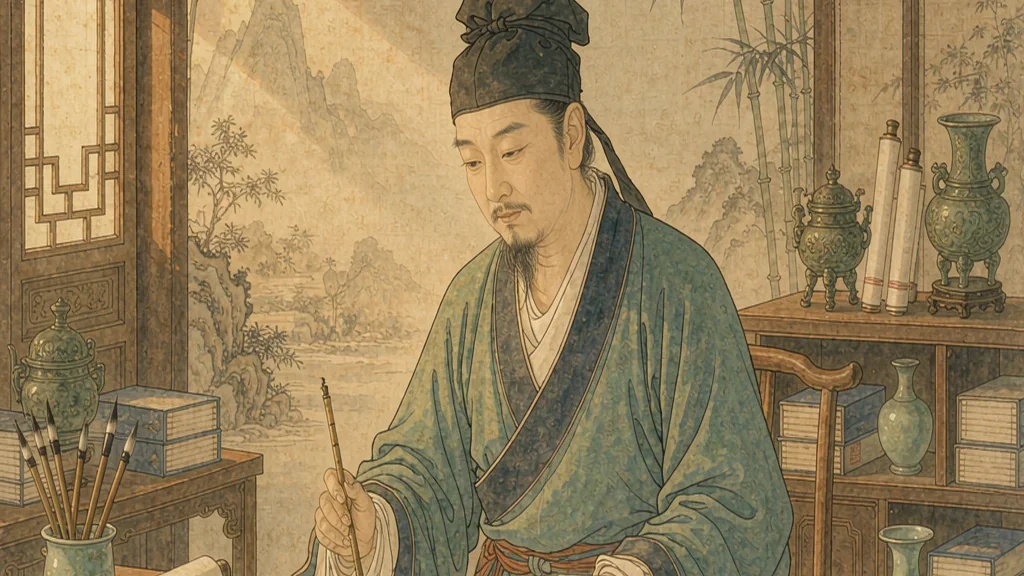
Ming professional painting refers to the work of salaried, market-active artists who made their living by the brush during the Ming dynasty (1368–1644), as distinct from the scholar-amateur literati who painted for self-cultivation. The dominant professional current of the early Ming was the Zhe School (Zhe pai), founded by Dai Jin and carried on by Wu Wei and others, which revived the bold, wet, cropped manner of the Southern Song academy. Later, regional professional centers such as the Jiangxia School and the popular workshops of Suzhou, Nanjing, and the southeast kept professional painting thriving. These artists supplied the screens, albums, and scrolls that furnished homes, temples, and the art market, and they preserved a high level of technical brilliance even as literati taste rose to cultural dominance.
The Zhe School and Dai Jin
The Zhe School takes its name from Zhejiang province, the native region of its founder Dai Jin (戴进, c. 1388–1462). Dai trained in varied skills—figure, landscape, and flower painting—and is said to have served briefly in the imperial treasury workshop before returning south. His style reworked the Southern Song academy manner: strong axe-cut texture strokes, firm contours, and dramatic cropped compositions.
Dai Jin's reputation grew after his death, when later writers anointed him the head of a "school" that answered the courtly professional need for vigorous, legible images. Although the label "Zhe School" was partly a later construction, it usefully names the early-Ming professional mainstream centered on Zhejiang and Nanjing.
Wu Wei and the Followers
Wu Wei (吴伟, 1459–1508) became the most celebrated successor to Dai Jin and was favored at the imperial court, reportedly summoned by the Chenghua and Hongzhi emperors. His brush was broader and more impulsive than Dai Jin's, pushing toward the "brush-wild" (kuang bi) energy that later critics both admired and faulted.
Around Wu Wei gathered painters such as Zhang Lu and Jiang Song, sometimes grouped as the "Jiangxia School" (after his birthplace). These followers spread the Zhe manner through the mid-Ming professional network, and their works remained popular in the marketplace even as literati critics grew dismissive of "mere skill."
Style and Technique
Ming professional landscape favored ink monochrome or light color, quick and confident strokes, and the "axe-cut" and "hemp-fiber" texture methods inherited from the Song. Figures and birds-and-flowers were also common, often with a narrative or decorative clarity suited to screens and宴 (banquet) settings. The aim was visual impact and readability rather than private meditation.
Because professionals worked for patrons, their pictures tended to be larger, more finished in surface, and more varied in subject than the quiet albums of the literati. This pragmatic, client-facing character is what defines the professional as a social type, whatever the exact style.
Professional Versus Literati
The Ming art world is often described as a tension between professionals and literati. Literati theory, championed by Dong Qichang in the late Ming, prized amateur status, antique lineage, and "south" (literati) over "north" (professional) manners, and it explicitly ranked the Zhe School as a lower, merely skillful path.
In practice the divide was porous: professionals like Qiu Ying collaborated with and were respected by literati, and some literati painted for money. Still, the ideology mattered. It shaped collecting, criticism, and which names were preserved in the canon, often to the disadvantage of gifted professionals.
Regional Centers
Beyond the Zhe/Jiangxia line, the Ming saw several professional hubs. Suzhou (Wu region) had a large market in which skilled painters produced literati-style works for sale; Nanjing was a political and artistic center with strong figure and landscape traditions; and the southeast coast developed workshops serving merchants and overseas trade.
Temple and tomb mural painting also remained a professional craft, carried out by anonymous or semi-anonymous workshops. These muralists kept alive large-format figure and decorative skills that the elite easel tradition often ignored, forming an invisible backbone of Ming visual culture.
Subjects and Patrons
Professional painters served a wide clientele: the imperial family and princes, local officials, wealthy merchants, and temples. Subjects ranged from auspicious landscapes and immortals to historical narratives, beauties, and birds-and-flowers with bright, saleable appeal. Themes of longevity, prosperity, and loyalty were perennially requested.
This patronage shaped a pictorial language that was accessible and often cheerful. Where a literatus might paint a lonely scholar by a cold stream, a professional might paint a bustling festival or a radiant immortal—art meant to please and to function, not only to express.
Downgrading by Later Critics
From the late Ming onward, the Zhe School's fortunes fell in critical esteem. Dong Qichang's northern/southern dichotomy placed professional, Song-derived manner in the "north," associated with outward technique rather than inner principle. Qing collectors who followed Dong's lead thus tended to undervalue Zhe works.
Modern scholarship has corrected this bias, recognizing that Ming professionals maintained essential continuities from the Song academy and satisfied real cultural needs. The very traits critics scorned—fluency, vigor, popularity—are now seen as signs of a living, working art world.
Legacy
Ming professional painting transmitted the Southern Song academy method into later times and fed the popular painting of the Qing and beyond. Its emphasis on brush vigor and clear composition survived in regional "schools" and in the training of decorative and genre painters. Even the literati idiom owed it a debt, since the two worlds constantly exchanged motifs and methods.
Today the Zhe School and its kin are studied not as a failed alternative to literati art but as the professional half of a complete Ming picture—proof that Chinese painting was always both a scholarly pursuit and a skilled trade.
❓ Frequently Asked Questions
What is Ming professional painting?
It is the work of salaried, market-active artists who earned a living by the brush during the Ming dynasty, distinct from scholar-amateur literati painters.
What was the Zhe School?
The Zhe School was the early-Ming professional mainstream founded by Dai Jin; it revived the bold, wet, cropped Southern Song academy manner.
Who were its main masters?
Its founder was Dai Jin, and its most celebrated follower was Wu Wei, around whom gathered the Jiangxia School painters.
How did literati critics view it?
Late-Ming literati such as Dong Qichang ranked it as a lower, merely skillful "northern" manner, a bias modern scholars have corrected.
What subjects did professionals paint?
They painted landscapes, figures, immortals, beauties, birds-and-flowers, and narratives for court, merchants, and temples.
Why does Ming professional painting matter?
It transmitted the Song academy method into later times and shows that Chinese painting was both a scholarly pursuit and a skilled trade.