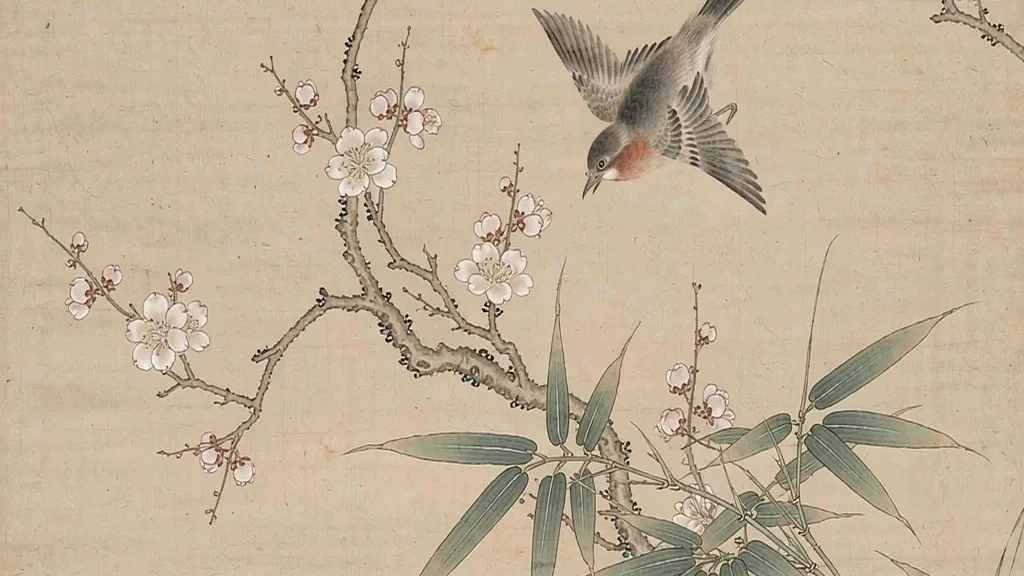
When the Western viewer first encounters a Chinese painting, the question often arises: why so little color? The answer lies not in technical limitation but in philosophical choice. For the Chinese scholar-painter, the five shades of black ink contained all the colors of the universe — and to add actual color was to diminish the painting's spiritual power. But color was never entirely absent. From the mineral greens and blues of Tang landscape to the soft washes of Qing flower painting, color played a complex and evolving role in Chinese art.
Mineral Pigments: The Colors of the Cosmos
The earliest Chinese paintings used mineral pigments — azurite for blue, malachite for green, cinnabar for red, orpiment for yellow, and lead white for white. These pigments were ground from natural minerals and mixed with animal glue as a binding medium. They produced colors of extraordinary brilliance and permanence; the blue and green on Tang dynasty paintings are as vivid today as when they were applied.
Mineral pigments were expensive and difficult to work with. Azurite had to be imported from Afghanistan; cinnabar was toxic; grinding the minerals to the correct consistency required hours of labor. The cost and difficulty of mineral pigments meant that color was reserved for the most important works — court paintings, temple murals, and commissions from wealthy patrons.
Vegetable and Synthetic Colors
Alongside mineral pigments, Chinese painters used vegetable dyes extracted from plants. Indigo provided blue, madder provided red, and the sap of the gardenia (栀子) produced yellow. These organic pigments were less brilliant than minerals but easier to prepare and more suitable for the wash techniques of literati painting.
During the Ming and Qing dynasties, new synthetic pigments were introduced from Europe and the Middle East. The most famous is 'foreign red' (洋红, yánghóng), a pigment derived from the cochineal insect that produced colors more brilliant than traditional cinnabar.
The Literati Rejection of Color
The literati tradition, beginning in the Song dynasty and culminating in the Yuan, increasingly rejected color in favor of monochrome ink. This was not a rejection of visual beauty but a philosophical choice. Color was associated with the surface of things, with the transient and the superficial. Ink revealed the essence. The 'five colors' of ink — dry, wet, thick, light, and burnt — were considered sufficient to represent all phenomena.
This color skepticism was also social. Color was associated with professional painters who served the court and the market; the literati amateur distinguished himself by his preference for ink. To paint in color was to advertise oneself as a craftsman, not a gentleman.
Mineral Colors in Buddhist and Court Art
Despite the literati rejection of color, the tradition of brilliant mineral-color painting continued without interruption in Buddhist and court contexts. The Dunhuang murals, the blue-green landscape tradition, and the bird-and-flower paintings of the Song academy all used color to create effects of splendor and naturalistic precision that were beyond the reach of ink wash.
The Qianlong Emperor of the Qing dynasty was a great patron of color painting. His court painters combined Chinese mineral pigments with European techniques, creating works that were more colorful than anything in the literati tradition.
The Modern Revival of Color
In the 20th century, Chinese painters began to experiment with color in ways that combined traditional Chinese materials with Western influences. Lin Fengmian (林风眠, 1900–1991) created a distinctive modern style using saturated colors on paper. Zhang Daqian's splashed-color landscapes of the 1960s used brilliant mineral pigments in a radically free manner.
Today, color is fully accepted in Chinese painting. Contemporary artists work in both ink monochrome and color, and combinations of the two. The old prejudice against color has faded, replaced by an inclusive approach that respects both traditions.
The Preparation of Mineral Pigments
The preparation of mineral pigments was a highly skilled craft in itself. The mineral was first crushed with a hammer, then ground in a mortar with water to produce a fine powder. The powder was washed repeatedly to separate the finer particles from the coarser ones — finer particles produced lighter colors, coarser particles produced darker ones. The best pigments were washed seven times to achieve the desired purity.
The ground pigment was mixed with a binding medium — typically animal glue (明胶, míngjiāo) made from cowhide or fish bladder. The pigment-to-glue ratio was critical: too much glue made the paint crack; too little made it powder off the surface. Each pigment required a different ratio, and experienced painters could adjust the consistency by feel.
Regional and Historical Variations in Color Use
Different periods of Chinese painting had characteristic color palettes. Tang dynasty figure painting used bright, saturated colors — cinnabar red, azurite blue, malachite green — applied in thick, opaque layers. Song dynasty landscape painting used more subtle colors — pale washes of green and blue, with ink as the dominant medium. Ming and Qing flower painting developed a palette of soft, translucent colors that allowed the white paper to show through.
Regional variations were also significant. The court painters of Beijing used more mineral colors. The literati of Suzhou preferred ink. The professional painters of Yangzhou, who served a commercial market, used a broader range of colors, including the new synthetic pigments imported from Europe. Each region and each tradition had its own relationship to color.
The Symbolism of Color in Chinese Painting
Colors in Chinese painting carried symbolic meanings that were understood by viewers. Red (红, hóng) symbolized joy, good fortune, and vitality — it was the color of weddings and festivals. Black (黑, hēi) was the color of water and the north, associated with winter and contemplation. White (白, bái) was the color of mourning and purity, but also of the unpainted paper, which was considered an active element in the composition.
Green (绿, lǜ) and blue (蓝, lán) were associated with spring, growth, and the Daoist concept of natural vitality. Yellow (黄, huáng) was the imperial color, reserved for the emperor's use. In Buddhist painting, gold (金, jīn) was used for the bodies of enlightened beings, symbolizing their radiance and transcendence of the material world.
❓ Frequently Asked Questions
📝 Chinese Vocabulary
颜料 — : pigment; coloring material for painting
石色 — : mineral color; inorganic pigments from stones
草色 — : plant color; organic dyes from vegetation
五色 — : five colors; the five shades of ink in Chinese theory
设色 — : color application; the technique of applying pigments
明胶 — : animal glue; binding medium for mineral pigments
铅白 — : lead white; a common white pigment
石青 — : Azurite blue, a prized mineral pigment used for the skies and mountains of blue-green landscape painting.
🎉 Fun Facts
- The famous blue pigment used in Tang painting comes from lapis lazuli, which was more expensive than gold in medieval China.
- Some Chinese mineral pigments, like azurite, degrade over time and change color; paintings that were originally blue-green may now appear brownish.
- The Qianlong Emperor owned a complete set of mineral pigments preserved in sealed porcelain jars; they are now in the Palace Museum.
- Some Chinese mineral pigments, like realgar (雄黄), were also used in traditional medicine.
- The Qianlong Emperor commissioned a complete set of over 100 mineral pigments for his court painters.
- Grinding a batch of fine azurite could take days of washing and levigating, and the best grade was reserved for the skies and robes of the most important figures.