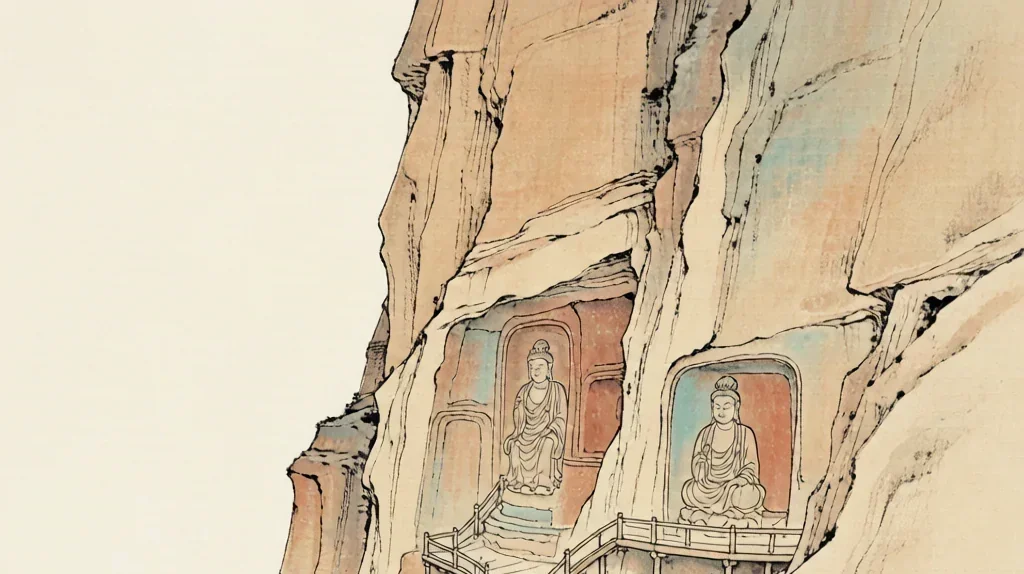
Rising alone from the Gansu plain, a rounded peak the color of rusted earth has been hollowed into one of the most poetic sites in all of Chinese Buddhist art. The Maijishan Grottoes (麦积山石窟, mài jī shān shí kū) — the "Wheat Stack Mountain Caves" — are a honeycomb of nearly two hundred cliff-side chambers whose painted clay Buddhas seem to gaze out over the Silk Road with an uncharacteristic tenderness. Where other great grottoes impress with scale and majesty, Maijishan moves with intimacy: its bodhisattvas smile, its mothers cradle children, and its Nirvana scenes ache with human grief. It is, in the truest sense, a cliff of a thousand gentle faces.
Historical Context: A Frontier of Faith
Maijishan lies in the corridor between central China and the Tarim Basin, the eastern artery of the Silk Road through which Buddhism entered China from India and Central Asia. Carving began under the Later Qin (后秦) state around the early fifth century CE, when the region was a frontier of competing dynasties and a crossroads of cultures. From there the caves grew across the Northern Wei (北魏), Western Wei (西魏), Northern Zhou (北周), Sui, and Tang, with later repairs continuing into the Ming and Qing.
Because the site sat at a cultural hinge, its art absorbed both foreign and native currents. Early Maijishan figures show the broad shoulders, thin waists, and transcendental calm of Gandhara and Central Asian models, while later works reveal the rounded, soft-featured, emotionally warm style that became distinctly Chinese. The grottoes thus preserve, in stone and clay, the very transformation of Buddhism as it was "sinicized" over a millennium.
Craftsmanship: The Art of Painted Clay
The defining material of Maijishan is not stone but clay. The local mountain is too soft and friable for fine carving, so artisans modeled their images in layered clay over a core of wood and straw, then finished and painted them. This technique allowed an extraordinary delicacy: thin, swaying drapery; slender, expressive hands; and faces with a near-fleshly softness that stone could not easily achieve.
Painting was integral, not decorative. Pigments derived from minerals — azurite, malachite, cinnabar, and gold leaf — gave the figures their glowing presence, and the surrounding cave walls were often covered with murals of donors, apsaras, and floral scrolls. The result is a total environment in which sculpture and painting merge. The famous "Smiling Buddha" of Cave 44, with its calm, knowing grin, and the "Nirvana" group showing grief-stricken disciples around the dying Buddha, are masterpieces of this tender, human-centered style.
Access was itself an engineering feat. The caves were reached by lashing wooden galleries, ladders, and plank walkways directly to the cliff, producing what travelers described as a vertical city of timber clinging to the rock. Earthquakes and decay have taken most of these away, leaving the dark cave mouths high on the face, but enough survives to imagine the original dizzying scaffold.
Cultural and Religious Significance
Maijishan is one of the four great grotto complexes of China, alongside Yungang, Longmen, and (in the Mogao sense) Dunhuang, yet it is unique in its medium and mood. Its painted clay sculptures form the largest and best-preserved collection of their kind, a continuous record of how Buddhist iconography evolved from foreign import to Chinese idiom. For the study of Chinese art history, Maijishan is indispensable: it supplies missing links between the austere northern Wei style and the full-flowered Tang.
Religiously, the site reflects the lay devotion of the Silk Road world — merchants, monks, and local rulers who sponsored caves for merit, safe passage, and the welfare of ancestors. The presence of donor portraits and family groups within the caves shows that Buddhism here was not only monastic but domestic, woven into the hopes of ordinary households. The maternal imagery, especially the tender depictions of the Hariti (送子观音, sòng zǐ guān yīn, the child-giving Guanyin), speaks to a faith concerned with life, fertility, and protection as much as with transcendence.
Legacy and Preservation
Listed among the Maijishan component of the UNESCO "Grottoes of Maijishan" recognition and protected as a national treasure, the site today preserves some 194 caves and more than 7,000 clay and stone sculptures, together with extensive murals. Conservation focuses on stabilizing the fragile clay against humidity, salt, and the insects of the humid Gansu valley, while limiting visitor impact on the delicate pigments.
More than a monument, Maijishan is a quiet argument about what Chinese sculpture could be at its most humane. In an art form often associated with imperial power and cosmic awe, these cliff-side Bodhisattvas chose instead to smile — and in smiling, they turned a remote frontier mountain into one of the warmest expressions of Buddhist compassion anywhere in Asia.
Maijishan's sculptures are overwhelmingly clay over a wooden armature rather than stone, which gives them a soft, almost flesh-like modeling unusual among cave complexes. Worshippers reach them by a vertiginous lattice of plank walkways bolted into the rock face — the 'sky ladders' that have thrilled and terrified pilgrims for fifteen centuries. The site's flying apsaras (飞天, fēi tiān), robes curling like smoke, and its serene Tang-dynasty seated Buddhas earned it the nickname 'the oriental sculpture gallery' (东方雕塑陈列馆, dōng fāng diāo sù chén liè guǎn). Because the clay was continuously repaired and repainted, the figures preserve a living record of changing taste from the fiercely expressive Northern Wei to the rounded tranquility of the Tang.
❓ Frequently Asked Questions
Q: Why is Maijishan called the 'Wheat Stack Mountain'?
A: The name Maijishan (麦积山) means 'Wheat Stack Mountain' because the solitary conical peak, rising abruptly from the Gansu plain, resembles a pile of harvested wheat. The grottoes are cut into the sheer red-ochre cliff face of this isolated hill, making the entire mountainside a vertical museum of sculpture.
Q: What is special about Maijishan's sculptures?
A: Unlike the stone-carved Buddhas of Yungang or Longmen, most Maijishan figures are modeled in clay and painted, giving them a soft, intimate, almost flesh-like quality. The famous 'Smiling Buddha' and the serene 'Nirvana' group are celebrated for their warmth and human feeling, a style that influenced later Chinese Buddhist sculpture.
Q: How old are the Maijishan Grottoes?
A: Carving began in the Later Qin (后秦) state around the early fifth century CE and continued through the Northern Wei, Western Wei, Northern Zhou, Sui, Tang, and later dynasties, spanning more than a thousand years. The site preserves some 194 caves and roughly 7,200 extant clay and stone sculptures.
Q: How were the caves reached on such a steep cliff?
A: Early caves were reached by wooden ladders and walkways clinging to the rock. Centuries of repair produced an elaborate scaffold of plank paths and pavilions — described in old travel records as 'a hive of wooden galleries' — though many have fallen away, leaving the cliff pocked with dark openings high above the ground.
Q: What makes Maijishan's sculpture different from other grottoes?
A: Unlike Yungang or Longmen, where hard stone was carved, Maijishan's soft conglomerate rock made stone carving impractical, so artisans modeled in painted clay instead. The result is a body of work famous for lifelike, tender faces, especially the Song-dynasty water-moon Guanyin and the plump, smiling attendants. Because clay could be shaped and repainted, the figures feel intimate rather than austere. Scholars often call Maijishan the finest surviving gallery of Chinese painted-clay sculpture, a counterpart to the stone Buddhas of the northern grottoes.
Q: When were the Maijishan caves made and by whom?
A: The first caves date to the Later Qin in the early fourth century, with major expansion under the Northern Wei, Northern Zhou, Sui, and Tang, and later refitting in the Song and Ming. Patrons ranged from rulers and ordained monks to local gentry and lay devotees, and the cliff was continually reworked for nearly a thousand years. This long, layered history means a single visit can show the slender restraint of the Northern Dynasties beside the fuller grace of the Tang and the gentle domesticity of the Song, all stacked up the same honey-colored rock.
Beyond the standing and seated Buddhas, Maijishan is rich in flying apsaras, the celestial musicians and dancers who arc across cave ceilings with scarves trailing. These figures, lightly modeled in clay and outlined in paint, give the dim interiors a sense of motion and music, as if the heavens themselves leaned into the worship space. Around them run bands of lotus, cloud, and flame that frame the main icons and lead the eye upward. The decorative program was never merely pretty; it placed the devotee inside a cosmos of sound and light, with the apsaras acting as messengers between the human cave and the buddha-fields above. Because the clay could hold fine detail, Maijishan's ornament often reads as both doctrine and delight, a rare intimacy among China's cave temples.
A walk up Maijishan is a walk through a thousand years of changing taste. The earliest Northern Dynasties figures are slender, severe, and heavily draped, with distant, otherworldly faces. By the Tang the bodies fill out, the smiles warm, and the clay seems to breathe. The Song then turns devotion domestic: Guanyin lounges in relaxed water-moon pose, and child attendants wear round, cheerful faces that feel almost like neighbors. This stylistic ladder is unusually clear because later donors often repainted or re-clothed earlier images rather than replacing them, so layers of period sit close together. For art historians the cliff is therefore a textbook of Chinese sculptural change, where the same mountain records how a nation's idea of the divine slowly softened from awe to intimacy.
To reach caves high on a near-vertical cone, generations of builders fixed wooden plank roads and galleries, the zhan dao, directly into the rock face. Old descriptions compared the result to a beehive of timber clinging to the cliff, a dizzying scaffold that let monks and pilgrims circulate among the openings. Most of that wood has long since rotted or been removed, leaving the caves apparently floating on bare rock, but the bolt holes and beam sockets remain as evidence. The galleries were practical as well as dramatic: they shaded the clay from rain and gave visitors a processional route past the images. Reaching the art thus meant a small act of courage, and the very difficulty of access helped preserve the sculptures by keeping weather and casual hands at a distance.