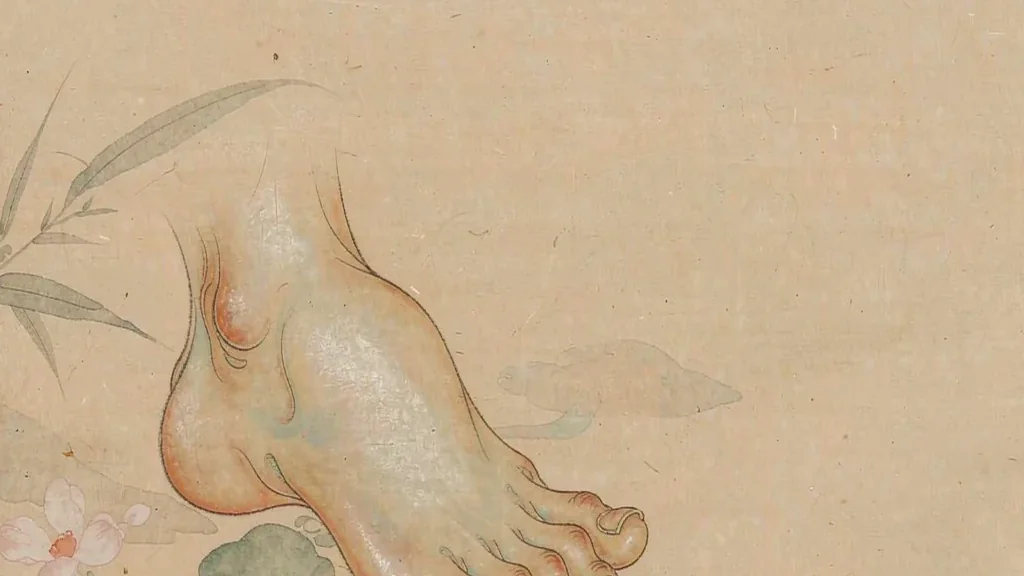
No subject in Chinese sculpture is more controversial than the carved and bound foot. For nearly a thousand years, from the Song dynasty to the early 20th century, Chinese women of the elite and middle classes underwent the painful practice of foot binding, and the result — the 'three-inch golden lotus' (三寸金莲, sāncùn jīnlián) — became a subject of sculptural representation in miniature shoes, foot-shaped porcelain pillows, and erotic carvings. The carved foot object is a complex artifact: it is at once an object of desire, a symbol of female submission, a mark of status, and a record of suffering.
The Origins of Foot Binding
Foot binding is traditionally said to have begun in the court of the Southern Tang dynasty (937–975 CE), when the emperor decorated a favorite concubine's feet with silk bindings to make her dance on a lotus-shaped platform. The practice spread slowly at first, then rapidly during the Song dynasty, when it became associated with feminine beauty, refinement, and sexual allure.
By the Ming and Qing dynasties, foot binding was nearly universal among elite and middle-class women. Bound feet were called 'golden lotuses' (金莲, jīnlián), and the process of binding — which broke the arch of the foot and folded the toes under — was endured from early childhood.
Carved Representations of Bound Feet
The 'golden lotus' was celebrated in Chinese sculpture through miniature shoes, foot-shaped objects, and erotic carvings. Miniature shoes (弓鞋, gōngxié), often made of embroidered silk on a carved wooden or porcelain sole, were displayed on stands as decorative objects. Porcelain pillows in the shape of bound feet — known as 'foot pillows' (莲枕, liánzhěn) — were used to support the neck during sleep.
More explicit erotic carvings in jade, ivory, and wood showed bound feet in intimate contexts. These objects were part of the 'chamber literature' (房中艺术, fángzhōng yìshù) of the Ming and Qing dynasties, prized by collectors for their craftsmanship and their connection to the cult of the golden lotus.
The Craft of Lotus Shoes
Lotus shoes (弓鞋, gōngxié) were among the most technically accomplished products of Chinese textile and carving arts. The shoes were typically 8–10 cm long, covered with elaborate embroidery, and often had ivory or wooden platforms that imitated the bound foot's shape. The best lotus shoes were treasured objects, kept in boxes and displayed on special occasions.
The carving of wooden foot forms, or 'foot lasts' (脚模, jiǎomó), that provided the shape for lotus shoes was a specialized craft. The carver had to understand the anatomy of the bound foot — the folded toes, the high arch, the narrow heel — to produce a form that would fit the shoe.
Critique and Abolition
Foot binding was criticized by Chinese intellectuals as early as the Song dynasty, but it was not until the late 19th century that a serious anti-foot-binding movement emerged. Reformers like Kang Youwei and Liang Qichao argued that the practice weakened the nation by disabling half its population. Christian missionaries also campaigned against foot binding.
The practice was banned after the establishment of the Republic of China in 1912, but it continued in remote areas into the 1930s. The last generation of women with bound feet is now passing away.
The Legacy in Sculpture
Today, lotus shoes and bound-foot carvings are collector's items, displayed in museums and private collections. They are troubling objects — beautiful in their craftsmanship but painful in what they represent. They remind us that art can be created in service of cruelty, and that the most exquisitely carved object can embody human suffering.
Museums in China and abroad now display these objects with contextual information that explains their history, rather than simply presenting them as decorative art.
The Social Meaning of Bound Feet
Foot binding was not merely a cosmetic practice but a social system that shaped women's lives in fundamental ways. Women with bound feet could not walk long distances or stand for extended periods. They were confined to the inner quarters of the home, dependent on servants for many daily activities. This physical limitation was part of the attraction: bound feet signaled that a woman was wealthy enough to be inactive.
The bound foot was also intensely eroticized in Chinese culture. The 'three-inch golden lotus' was considered the most attractive part of a woman's body. Men wrote poems praising the beauty of bound feet, and the act of unwrapping the bindings was considered a deeply intimate act. The eroticization of bound feet created a demand for shoes and foot-related objects that were among the most intimate and personal items in Chinese decorative arts.
The Production of Lotus Shoes
The making of lotus shoes was a specialized craft that employed thousands of women across China. The shoes were made of silk or cotton, with embroidered designs that included flowers, butterflies, birds, and auspicious symbols. The soles were often made of wood or layers of cloth stiffened with paste, shaped to fit the bound foot's distinctive form.
The most elaborate lotus shoes were made for wedding trousseaus, with the finest materials and most intricate embroidery. A bride might receive dozens of pairs of lotus shoes as part of her dowry, each pair more beautiful than the last. The shoes were treasured objects, kept in special boxes and passed down through generations of women.
The End of Foot Binding
The movement to end foot binding gained momentum in the late 19th and early 20th centuries. Chinese reformers, influenced by Western ideas, argued that foot binding was a barbaric practice that weakened the Chinese race. Natural-foot societies were formed, and women who had never bound their feet were called 'heavenly feet' (天足, tiānzú).
The practice was officially banned in 1912 after the founding of the Republic of China. However, it continued in rural areas for another two decades. The last generation of women with bound feet in China is now passing away, with only a few elderly women surviving today. Their feet are a living record of a practice that shaped Chinese women's lives for a thousand years.
❓ Frequently Asked Questions
📝 Chinese Vocabulary
三寸金莲 — : three-inch golden lotus; the bound foot
弓鞋 — : lotus shoe; miniature shoes for bound feet
缠足 — : foot binding; the practice of binding women's feet
莲枕 — : lotus pillow; a porcelain pillow shaped like a bound foot
金莲 — : golden lotus; the euphemism for bound feet
天足 — : heavenly foot; a natural, unbound foot
缠足 — : The traditional practice of tightly binding the feet of young girls to restrict their growth, producing the small deformed foot known as the golden lotus.
莲步 — : A poetic term meaning lotus steps, describing the small swaying gait of a woman with bound feet, often celebrated in classical literature.
🎉 Fun Facts
- The ideal bound foot was exactly three inches (10 cm) long, hence 'three-inch golden lotus.'
- Lotus shoes were sometimes made with ivory soles so that the foot clicking on the floor could be heard — considered erotic.
- The Smithsonian collection includes over 100 pairs of Chinese lotus shoes, collected in the early 20th century.
- The smallest bound feet on record measured only 7.6 cm (3 inches) in length.
- In the 1920s and 1930s, some women who had bound feet began wearing Western-style shoes to hide their feet and appear modern.
- In some late-imperial towns, informal gatherings were held where women displayed their bound feet and embroidered shoes, judging them on smallness and the fineness of the stitching, a regional pastime now vanished.