← Back to Sculpture & Grottoes
Chinese Sculpture
Tang Dynasty Sculpture: The Six Steeds of Zhao Mausoleum (唐代雕塑): Imperial Horses in Stone
✍️ by xiaoyu luo
🗓️ Updated Jul 29, 2026
Last updated: July 2026 · Reading time: 8 min
Of all the animals in Chinese art, none carried more political weight than the horse — the engine of empire on the northern frontier. The Tang dynasty (唐, Táng, 618–907 CE) elevated the horse to a symbol of sovereign power, and nowhere more beautifully than in the Six Steeds of the Zhao Mausoleum (昭陵六骏, zhāo líng liù jùn). These six limestone reliefs, carved in the seventh century for the tomb of Emperor Taizong (唐太宗), depict the emperor's own battle mounts with a dignity and realism never before seen in Chinese stone. Part portrait, part political manifesto, they capture the cosmopolitan confidence of a dynasty that ruled the Silk Road and married Chinese and Eurasian forms.
Historical Context: A Warrior-Emperor and His Mounts
Emperor Taizong founded the Tang golden age through war. As a young prince he led cavalry charges that unified a fractured realm, and he attributed his survival in several desperate engagements to specific horses. When he died in 649, his Zhao Mausoleum outside Chang'an was furnished with a spiritway of stone, and among its honors were the six steeds, each shown in profile, some wounded, each bearing a name and a short inscription said to be in the emperor's own calligraphy.
The choice of subject was deliberate. In steppe and Central Asian culture, a ruler's horse was an extension of his authority and fortune; by enshrining his six companions in stone, Taizong presented himself in the mold of a nomadic-style conqueror-king even as he ruled a Chinese state. The reliefs thus encode a fusion at the heart of Tang identity — a Chinese empire fluent in the visual language of the Eurasian interior.
Craftsmanship: Relief with Volume
The steeds are carved in low to medium relief on rectangular limestone slabs, yet they achieve a surprising sense of three-dimensional volume. The carvers modeled rounded haunches, taut bellies, and flying manes with confident undercutting, so that the horses seem to press forward out of the stone. Each is shown with tack and saddle furniture appropriate to a Tang cavalry mount, and several display arrow wounds — one, "Saluzi" (飒露紫), is being tended by a groom who extracts an arrow, a scene of rare narrative intimacy.
Scholars attribute the original designs to the court painter Yan Liben (阎立本), famed for his portraits of foreign envoys, and the modeling indeed shows painterly observation translated into stone. The inscriptions, traditionally credited to Taizong himself, lend the works the authority of imperial authorship. The result is neither the flat schematic beasts of Han nor the otherworldly calm of Buddhist grotto art, but something new: a secular, aristocratic, almost biographical sculpture.
Cultural and Artistic Significance
The Six Steeds are a key exhibit in the story of how Chinese sculpture absorbed foreign influence. Their muscular, individualized bodies and sense of movement reflect Sasanian Persian and Sogdian equestrian prototypes carried east along the Silk Road, reinterpreted through Tang taste. They mark the high point of Tang monumental relief and a departure from the symbolic animal sculpture of earlier dynasties toward observational, portrait-like realism.
Politically, the steeds functioned as a visual chronicle of legitimate rule. By commemorating the horses that won his battles, Taizong grounded his mandate in personal courage and loyalty — virtues central to the Confucian and martial ideals of kingship. The works also influenced later tomb art, spawning centuries of stone horses and spiritway beasts at the graves of emperors and nobles, down to the Ming tombs outside Beijing.
Loss, Survival, and Legacy
The steeds' modern fate is bittersweet. Four remain in China, conserved at the Xi'an Beilin (Forest of Steles) Museum. Two — "Saluzi" and "Baidui" (白蹄乌) — were cut from their slabs in the early twentieth century and sold abroad; they now reside at the University of Pennsylvania Museum of Archaeology and Anthropology in Philadelphia. Their removal, amid the turmoil of republican-era China, remains a touchstone in debates over the repatriation of Chinese antiquities.
Despite the separation, the Six Steeds endure as a summit of Chinese representational sculpture and a symbol of the Tang world's openness. They remind us that the dynasty's greatness was not only in its poets and pagodas but in its willingness to let a foreign horse gallop, in stone, through the gateway of an emperor's tomb — and to call that horse a hero.
The Six Steeds of the Zhao Mausoleum
The 'Six Steeds of the Zhao Mausoleum' (昭陵六骏, Zhāo Líng Liù Jùn) were lifelike reliefs of the six horses that carried Emperor Taizong through his battle campaigns, carved in low relief on slabs flanking his tomb. Each horse is named and individuated — 'Saluzi' arrow-wounded at a famous charge, 'Qingzhui' who died beneath the emperor at Hulao — blending portraiture of animal and memorial of war. Tang sculpture at large absorbed foreign influence along the Silk Road, producing bodhisattvas with fuller faces, flowing drapery, and a new naturalism, yet kept a Chinese core of dignity and balance. These reliefs became the archetype of equestrian monumental art in East Asia, and fragments of the originals are today split between Chinese museums and the University of Pennsylvania.
❓ Frequently Asked Questions
Q: Who made the Six Steeds and for whom?
A: The Six Steeds (昭陵六骏, zhāo líng liù jùn) were carved for the Zhao Mausoleum (昭陵) of Emperor Taizong of Tang (唐太宗), the dynasty's second and greatest ruler, who reigned 626–649 CE. They commemorate the six horses that carried him through decisive battles uniting China. Tradition attributes the designs to the artist Yan Liben (阎立本) and the inscriptions to the emperor's own calligraphy.
Q: Why were the horses so important to Taizong?
A: As a warrior-emperor, Taizong credited his horses with saving his life in combat. One, 'Saluzi,' was shot in the chest while charging; another, 'Quanmaogua,' carried him to safety. By immortalizing them in stone at his tomb's spiritway, he honored their loyalty as he would honored generals, blending the bond between rider and mount into the iconography of kingship.
Q: What happened to the original steeds?
A: Four of the limestone reliefs remain in China, housed at the Xi'an Beilin Museum. Two — 'Saluzi' and 'Baidui' — were removed in the early twentieth century and are now at the University of Pennsylvania Museum in Philadelphia. Their removal is a famous, contested chapter in the story of China's lost antiquities.
Q: How do the steeds show foreign influence?
A: Their round, muscular bodies, flying manes, and almost portrait-like individuality reflect the equestrian art of the Silk Road and Sasanian Persia, filtered through Tang cosmopolitan taste. Unlike the flat, symbolic beasts of earlier Chinese art, the steeds are modeled with volume and movement, evidence of how the Tang absorbed Eurasian forms into a Chinese idiom.
Q: What other famous Tang sculpture survives besides the Six Steeds?
A: Tang sculpture is also celebrated for its sancai glazed tomb figures, for robust Buddhist bodhisattvas from cave temples such as Tianlongshan, and for the spiritway beasts before the Qianling tomb of Empress Wu Zetian. Together these show a dynasty comfortable with volume, movement, and foreign influence across both court and temple art.
Q: Why are the Six Steeds considered a turning point in Chinese art?
A: They broke from the flat, symbolic animal carvings of earlier dynasties by modeling horses with observed volume, arrow wounds, and individual identity. In doing so they anticipated the naturalism that would flower in later Chinese figurative art, marking a shift toward portrait-like realism in stone.
Key Terms
昭陵六骏
zhāo líng liù jùn
唐太宗
táng tài zōng
阎立本
yán lì běn
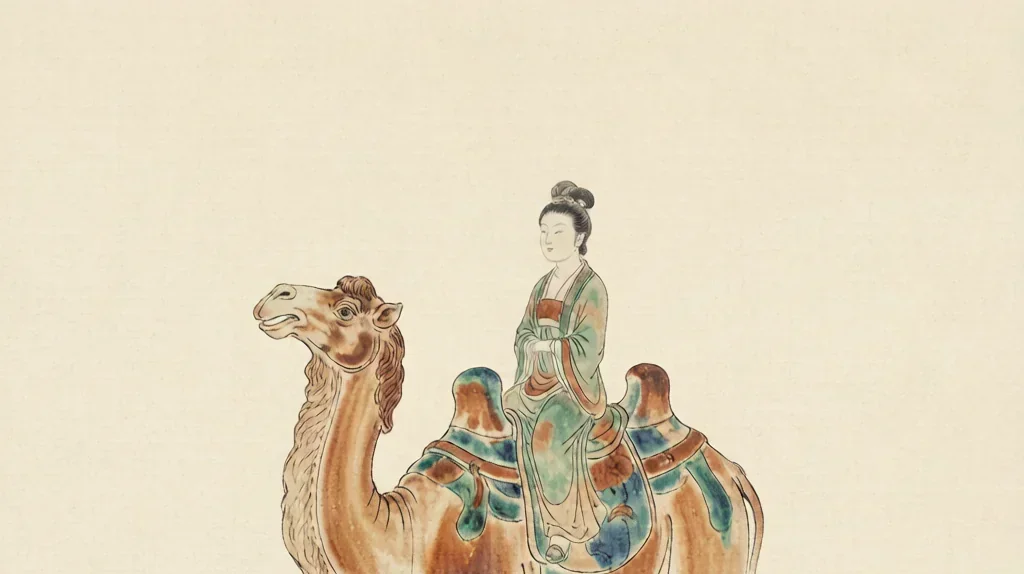
唐三彩 (táng sān cǎi)Tang sancai, the lead-glazed polychrome pottery of the Tang dynasty, typically in amber, green, and cream, used for tomb figurines, horses, and camels.
昭陵 (zhāo líng)The Zhao Mausoleum, tomb of Emperor Taizong, where the Six Steeds reliefs were set along the ceremonial spiritway leading to the burial mound.
翁仲 (wēng zhòng)Large stone human figures, both civil and martial, placed in rows along the spiritway of imperial tombs to guard and welcome the arriving soul.
天王 (tiān wáng)Heavenly King, a fierce guardian deity frequently carved in Tang Buddhist sculpture, usually shown trampling a demon and wreathed in flowing scarves.
武则天 (wǔ zé tiān)Wu Zetian, China's only reigning empress, whose Tang-era Qianling tomb is approached by a monumental avenue of stone sculpture.
Fun Facts
- One steed, 'Saluzi,' is shown being treated by a groom pulling an arrow from its chest — a rare moment of veterinary narrative in Chinese imperial art.
- Two of the six reliefs traveled farther than their emperor ever did, crossing the ocean to Philadelphia in the early 1900s.
- The horses' names are recorded in Taizong's own inscriptions, making the steeds among the few imperial sculptures credited to a ruler's personal hand.
- The Six Steeds were originally mounted on a screen-like wall at the rear of the spiritway, so that visitors approaching the tomb would meet the emperor's horses in procession before reaching his mound.
- Tang imperial tombs routinely included not only horses but also stone camels, ostriches, and foreign grooms, reflecting the cosmopolitan tribute missions that reached the capital from across Asia.
- Near-complete later copies of the Six Steeds were carved at the same scale and displayed in Xi'an, so visitors today can see all six together even though two of the originals are in Philadelphia.
Tang Tombs and the Spiritway
The Six Steeds stood along the spiritway, the ceremonial approach to an imperial Tang tomb, and they were far from alone. A typical Tang imperial burial was preceded by a procession in stone: paired columns, winged horses, ostriches, camels, and rows of human figures called spirit generals and civil officials, all set to welcome or challenge the arriving soul. These avenues expressed the same confidence as the steeds, modeling the empire in miniature with tribute beasts from the Silk Road and guardians drawn from Chinese lore. The arrangement was carefully ranked, so that the visitor's walk toward the mound became a rehearsal of approaching the throne. In this context the horses were not mere portraits but members of a sculpted court, each figure a loyal servant stationed forever on the road to the afterlife.
Buddhist Sculpture and the Sancai Glaze
Beyond the imperial tombs, Tang sculptors reshaped Chinese Buddhism in stone and clay. Cave temples and monastery workshops produced bodhisattvas with fuller faces, relaxed postures, and flowing robes that reveal a new naturalism absorbed from India and Central Asia. At the same time, the tomb workshop developed sancai, a lead glaze in amber, green, and cream that clad pottery horses, camels, and attendants in cheerful color. Though sancai figures are ceramic rather than stone, they share the Tang love of volume and movement seen in the Six Steeds, and together they define the dynasty's sculptural character: confident, cosmopolitan, and unmistakably sensuous. The same century that carved Taizong's horses also molded the plump benign guardians that still greet visitors in museum galleries today.
The Tang Ideal of Plenitude
If one word captures Tang sculpture, it is fullness. Where earlier Chinese art favored restraint and symbols, Tang carvers and modelers embraced weight, roundness, and physical presence. Court ladies in stone and pottery are robed and prosperous, Buddhist guardians are broad-shouldered and muscular, and even the horses of the Zhao Mausoleum carry themselves with concentrated mass. This taste reflected a society at the height of its power, secure enough to celebrate abundance rather than conceal it. The aesthetic also traveled: Tang prototypes influenced sculpture in Korea and Japan, where similar full-faced Buddhas still testify to the dynasty's reach. When later ages looked back on the Tang, they remembered it as an age of confidence, and its sculpture remains the clearest proof that the empire liked its art the way it liked its horses, substantial and in motion.