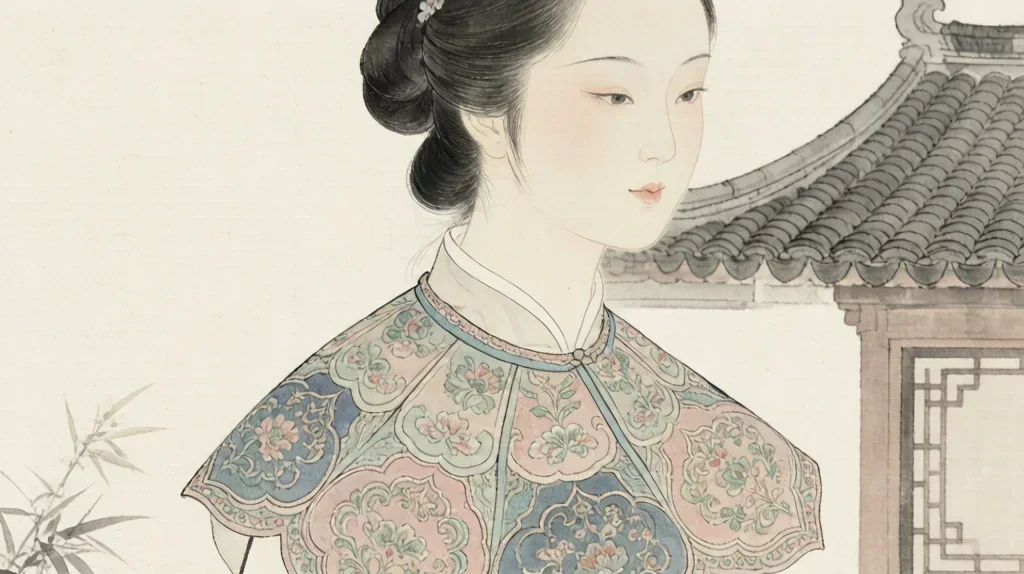
Picture a woman in a Ming or Qing dynasty courtyard, and around her shoulders you may see not a necklace but a small constellation of clouds — a flat, circular cape of embroidered silk that spreads like a halo across the upper body. This is the cloud collar (云肩, ), one of the most poetic garments in the Chinese wardrobe. Worn by women over their robes, it turned the shoulders into a stage for auspicious imagery: clouds, flowers, butterflies, and fruit, all stitched in bright silk and edged with swaying tassels. The cloud collar is exactly what its name promises — a shoulder full of clouds — and it remains a favorite of costume designers for the way it frames the face with pure ornament.
A Collar That Became a Cape
The cloud collar began, as its name suggests, as a form of neckwear, but it grew into a broad shoulder piece that covered the upper chest and back while leaving the arms free. Its shape is usually circular or petal-like, built from segments that radiate outward like the lobes of a cloud or the petals of a flower. Worn over a high-collared robe, it softened the body's lines and drew the eye upward to the face. In an era when women's outer clothing was often subdued, the cloud collar provided a sanctioned burst of color and meaning.
Though associated especially with the Ming and Qing dynasties, the idea of a decorative shoulder piece has older roots in Central Asian and Buddhist costume, reaching China along the same routes that brought so much else. By the late imperial period the cloud collar had become distinctly Chinese, a garment whose very form quoted the auspicious clouds carved on temples and painted on porcelain. To wear it was to wear a slice of the heavenly atmosphere.
Shape and Symbol in Every Lobe
The construction of a cloud collar is itself symbolic. Many are divided into four, eight, or more lobes, echoing the four directions or the petals of a lotus. The central opening frames the neck, while the lobes spread across the shoulders and upper arms. Embroidered into each lobe are clouds, of course, but also peonies for wealth, lotuses for purity, pomegranates for many children, and butterflies for joy. The whole composition is a wish-list for a good life, laid out in silk around the wearer's shoulders.
Color carries the same hopeful grammar. Reds and pinks signal happiness and marriage; greens and blues suggest growth and harmony; gold thread outlines the clouds like sunlight. Tassels and small bells often hang from the lower edge, so the collar moved and sounded as the woman walked, adding life to the static embroidery. The garment was meant to be both seen and felt in motion.
When and Where It Was Worn
Cloud collars were most closely tied to celebration. A bride might wear a richly embroidered one as part of her wedding attire, where its cloud-and-flower imagery blessed the new union with fertility and fortune. They also appeared at festivals, family gatherings, and stage performances, anywhere a woman wished to appear at her most adorned. Because they sat on top of the robe rather than replacing it, they were a flexible accessory — added for the occasion and removed afterward.
Regional styles varied. Collars from the north could be bold and large, while those from the Jiangnan region favored finer, more delicate stitching and lighter palettes. Some were made for daily festive wear, others as heirloom pieces saved for the grandest moments. Regardless of origin, the cloud collar always did the same job: it crowned the shoulders with a portable garden of good omens.
Craft and the Hand Behind It
A fine cloud collar is a serious piece of needlework. The lobes are often built on a foundation of pasted layers for body, then covered with satin and embroidered in satin stitch, couching, and seed stitch. Gold-wrapped thread outlines the clouds, and the tassels are made of knotted silk. Because the collar is seen from all sides, the embroidery must be finished on both the front lobes and those that fall behind the shoulders — a hidden care that rewards a glance from behind.
As with much Chinese women's craft, the makers were usually women, working within the home or in specialist workshops. A well-made collar advertised not only the wearer's status but the skill of her household. In museum collections today, the finest cloud collars are studied as textile art in their own right, admired for compositions that rival any painted scroll in balance and invention.
A Shoulder Full of Clouds Today
The cloud collar is rare in daily life now, but it enjoys a strong afterlife in Chinese opera, film, and fashion. Designers borrow its radiating shape for modern capes and bridal accessories, and it appears in exhibitions of traditional costume as a symbol of feminine ornament at its most imaginative. For anyone interested in how clothing can carry wishes as well as style, the cloud collar is a perfect study: a garment that literally wraps the wearer in clouds.
Next time you see a historical drama where a woman's shoulders bloom with embroidered petals, you are seeing the yunjian at work. It is a reminder that the Chinese wardrobe never settled for plain function — even the collar was a place to hang a little sky.
Clouds as a Chinese Symbol of Fortune
To understand the cloud collar, one must first understand the Chinese cloud. The auspicious cloud, or xiang yun, appears everywhere in traditional art, from the carved brackets of temple roofs to the painted grounds of porcelain, where it signals heaven's favor and good fortune. The collar takes this floating motif and lays it directly on the body, so the wearer seems to carry a piece of the sky on her shoulders. Unlike a storm cloud, the Chinese cloud is rounded, scrolling, and benign, a carrier of rain and blessing rather than danger. By wearing it, a woman placed herself inside that vocabulary of luck. The garment is therefore not merely pretty; it is a small act of sympathy with a much older visual language, one in which to be surrounded by clouds was to be surrounded by grace.
Regional Hands: North and South
Although the cloud collar is one idea, its making varied by place. Collars from the north tended to be bold and large, with broad lobes and strong color, suited to the brighter ceremonial dress of the region. Those from the Jiangnan area around Suzhou and Hangzhou favored finer, more delicate stitching and lighter palettes, reflecting the gentle elegance prized in southern taste. Some collars were everyday festive wear, washed and reworn; others were heirloom pieces brought out only for weddings and great gatherings. These differences were never written as rules but lived in the hands of local makers, who passed their preferences down through families and workshops. The result is a garment that feels both unified and local, recognizable everywhere yet spoken with a slight regional accent.
The Cloud Collar on Stage and Screen
Today the cloud collar survives most visibly in performance. Beijing and other regional operas use radiating shoulder pieces to crown their female leads, borrowing the collar's instant read of ornament and status. Historical dramas and films set in the Ming and Qing periods dress their heroines in embroidered clouds across the shoulders, because the shape reads at once as traditional and romantic. Costume designers outside China have also adopted the radiating form for capes and bridal accessories, charmed by its symmetry. In museums the finest examples are displayed as textile art in their own right. So while the collar has left daily life, it has not left sight; it circulates instead on the stage, the screen, and the exhibition wall, still doing the old work of turning shoulders into a garden of good omens.
❓ Frequently Asked Questions
📝 Chinese Vocabulary
云肩 — : the cloud collar, a decorative shoulder piece.
云 — : cloud, an auspicious motif in Chinese art.
披肩 — : a shoulder cape or wrap.
流苏 — : the tassels that hang from the collar's edge.
牡丹 — : The peony, an auspicious motif on cloud collars symbolizing wealth and honor.
莲花 — : The lotus, a motif on cloud collars representing purity.
石榴 — : The pomegranate, a motif on cloud collars wishing the wearer many children.
蝴蝶 — : The butterfly, a motif on cloud collars standing for joy.
🎉 Fun Facts
- Many cloud collars are divided into four or eight lobes, echoing the four directions or the petals of a lotus.
- The cloud collar's shape quotes the same auspicious clouds carved on temple roofs and painted on porcelain.
- Fine collars were embroidered on both the front and back lobes, so the craft was visible even from behind.
- A bride might wear a richly embroidered cloud collar as part of her wedding dress, its flowers and fruit quietly wishing the marriage fertility and good fortune.
- Small bells or tassels often hung from the lower edge, so the collar chimed softly as the wearer moved, an ornament you could hear as well as see.
- The cloud collar's ancestors lie in Central Asian and Buddhist shoulder pieces that traveled to China along the same trade routes as so much else, before becoming distinctly Chinese.