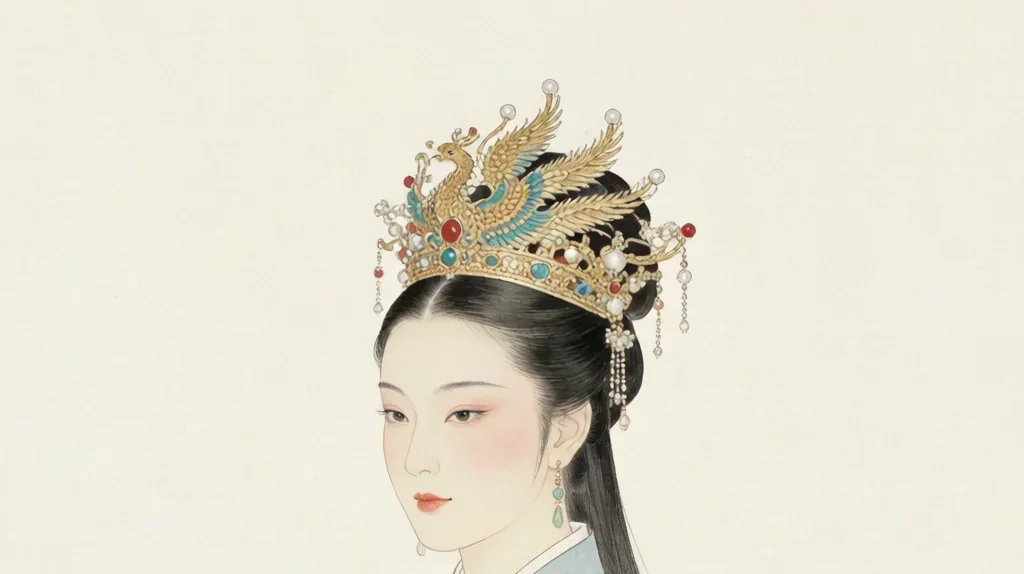
On the most important day of a traditional Chinese woman's life, she did not simply put on a pretty dress. She was crowned. The phoenix crown and cloud cape (凤冠霞帔, ) was the highest formal attire a bride could wear, a blaze of red silk, dangling pearls, and gilded phoenixes that marked her transformation from daughter to wife. For centuries this was the pinnacle of Han Chinese bridal dress, reserved for the wedding itself and charged with wishes for fertility, harmony, and noble fortune. To understand the phoenix crown is to understand how clothing could carry the hopes of two families at once. Few garments in the world weigh so much in meaning per ounce of gold.
The Phoenix Crown: A Bride Made Empress for a Day
The fengguan, or phoenix crown, is a headdress built on a frame of lacquered wood or bamboo and covered with ornaments. Around its rim sit gilded dragons and phoenixes, while below hang strings of pearls and small gold plaques that sway with every step. In imperial times such crowns were worn by empresses and high-rank consorts; by the Ming dynasty the right to a phoenix crown had spread to wealthy brides, who borrowed the majesty of the palace for their single great day. The effect was to make the bride, briefly, the equal of royalty.
The phoenix is no random choice. In Chinese symbolism the phoenix is the queen of birds, a creature of grace and good omen, and it pairs naturally with the dragon that represents the groom. A crown crowned with phoenixes therefore speaks a quiet sentence about marriage: the union of dragon and phoenix, male and female, strength and beauty. The pearls that hang before the bride's face were said to conceal her blushes and to tremble like tears of joy.
The Cloud Cape: Status Worn Over the Shoulders
The second half of the ensemble is the xiapai or xiapei, the "cloud cape" — a long, band-shaped scarf of richly patterned red or embroidered silk that hangs from both shoulders down the front of the robe, often with a pair of pendants at its lower ends to keep it straight. In the Song and Ming dynasties the cloud cape was actually a mark of official rank worn by noblewomen, and its use in weddings borrowed that authority. Draped over the red bridal gown, it turned the bride into a walking emblem of dignity.
The cape's name comes from its resemblance to auspicious clouds, and its embroidery usually shows phoenixes, peonies, and waves — symbols of nobility, wealth, and continuity. Because it was a formal, almost ceremonial garment, the cloud cape signaled that the wedding was not a private affair but a public, ordered joining of families under proper rites. The bride wore her status on her shoulders.
Red, the Color of the Day
No discussion of Chinese bridal dress is complete without red. Unlike the white of many Western weddings, the traditional Chinese bride is wrapped in red from head to toe — red gown, red shoes, red veil — because red is the color of luck, joy, and the warding off of malicious spirits. The phoenix crown and cloud cape sit on top of this red foundation, multiplying its auspicious force. Even the patterns are chosen for blessing: double happiness characters, coinciding ducks, and the dragon-and-phoenix motif itself.
The red veil, or honggaitou, covered the bride's face during the procession to the groom's home, lifted only at the marriage chamber. Combined with the crown above, the veil below created a mysterious, sacred figure who was revealed only to her husband. Red thus did double duty: it protected and it proclaimed, surrounding the bride in a color that everyone present read as fortune made visible.
From Palace Rite to Family Treasure
Because a true phoenix crown was expensive, many families rented or borrowed one, or commissioned a simpler version set with fewer pearls. The finest crowns, however, became heirlooms passed from mother to daughter, each wearing the same gold phoenixes down the generations. In this way the garment accumulated family memory as well as symbolic meaning, linking brides separated by a century through a single object.
The cloud cape, too, could be reused or remade, its embroidery refreshed as fashions changed. What stayed constant was the idea that the bride deserved the grandest dress available, because her role as the new wife and future mother was the hinge on which the family's future turned. The phoenix crown and cloud cape were, in the end, investments in continuity.
Echoes in the Modern Wedding
Today few brides wear a full phoenix crown and cloud cape for the whole day, but the tradition survives strongly in the Chinese tea ceremony and in the red qipao or embroidered jacket many wear for part of the celebration. Television and film have renewed interest in the authentic crown, and costume ateliers once again make them for weddings and photos. The dragon-and-phoenix motif remains everywhere on invitations, cakes, and gifts.
For a culture that prizes family and auspicious beginnings, the phoenix crown and cloud cape are more than costume — they are a blessing made wearable. When a modern bride dons red and gold, she steps into a line of women who were, for one day, crowned like phoenixes themselves.
The Wedding Procession
The bridal dress was never worn in private alone; it belonged to a procession. On the wedding morning the groom's family sent a decorated sedan chair to fetch the bride, often escorted by musicians and bearers, and the phoenix crown traveled with her as the heart of the display. Covered by the red veil, the bride was carried from her old home to the groom's, where the couple would bow to heaven, earth, and their parents. The clothing thus marked a physical journey as much as a change of status, and the street itself became a stage for the family's hopes. Even today the idea of a grand entrance survives in the modern wedding entrance.
The Groom's Dragon, the Bride's Phoenix
The marriage symbolism was balanced, not one-sided. Just as the bride wore the phoenix, the groom's attire carried the dragon, so the two together formed the complete dragon-and-phoenix pair. Families paid attention to how the creatures met: the dragon should face the phoenix, and both should look toward the center of the couple's union. This matching extended to invitations, the wedding bed, and the gifts, all echoing the same motif. The point was harmony of opposites, the idea that a good marriage joins strength and grace rather than one dominating the other, a lesson woven literally into the clothes.
Regional Styles of Bridal Dress
Although red and the dragon-phoenix motif unite Chinese weddings, the exact bridal look varies by region. Northern families often favored the full phoenix crown and a heavier robe, while southern brides might choose the lighter embroidered xihefu or a longfenggua for the tea ceremony. Some areas added a blue or green accent for the rehearsal day, reserving red for the main event. Overseas Chinese communities blended these styles with local fabric and fit, producing hybrid looks that still read as Chinese. The variety shows that the tradition was never a single costume but a family of customs, each household choosing the version that fit its own story.
❓ Frequently Asked Questions
📝 Chinese Vocabulary
凤冠霞帔 — : the phoenix crown and cloud cape, traditional bridal attire.
凤冠 — : the phoenix crown headdress.
霞帔 — : the cloud cape worn over the shoulders.
红盖头 — : the red wedding veil.
龙凤褂 — : the dragon-phoenix gown, an embroidered bridal dress showing the couple as a paired motif.
双喜 — : the 'double happiness' character, a standard bridal decoration wishing marital joy.
珠翠 — : pearls and kingfisher-feather ornaments that framed the phoenix crown.
秀禾服 — : a southern-style embroidered bridal ensemble worn at the tea ceremony and photos.
🎉 Fun Facts
- The phoenix crown was originally palace wear for empresses, and brides borrowed its majesty for a single day.
- The cloud cape began as a mark of official noble rank in the Song and Ming dynasties before becoming bridal dress.
- Fine phoenix crowns were often family heirlooms, worn by brides across generations of the same household.
- Bridal red shoes were often embroidered with pomegranates or fish, carrying wishes for many children and a harmonious home.
- The bride was fetched in a decorated sedan chair, and the phoenix crown rode with her as the centerpiece of the procession.
- Families sometimes checked that the dragon on the groom's attire faced the phoenix on the bride's, reading the paired direction as a sign of harmony.