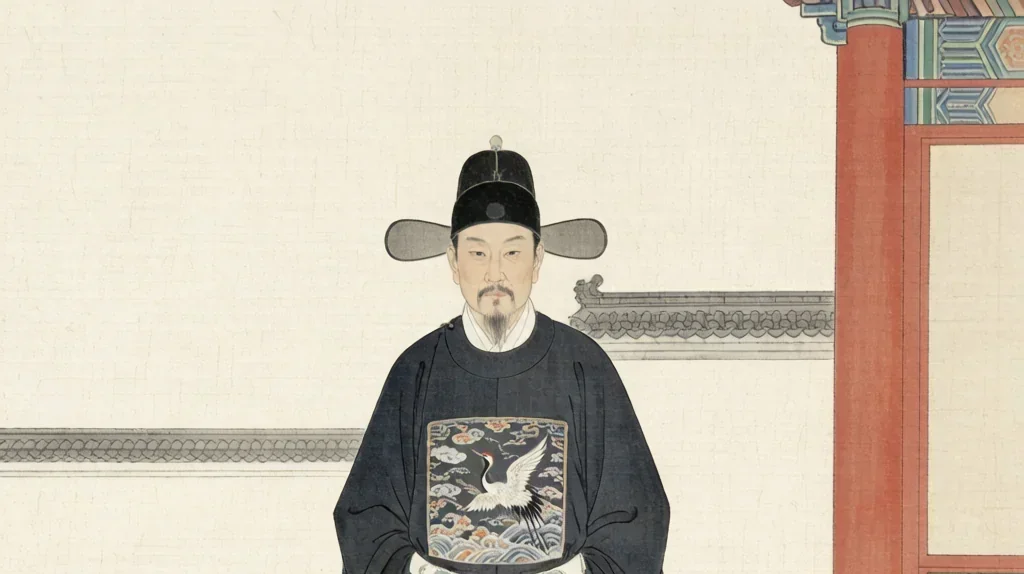
In imperial China, you could read a man's job title from across a courtyard. Not from his words or his seal, but from the square of embroidery on his chest. The scholar-official's robe (官服, ) was the formal dress of the civil and military elite, and it carried its owner's rank stitched directly into the cloth. A crane meant a top civil minister; a lion meant a senior general; a quail meant a humble ninth-rank clerk. This was clothing as a civil-service chart, a system so precise that a glance could tell you exactly where a stranger stood in the empire's hierarchy. Long before ID cards, China wove identity into the robe.
A Bureaucracy You Could Wear
Imperial China was governed by a vast corps of officials selected through examination and appointed by the throne. To keep so large a hierarchy legible, the state turned dress into a code. From the Ming dynasty onward, and refined under the Qing, officials wore a long robe with a buzi — a square insignia — on the front and back. The creature embroidered there announced the wearer's rank, from the exalted first rank down to the ninth. The system was enforced by law, and wearing the wrong badge was a serious offense. Clothing was, quite literally, the organization chart of the state.
The logic behind the creatures is telling. Civil officials, who governed through learning and pen, were represented by birds — elegant, soaring, refined. Military officials, who protected the realm through force, were represented by beasts — powerful, dangerous, noble. The split between feather and fur was a quiet statement about two kinds of service to the emperor, each honored yet clearly distinct. A court full of robes was a field guide to the empire's power.
The Rank Badges: Birds for Civil, Beasts for Military
The civil ranking by bird is remarkably specific. The first rank, the most senior, wore the crane, long a symbol of nobility and longevity. The second rank wore the golden pheasant, the third the peacock, the fourth the wild goose, the fifth the silver pheasant, the sixth the egret, the seventh the Mandarin duck, the eighth the quail, and the ninth the paradise flycatcher. Each bird was chosen for its recognized virtue or beauty, mapping moral qualities onto administrative grade. To be promoted was, among other things, to change your bird.
Military officials followed a parallel scale of beasts. The first rank wore the lion, king of animals; the second the tiger or bear; the third the leopard; and lower ranks descending through bears, tigers, and other creatures. The qilin, a auspicious mythological beast, sometimes appeared for the highest military honors. Because the badges were paired — one on the chest, one on the back — the rank was visible from any angle, a built-in transparency for a society that valued order.
Color, Cut, and the Dragon
Beyond the badge, color carried meaning. Bright yellow was reserved for the emperor and his closest family, while high officials favored deep blue, purple, or crimson robes depending on the period and occasion. The robe itself was a round-collar, center-closing gown that reached the floor, worn over a skirt-like under-robe and with a girdle from which official tablets and pouches hung. In the Qing dynasty the robe often showed descending dragons and cloud bands, linking the official to the dragon throne he served.
The famous "dragon robe" or mangpao deserves mention here. While the emperor wore the five-clawed dragon, officials of the highest standing were granted robes with the four-clawed dragon as a special favor. The number of claws was thus itself a rank marker, a detail visible only to those who knew to count. Such subtleties show how deeply the clothing encoded the constitution of the realm.
How the Robe Was Worn and Made
An official's wardrobe was extensive, with different robes for court audiences, sacrificial rites, and ordinary office days. The most splendid, the court robe, was worn at grand ceremonies and included a skirt-like lower section and a horseshoe-cuff jacket. All of it was made by imperial workshops or licensed tailors to strict specifications, since unauthorized imitation of rank dress was criminal. The embroidery alone on a single badge could take weeks, using gold and colored silk thread on a ground of dark satin.
The robe was completed by accessories that also signaled status: a transparent bead necklace for certain ranks, a hat with a finial whose material — coral, sapphire, or plain metal — marked grade, and a girdle of jade or gold. Taken together, the full outfit was less a costume than a certificate, worn on the body and inspected by all who met its owner. The official literally carried his authority in his clothes.
Why the Ranked Robe Mattered
The genius of the ranked robe was that it made the abstract hierarchy of empire visible and unavoidable. In a society that prized order and filial hierarchy, dress reinforced the lesson daily: everyone had a place, and that place was written on the chest. For the official, the robe was both privilege and pressure, a constant reminder that he represented the throne. For the citizen, it was a quick guide to whom to bow to and how deeply.
Today these robes survive in museums and in period dramas, their embroidered birds and beasts admired as art. But they remain one of history's clearest examples of clothing as administration — a system where the question "Who are you?" could be answered, fully and legally, by looking at what a man wore. The scholar-official's robe proves that in China, thread could carry the weight of the state.
Women at Court: A Parallel Rank
The bird-and-beast code was not reserved for men alone. Qing courtwomen, from the empress down to the wives of officials, wore robes marked with their own rank insignia, set in a female cut with a side closure and a contrasting hem. A noblewoman's badge used the same logic as her husband's or father's, so a family's standing was written on every member who appeared at court. These women's robes are less often illustrated than the men's, yet they followed an equally strict schedule of creatures and colors. Studying them shows that the ranked wardrobe was a whole-household system of status, not merely a man's uniform.
The Badge Across Asia
China's ranked robe proved so effective as a visual language of hierarchy that neighboring courts adopted their own versions. Korean and Vietnamese royal courts, which modeled much of their ceremony on the Chinese example, used similar square insignia with local creatures and color schemes to mark civil and military grades. The spread shows how dress could travel as diplomacy: a shared grammar of badges let allied courts read one another's officials at a glance. Today the Korean rank badges survive in court portraits and museum collections, a quiet reminder that the buzhi was an East Asian invention as much as a Chinese one.
Worn Memory: Surviving Robes Today
Few original ranked robes remain outside museums and a handful of aristocratic family collections, because silk is fragile and the robes were worn hard at ceremony after ceremony. Those that survive let historians confirm details the written statutes only hint at: the exact tilt of a crane's wing, the number of claws on a granted dragon, the weight of a gold thread. Conservators handle each badge as both art and document, since the embroidery records a real person's place in the imperial order. For modern visitors, a glass case of ranked robes is the closest view most will get of how China once made its government literally wearable.
❓ Frequently Asked Questions
📝 Chinese Vocabulary
官服 — : official's robe or court dress.
补子 — : the square rank insignia on an official's robe.
蟒袍 — : the dragon robe granted to the highest officials.
一品 — : the first (highest) official rank.
文官 — : civil official, a member of the literary bureaucracy whose robe bore a bird badge.
武官 — : military official, whose robe bore a beast badge rather than a bird.
顶戴 — : the hat finial and its material, which announced an official's rank at a glance.
补服 — : the rank-designated robe or coat bearing the square insignia of office.
🎉 Fun Facts
- The first-rank civil badge shows a crane, while the first-rank military badge shows a lion — bird versus beast marked the two branches of service.
- Rank badges appeared on both the chest and the back, so an official's grade was visible from any direction.
- The emperor's dragon had five claws, but top officials were granted a four-clawed dragon robe — counting claws was itself a rank check.
- The imperial statutes specified not only the creature on a badge but its exact shade and surrounding clouds, so a tailor who stitched the wrong color could be punished.
- Women of the Qing court had their own parallel rank dress, rendered in a female cut with birds and beasts, showing the code was not only for men.
- A single hand-embroidered civil-bird badge could occupy a court embroiderer for months, which is why surviving examples are prized by collectors today.