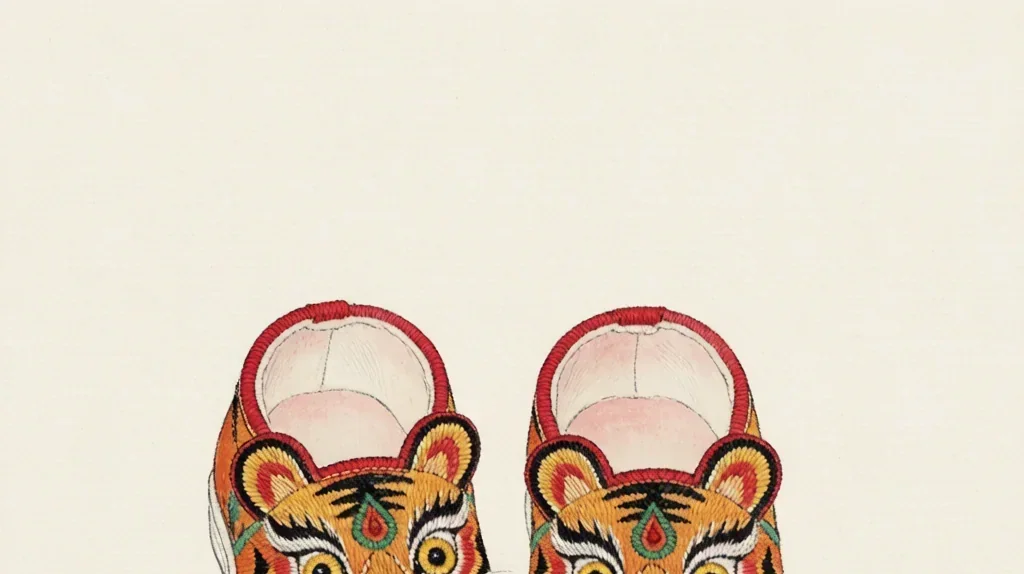
In villages across northern and central China, a grandmother's most treasured gift to a new baby was often not a toy or a blanket but a pair of tiny shoes sewn with a fierce, grinning tiger's face. These are the tiger-head shoes (虎头鞋, ), handmade cloth footwear for small children, decorated with embroidered eyes, whiskers, and a striped brow that turns each shoe into a miniature guardian beast. For centuries they were far more than cute handicrafts: they were protective charms stitched by loving hands, meant to keep evil spirits away from a child's most vulnerable feet. The tiger-head shoe is where Chinese folk belief, family love, and needlework meet in a single, smiling object.
A Beast of Protection for Tiny Feet
In Chinese folklore the tiger is the king of beasts and a powerful defender against demons and disease. Infants, with their soft skulls and wobbly steps, were thought to be especially open to harm from wandering spirits, and so parents dressed them in tiger imagery to borrow the animal's courage. A pair of tiger-head shoes was believed to give a child the tiger's strength, scare away misfortune, and help the little one learn to walk boldly. The logic was sympathetic magic: wear the tiger, become like the tiger.
This belief was not limited to shoes. Tiger-headed hats, tiger-patterned bibs, and tiger pillows all served the same purpose of surrounding a child with protective power. But the shoes held a special place because feet touch the ground, the threshold between the safe home and the uncertain outside world. Guarding the feet was, in folk thinking, guarding the whole child.
How a Pair Is Made
Traditional tiger-head shoes are entirely handcrafted from layers of old cloth stiffened with paste to form a thick, durable sole, then covered with bright cotton and embroidered. The maker — usually a mother or grandmother — builds up the tiger's face at the toe: two round eyes, a black nose, a wide mouth with tiny teeth, and eyebrows that curl like flames. Tufts of colorful thread or even real cat whiskers were sometimes added for liveliness. The sides and heel carry stripes of orange, red, and black, echoing the tiger's coat.
The work is patient and detailed. A single pair can take several days of stitching, and the best examples show remarkable skill in the symmetry of the two faces. Because they were made at home rather than in factories, no two pairs were exactly alike; each carried the maker's particular touch and the family's hopes. This is why surviving antique pairs are valued today not just as clothing but as folk art.
Color, Symbol, and Regional Style
The palette of tiger-head shoes is deliberately bold. Red and yellow, the colors of luck and the imperial court, dominate, while green, blue, and black outline the features. In some regions the tiger's eyes are made of coins or buttons to catch the light, and in others a small "king" character is embroidered on the forehead, a reference to the tiger's title as ruler of the mountains. The variety reflects China's many local embroidery traditions, from the bright, rounded faces of the north to the finer, more delicate versions of the Yangtze delta.
Regional differences also show up in shape. Shoes from Shandong tend to be plump and cartoonish, while those from the south may be slimmer with more intricate stitching. Despite these differences, the message is constant: a cheerful tiger who watches over the child. The exaggeration of the face — huge eyes, big smile — is intentional, making the guardian look friendly rather than frightening to the baby who wears it.
The Women Behind the Needle
Tiger-head shoes are a quiet record of women's artistry in a society where their work was rarely signed or credited. Mothers and grandmothers passed the patterns down orally, from hand to hand, teaching daughters the stitches that signaled a "good" tiger. Making these shoes was a way for women to express care that could not always be spoken aloud, and to contribute to the family's spiritual protection of its youngest member. The shoes therefore carry two kinds of value: the visible craft and the invisible love.
In the past, a bride was sometimes expected to demonstrate her needlework, and children's tiger shoes were a showcase of her skill. A well-made pair announced that a woman was diligent, careful, and devoted to her family's welfare. The garment was thus entangled with ideas of female virtue and domestic competence, even as it kept its primary job of guarding the child.
From Cradle to Museum
Today tiger-head shoes are seldom worn daily in cities, but they survive in rural areas, in folk-art markets, and in museum collections as emblems of intangible cultural heritage. Craftswomen in several provinces still teach the skill, and the shoes appear at festivals and in children's fashion inspired by tradition. Collectors prize antique pairs for their embroidery and the glimpse they offer into everyday village life a century ago.
The tiger-head shoe also travels well as a symbol of Chinese childhood itself. For families abroad, a pair on a shelf can be a small, warm link to grandparents and to a homeland. Whether worn, displayed, or remembered, the grinning tiger at the toe still seems to say the same thing it has said for generations: walk forward, little one, and do not be afraid.
Why Guard the Feet?
Folk belief held that a child's feet were the threshold between the safe home and the uncertain outside world, the place where wandering spirits and illness were most likely to enter. Clothing the feet in a tiger's face turned that vulnerable point into a guarded one. The logic was sympathetic magic: if the foot wore the king of beasts, the child borrowed the tiger's power to walk boldly and stay unharmed. This is why tiger shoes appear alongside tiger hats and bibs, forming a ring of protection around the body's edges. To understand the shoes is to see how seriously village life took the business of keeping a small child safe.
Reading the Tiger's Face
Every part of the embroidered face carries meaning. The round eyes stand for watchfulness, the black nose for the tiger's earthly power, the bared teeth for the ability to frighten harm away, and the curling eyebrows for the flames of energy. Whiskers, sometimes real cat hairs, made the beast look alive, and a small 'king' character on the brow named the tiger's title as ruler of the mountains. Because the face was built stitch by stitch, no two were identical, and a skilled maker could be known by how she shaped the smile. The shoe is, in effect, a tiny picture book of protection.
From Village Floor to Heritage List
As daily wear faded in cities, tiger-head shoes moved into a second life as folk art and intangible cultural heritage. Craftswomen in several provinces now teach the skill in workshops and schools, and the shoes appear at folk festivals, in children's fashion lines, and in museum displays of village life. Collectors value antique pairs for their embroidery and for what they reveal about a family's hopes a century ago. For families living abroad, a single pair on a shelf can still act as a warm link to grandparents and to a homeland. The grinning tiger at the toe has thus traveled from the cradle to the gallery without losing its original wish.
❓ Frequently Asked Questions
📝 Chinese Vocabulary
虎头鞋 — : tiger-head shoes for children.
虎 — : tiger, king of beasts and a protective symbol.
刺绣 — : embroidery, the core technique used to make the tiger's face.
外婆 — : maternal grandmother, a common maker of the shoes.
虎头帽 — : the tiger-head hat, a child's protective cap matching the tiger shoes.
虎头肚兜 — : the tiger bib, a toddler's chest covering in the same protective set.
千层底 — : the 'thousand-layer sole' built from many sheets of pasted cloth.
五毒 — : the 'five poisonous creatures,' another folk motif used to guard children in summer.
🎉 Fun Facts
- Some tiger-head shoes included a small "king" character on the forehead, echoing the tiger's title as ruler of the mountains.
- The shoes were part of a whole set of tiger-themed baby items, including hats, bibs, and pillows, all meant to protect the child.
- Because they were homemade, no two antique pairs are exactly alike, which is why collectors value them as folk art.
- The sole was built from many layers of old cloth glued with paste, the 'thousand-layer sole,' a thrifty way to make tough, quiet footwear.
- The maternal grandmother often presented the baby's first tiger shoes as he began to walk, wrapping the gift in wishes for courage.
- Not every pair showed a tiger; some regions made frog, fish, or lion baby shoes, each with its own folk blessing.