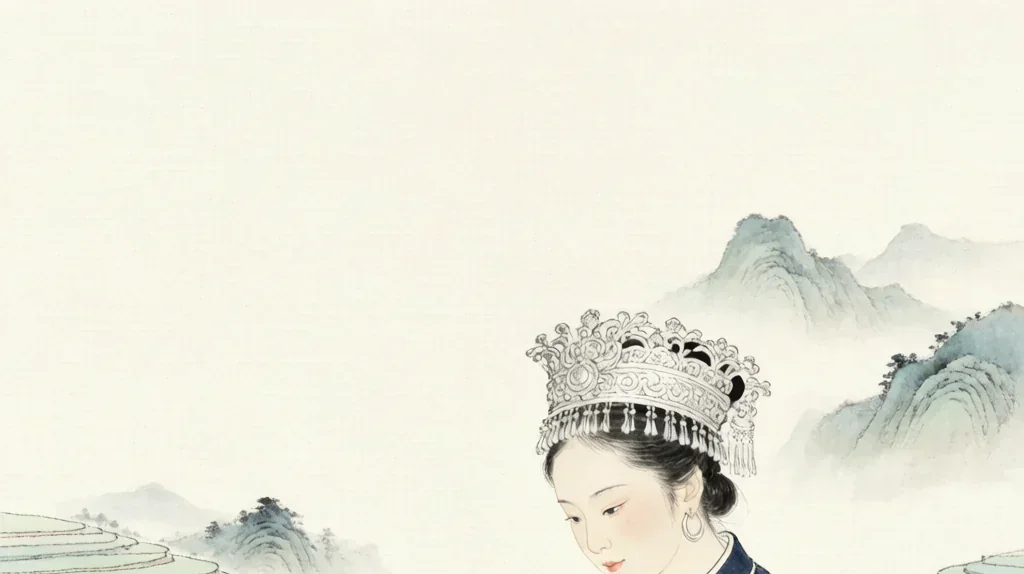
Among the misty mountains of Guizhou, Hunan, and Yunnan, the women of the Miao ethnic group have for centuries kept their history not in books but in thread. Miao embroidery (苗绣, ) is one of China's most extraordinary textile traditions, famous not only for its dazzling color and precision but for what it carries: legends of a great flood, memories of ancient migrations, and images of gods and ancestors. Because the Miao people long had no widely used written language, their embroidery became a script without words — a way to record who they were and where they came from, passed from mother to daughter across the generations. To wear a Miao jacket is, in a sense, to wear a family archive.
A People Who Wrote in Thread
The Miao are one of China's largest ethnic minorities, with communities scattered across the southwest and beyond. In the past, their stories traveled orally and through pattern. An elder would teach a girl not just how to stitch but what each motif meant, so that a single pleated skirt could hold a cosmology: the sun, the river of rebirth, the butterfly that gave birth to the Miao ancestors. When written records were unavailable or unsafe, embroidery preserved identity under the very eyes of outsiders who could not "read" it. The cloth was both a diary and a shield.
This is why scholars often describe Miao embroidery as a "script without words." The comparison is not metaphorical alone. Specific compositions — a tree of life, a pair of birds, a coiled dragon — recur across villages and encode shared myths. A skilled viewer can tell which branch of the Miao made a piece by its palette and its favored creatures. The embroidery is, quite literally, a regional literature worked in silk.
The Great Myths in Tiny Stitches
Central to Miao belief is the story of the butterfly mother, who according to legend laid the eggs from which the first ancestors hatched. She appears again and again in embroidery as a stylized winged figure surrounded by offspring, a gentle reminder of origins. Other common images include the dragon — not the fearsome imperial dragon of the Han but a friendly,带状 creature who brings rain and protection — and the phoenix, the twin, and a host of birds and fish that stand for fertility and good fortune.
These are not random decorations. They form a visual grammar of creation, survival, and blessing. A bride's costume, for instance, may be covered in butterflies and flowers to wish her children and a flourishing home, while a festival coat might display the ancestral dragon to claim continuity with the past. Reading the garment is like reading a chapter of the community's sacred history.
Technique: Layered, Lustrous, Alive
Miao embroidery is renowned for its density and relief. Artisans often build up many layers of stitching so the pattern stands proud of the cloth, catching light and shadow. They use a wide range of techniques — satin stitch, couching, chain stitch, and a distinctive "blind stitch" worked from the back so the front shows almost no trace of the thread's path. The result is a surface that looks painted yet is entirely needle-made. Metallic thread and tiny mirrors or beads are sometimes added to make the work shimmer during festival dances.
Color is fearless. Deep indigo grounds are lit by shocking pink, emerald, orange, and gold, a palette that reads beautifully against the dark wood of mountain houses and the flicker of bonfires. The contrast is deliberate: the embroidery is meant to be seen at a distance, on a moving body, during the great gatherings of the lunar calendar. Beauty here is public and communal, not private.
Costume and the Calendar of Festivals
Miao dress reaches its fullest expression at festivals such as the Sister's Meal Festival and the Lusheng competitions, when young people dress in their finest embroidered jackets, aprons, and pleated skirts to sing, dance, and court. The embroidery is the centerpiece of these events; a woman's reputation for skill can be made by a single stunning collar. For the community, the festival is a living museum where every costume is also a performance of heritage.
Silver ornaments usually accompany the embroidery — heavy necklaces, headdresses, and bangles that amplify the visual richness and mark wealth and status within the group. The combination of silver and saturated silk is unmistakably Miao, and it signals both beauty and belonging. To be fully dressed for the festival is to be fully visible as a Miao person.
Heritage, Change, and the Future of the Thread
Today Miao embroidery is recognized as an important part of China's intangible cultural heritage, and master embroiderers are honored for keeping the knowledge alive. Younger women learn in workshops and schools as well as at home, and designers collaborate with Miao artisans to bring the patterns into fashion and home goods. This brings income and pride, but also raises questions about how to preserve meaning while adapting form. The "script without words" now speaks to markets far from the mountains that birthed it.
What endures is the core idea: that a people can carry its memory in something made by hand. Whether on a remote hillside or in a city boutique, a butterfly on a Miao cloth still whispers the same old story of origins and survival. To look closely at Miao embroidery is to read a nation's memory, one brilliant stitch at a time.
Branches and Borderlines: A Map in Thread
The Miao are not one uniform group but a scatter of branches, and their embroidery maps that diversity. A piece from one village might glow with pink and orange and center on the butterfly mother, while another from a different region prefers deep blues and a coiled dragon. These are not random tastes but inherited visual dialects, passed from mother to daughter so faithfully that an expert can name a maker's homeland by the cloth alone. The embroidery thus works like a regional archive, each skirt or collar a sentence in a local tongue of pattern. To collect Miao embroidery across branches is therefore to hold a map of a people who, without a shared written script, drew their geography in thread, every village recognizable by the stories it chose to stitch.
The Teacher Was a Mother: Learning the Script
A girl learned Miao embroidery not in a classroom but at her mother's side, and she learned more than stitching. The elder taught which creature meant origin, which flower meant a flourishing home, and which composition belonged to their branch, so that meaning traveled with method. A clumsy or careless piece was not merely ugly; it failed to carry the right wish, and a girl's growing skill became a quiet measure of her character and her marriage prospects in village life. Because the knowledge was oral and manual, each generation re-copied the community's memory by hand, and the bond between teacher and learner was itself part of the art. The embroidery was, in this sense, a school without walls, its lessons spoken in silk.
Silver, Song, and the Festival Body
Miao embroidery reaches its full power only in motion and sound. At festivals the lusheng reed-pipe sounds, young people sing in call and response, and couples court in the open air, all while wearing embroidered jackets and skirts weighed with silver. The metal catches the firelight and amplifies the body's movement, turning the dancer into a moving composition of cloth, thread, and shine. Singing and embroidery are not separate arts here but one event, the visual and the musical reinforcing the same message of belonging and blessing. To see a festival is to understand that the embroidery was never meant for a quiet shelf; it was made to be worn, heard, and seen at a distance, a communal performance of who the Miao are.
❓ Frequently Asked Questions
📝 Chinese Vocabulary
苗绣 — : Miao embroidery.
苗族 — : the Miao ethnic group.
蝴蝶妈妈 — : the Butterfly Mother, a creation figure in Miao myth.
百鸟衣 — : the "hundred-birds robe," a ceremonial Miao coat.
姊妹节 — : The Sister's Meal Festival, a Miao spring gathering of singing, courtship, and finest dress.
芦笙 — : The lusheng, a Miao reed-pipe played at festivals and dances.
银饰 — : Silver ornaments, the heavy necklaces and headdresses worn with Miao embroidery.
盛装 — : Festive full dress, the complete embroidered and silver costume worn at great gatherings.
🎉 Fun Facts
- The Miao dragon in embroidery is friendly and rain-bringing, quite different from the imperial dragon of Han Chinese tradition.
- Some Miao embroidery is stitched from the back so the front shows almost no sign of the thread's path, a technique called the "blind stitch."
- A woman's skill at embroidery could shape her reputation and marriage prospects in traditional village life.
- The Miao are one of China's largest ethnic minorities, with communities scattered across Guizhou, Hunan, Yunnan, and beyond, and each branch keeps its own palette and favored creatures.
- Miao embroidery uses a bold palette of deep indigo lit by shocking pink, emerald, orange, and gold, a combination designed to be read at a distance against mountain houses and bonfire light.
- Heavy silver necklaces, headdresses, and bangles are worn with the embroidery, so that the full festival dress signals both beauty and belonging as a Miao person.