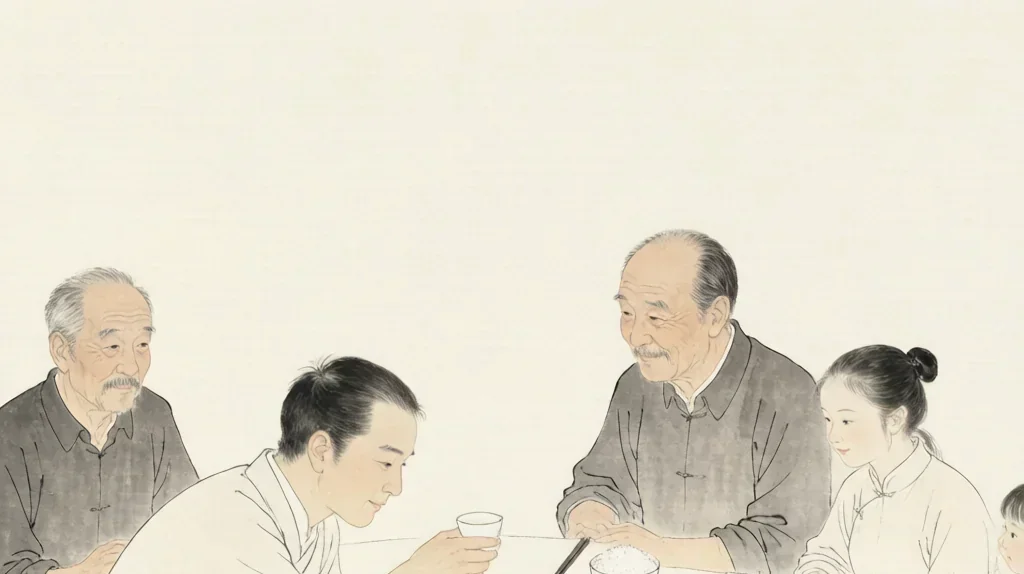
In China, a meal is never only about food. For thousands of years the table has been the place where families reunite, strangers become friends, and business is quietly sealed over a second round of toasts. The rules that govern this shared experience — known together as 餐桌礼仪 (cānzhuō lǐyí) — are not fussy decorations but a practical grammar of respect. They tell you when to lift your chopsticks, how to carry a glass, and why the host keeps piling food on your plate long after you are full. To understand Chinese dining etiquette is to understand how Chinese society thinks about hierarchy, generosity, and harmony, one bite at a time.
The Shared Table Through History
The communal style of Chinese dining has deep roots. Archaeological finds from the late Neolithic show large pottery煮 (zhǔ, boiling) vessels and shared serving basins, suggesting that early Chinese meals were cooked and eaten in common. By the Zhōu dynasty (周, c. 1046–256 BCE), the Lǐjì (礼记, Book of Rites) codified who might eat what, where they sat, and in what order they were served, tying food directly to rank and ritual. A noble and a commoner did not simply eat different amounts; the very arrangement of the meal announced their place in the cosmos.
The round table with a revolving center, now iconic in Chinese restaurants, is a relatively modern invention, but the spirit it serves is ancient. The character 宴 (yàn, banquet) combines 宀 (a roof) with 妟 (peace and evening), picturing people gathered under one roof in calm. From the Hàn (汉) tombs' mural feasts to the lavish tang (唐) banquets recorded in poetry, the message is consistent: to eat together is to affirm belonging. The famous 分餐 (fēncān, separate-serving) system of earlier courts gradually gave way to the shared-plate model that defines the popular table today, especially after the Sòng (宋) era made restaurants and teahouses part of daily urban life.
Confucian thought gave dining its moral weight. The Lúnyǔ (论语, Analects) records Confucius being careful about the appearance, smell, and切割 (qiēgē, cutting) of his food, treating appetite as a matter of self-cultivation. "Do not eat to excess" and "let the rice be clean" were not diet tips but virtues. Over centuries these attitudes hardened into everyday courtesy: the elder eats first, the guest is pressed to eat more, and the host proves worth by the abundance provided.
The Chopsticks: Small Tools, Big Rules
Nowhere is dining etiquette more visible than in the handling of chopsticks (筷子 kuàizi). The single most important taboo is never to plant them upright in a bowl of rice. Upright sticks rising from a white mound look exactly like the incense branches burned at a funeral altar, and the gesture is read as an omen of death — deeply unlucky at any meal, and especially taboo during the New Year. When you pause, lay them across the rim of your bowl or on the small rest provided.
Beyond that core rule, a cluster of smaller courtesies governs the hand. Do not stab food or spear a difficult piece; do not tap your bowl with the sticks, a habit linked in folklore with beggars signaling for alms; and never point at a person with your chopsticks while making a point at the table. When reaching for a shared dish, use the serving spoon or the clean opposite end of your chopsticks rather than the end that has touched your mouth. Passing food from chopstick tip to chopstick tip is also avoided, since that mirrors the way bones are passed during a funeral. None of these rules is about hygiene alone — each one quietly protects the ease of everyone at the table.
Children are taught these habits early, often through a gentle correction from a grandparent. Mastering them is part of growing up polite. A visitor who simply avoids the upright-rice mistake and uses serving utensils for shared plates will already be doing better than many nervous first-timers, and any small slip is usually met with warmth rather than reproach.
Toasting, Serving, and the Logic of the Meal
Toasting (敬酒 jìngjiǔ) turns drinking into a choreography of rank. The junior proposes a toast to the senior, often lowering their own glass so that its rim sits beneath the senior's — a physical bow in glass form — and saying 我敬您 (wǒ jìng nín, 「I toast to you」). The senior may sip or drain the cup; the junior generally drains theirs. Toasts begin with the host welcoming the table and then move from highest rank downward, so that no elder is accidentally skipped. A guest who never offers a toast to the host can seem distant, while one who toasts everyone in order shows refinement.
Serving follows the same logic. Hot towels, tea, and the first taste of a dish are offered to the eldest or most honored before anyone else. The host or the youngest diner often acts as pourer, refilling cups the moment they empty and never letting a senior's glass sit dry. When a dish arrives, it is turned — gently, on the 转盘 (zhuànpán, lazy Susan) — toward the honored guest first. Taking food from the far side of the table means waiting or asking, never stretching across an elder's reach. These habits look like choreography because they are: each move places someone else's comfort ahead of your own.
The question of when to begin eating is settled by status. No one lifts chopsticks before the most senior person at the table signals the start, usually with the first toast or the first serving. To dig in early is to announce, however unintentionally, that you place your own hunger above the group's order. Patience here is its own compliment to the elders present.
Dining Etiquette in Modern Life
Much of this etiquette survives intact in contemporary China, even as fast food and individual plates appear in cities. At family reunions, especially the Spring Festival Eve dinner (年夜饭 nián yè fàn), seating by seniority and the eldest's first bite remain the norm. In business, the banquet is still where trust is built; a foreign client who accepts the toasts, uses both hands to receive a gift of liquor, and lets the host lead will gain goodwill that a signed contract alone cannot buy.
New habits have layered onto the old. The "clean plate" campaign promoted by the government in recent years encourages diners not to over-order, softening the traditional pressure to leave mountains of leftover food as proof of the host's generosity. Public-health concerns have also spread the use of serving spoons (公筷 gōngkuài, "public chopsticks") for shared dishes, a change that actually reinforces the old courtesy of not mixing one's own utensils with the common food. Younger urbanites may seat themselves more casually at casual meals, but at any gathering that includes elders or superiors, the traditional order reasserts itself without comment.
Perhaps the most durable lesson is that Chinese dining etiquette is not about rigid prohibition but about attention. Noticing who is oldest, whose cup is empty, and whether the guest has been pressed to eat enough — these small acts transform a meal from refueling into relationship. The foreigner who stumbles over a rule but clearly tries will almost always be met with encouragement, because the effort itself is the courtesy.
Why the Table Still Matters
Chinese dining etiquette endures because it condenses the culture's central values into daily action. The shared dishes teach togetherness; the toasts teach respect for rank; the host's insistence on paying teaches that generosity outranks accounting. In a society that prizes 和 (hé, harmony), the meal is the warmest classroom, and the chopsticks are its pencils. To sit at a Chinese table and follow its quiet rules is to be enrolled, however briefly, in a two-thousand-year-old conversation about how people ought to treat one another — one shared dish, and one respectful toast, at a time.