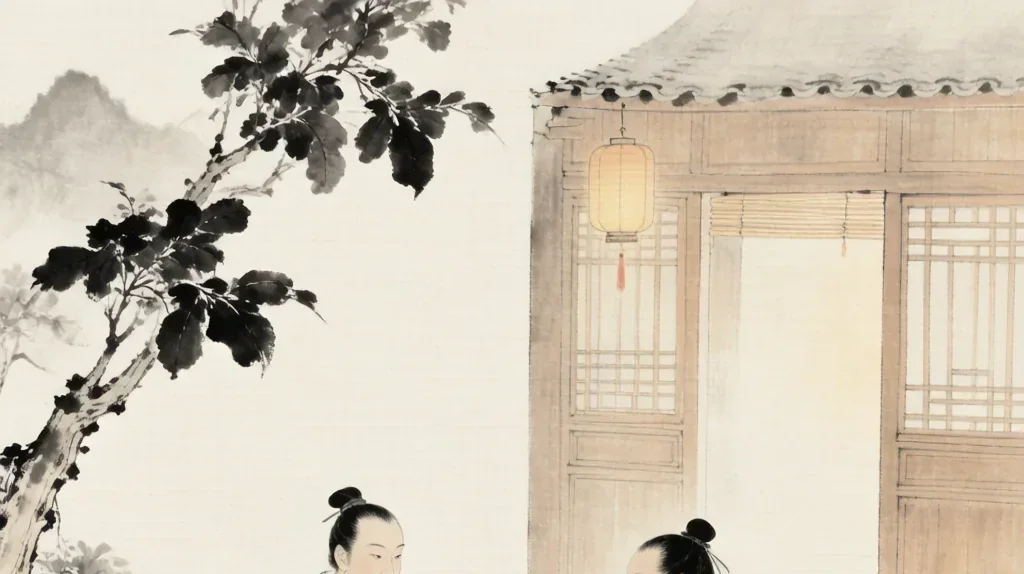
To be a guest in a Chinese home is to be temporarily adopted. From the moment the door opens, the host begins a quiet campaign of generosity — tea appears before you sit, the best seat is yours, the fruit is washed and cut, and the meal somehow has far more dishes than the number of people could need. This is 待客之道 (dàikè zhī dào), "the way of receiving guests," and it is one of the oldest and warmest strands of Chinese courtesy. More than mere manners, it is a philosophy: that to welcome someone well is to honor both them and yourself. Understanding it helps any visitor receive kindness gracefully and return it in kind.
The Roots of Chinese Hospitality
The duty to host well is woven into the classical texts. The Lǐjì (礼记, Book of Rites) instructed that a gentleman should welcome guests at the gate, lead them in, and see them off in person — a triad of attentions still performed today. The sage 孟子 (Mèngzǐ, Mencius) taught that there are three unfilial acts, and while most concern family, the broader Confucian vision placed harmonious human relations at the center of a good life. A guest, after all, is a relationship made present, and treating them well affirms the host's own 仁 (rén, humane virtue).
Geography reinforced the habit. For centuries China was a land of slow travel, where a visitor might arrive after days on foot or by boat, and turning someone away was unthinkable. Folk sayings still praise the host who "treats a stranger as a kinsman" (宾至如归 bīn zhì rú guī, "guests arrive as if returning home"). In rural courtyards and canal towns alike, the spare room and the extra bowl were kept ready. Hospitality was not a special event but a standing obligation, the social insurance of a close-knit world.
The ideal host was never merely generous but also 周到 (zhōudào, thoughtful in every detail). To host well meant anticipating needs: a footstool for the elder, a cooler drink in summer, a warmer one in winter, and never letting a cup sit empty. This attentiveness is itself the gift; the food is almost secondary to the care arranged around it.
The Welcome: Tea, Seating, and the First Gestures
Almost every Chinese visit opens with tea. The host rinses the cups, fills the guest's first, and keeps the pot moving so the cup never runs dry. The guest who knows the custom will tap two fingers on the table in thanks — the 叩指礼 (kòuzhǐ lǐ, "finger-tapping rite"), said to honor a Qing emperor who, traveling in disguise, poured tea for a servant who could not bow without revealing the secret. The small gesture lets gratitude be shown without breaking the equality of the moment.
Seating follows the logic of rank described in the rules of the table: the guest of honor takes the best chair, often facing the door or the window, while the host sits nearest the kitchen or the entry to serve. The host will press the guest toward the softer seat and may physically redirect them, and a gracious guest yields after a token protest. Offering the guest the first taste of fruit or snack, and replenishing it, are constant small honors. Even the cigarette, where smoking is common, is offered around the circle with both hands — the 散烟 (sànyān) ritual of sharing.
Gifts mark the threshold. A visitor arrives with something — a bag of fruit, a box of tea, a cake — never empty-handed, because to come with nothing implies you expect to be fed for free. The host receives it with both hands and usually waves it away once or twice, not from refusal but from 客气 (kèqi, polite modesty), before setting it aside to share. The gift is less an object than a token that the relationship is real.
The Meal as the Heart of Hosting
If tea opens the visit, the meal crowns it. A Chinese host measures success by abundance: the table should groan, leftovers should be plentiful, and the guest should be gently scolded for not eating more. "Eat more, eat more" (多吃点 duō chī diǎn) is the refrain of every feast. The host or the youngest present shuttle dishes toward the guest, and the guest who leaves food signals they were satisfied rather than starved — a fine point lost on many newcomers.
The contest over the bill is the most famous scene of Chinese hosting. The host considers paying a point of 面子 (miànzi, face), proof of means and goodwill, and will often slip to the counter while the guest is distracted, or physically wrestle the check from the guest's hand. A guest who insists too hard can embarrass the host; the polite dance is to offer sincerely, then yield with good grace, resolving to host next time. This rotation of treating — today you, next time me — is how Chinese friendship is banked and compounded.
Even the departure is choreographed. The host sees the guest to the door, often to the gate or the elevator, and stands watching until they turn the corner — a final courtesy that says the visit mattered. To leave too abruptly, or without thanking the elder of the house, reads as cold. The whole arc, from gate to gate, is the actual "gift" the host gives.
Hospitality in Modern China
Urban life has changed the setting but not the spirit. Apartments have replaced courtyards, and restaurants often stand in for the home table, yet the host still orders too much, still pours the tea, and still fights for the bill. Business entertainment (应酬 yìngchou) remains a serious form of hosting where the right restaurant and the right toast can do more than a slide deck. A foreign partner who accepts the care, toasts in turn, and later returns the invitation will find doors opening that contracts alone would not.
Technology has added new layers. Messages precede the visit, the host may send a location pin, and payment apps let the bill be settled invisibly — yet the old etiquette survives the screen. During holidays, especially Spring Festival, the duty to receive relatives and friends peaks, and homes stock extra supplies for the unannounced drop-in. The "guest hair" (客来扫地, "sweep when guests come") saying captures the cheerful scramble to tidy up at the sound of a knock.
Younger hosts may be more casual, offering a tour of the fridge rather than a seated banquet, but the underlying principle holds: make the other person comfortable, and never let them feel they are a burden. In a fast, crowded society, that insistence on making room for another person is precisely what keeps relationships human.
The Deeper Meaning of Receiving Guests
At its root, 待客之道 is a training in other-centeredness. The host practices setting aside their own comfort to build another's; the guest practices receiving without arrogance and repaying without calculation. Both roles teach 礼 (lǐ, propriety) not as stiffness but as a generous attention to others. In a culture that measures a person by their relationships as much as their achievements, the ability to host and be hosted well is a quiet form of wealth — and one freely available to anyone willing to pour the first cup of tea.