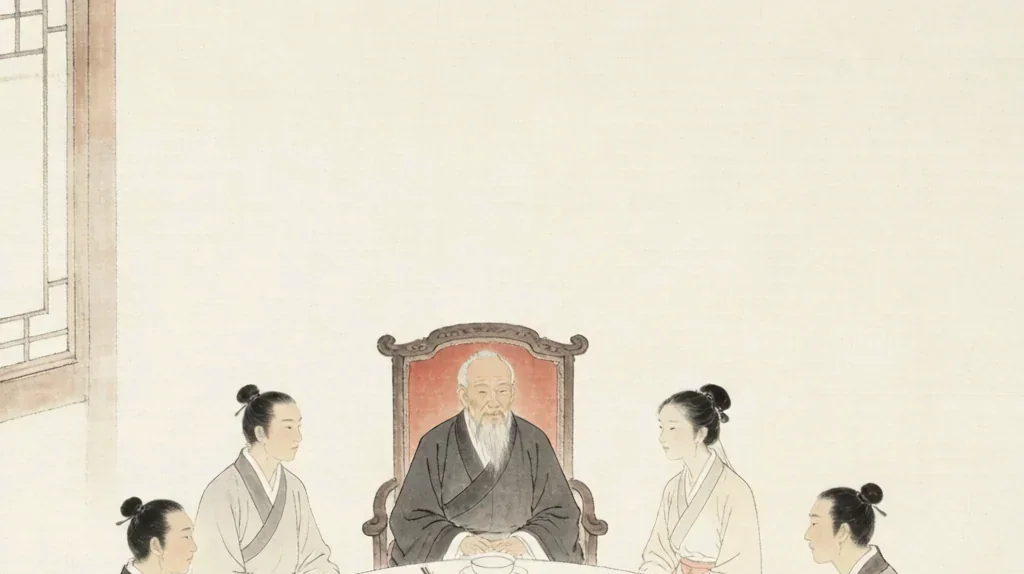
Where you sit in China can speak before you do. At a banquet, a family feast, or a business dinner, the arrangement of bodies around the table is a quiet map of the social order — who is honored, who serves, and who must wait. This system is called 座次尊卑 (zuòcì zūnbēi, "seating order and rank"), and it turns the simple act of sitting into a precise etiquette. Far from cold formalism, it is a way of showing respect without a word: the best seat goes to the worthiest, and everyone else finds their place in relation to them. For any visitor, learning the logic of the seat of honor is one of the fastest routes to graceful participation in Chinese life.
The Principle: Position as Respect
The idea that space encodes status is ancient. The Zhōu Lǐ (周礼, Rites of Zhōu) prescribed where rulers, ministers, and guests stood and sat at court, treating placement as a visible expression of the cosmic and political order. Confucius stressed that "without ritual there is no way to set right" the relations between high and low, and seating was among the clearest daily instances of that "ritual" (礼 lǐ). To seat someone well was to honor them; to mis-seat them was to insult, however unintentionally.
The underlying values are two: 尊 (zūn, to honor) and 卑 (bēi, to humble). The senior takes the high, safe, central place; the junior takes the low, busy, peripheral one. This is not mere hierarchy for its own sake but a courtesy made spatial — the guest of honor is protected from drafts and drafts of servants, given the best view, and spared the work of hosting. The geometry is kindly when read correctly.
Direction adds another layer. Traditional Chinese space is oriented by the compass and by the room's facing, with north and center historically most noble. A seat "facing south" (面南 miàn nán) was the emperor's; by extension, the seat that faces the door and sits away from it became the civilian "head" of the table. The door, not the window, is the key reference point.
The Seat of Honor and the Host's Place
At a formal banquet the 上座 (shàngzuò, 「seat of honor」) belongs to the most senior guest, the eldest, or the highest-ranked host present. It is the seat farthest from the entrance, facing the door — the spot with the best view and the least traffic. In a room with a clear "north" side, the central north seat is typically highest. The honored person is ushered there with a small flurry of deference, and refusing it too firmly can embarrass the host who insists.
The host sits opposite, nearest the door — the 下座 (xiàzuò, "lower seat"). This is not a slight to the host but a function: from there they can signal the servers, manage the toasts, and 「face」 the guests across the table. In a host-guest dinner the principal host may share the opposite seat with the co-host, while the guest of honor commands the far throne. The arrangement lets the host serve while the guest is served.
Between these poles, guests are ranked outward by age and status. The closer to the seat of honor, the higher the standing; the closer to the door, the more junior. Spouses and companions are placed to support the principal guests, not to claim rank of their own. A junior who discovers themselves near the door should take it lightly — it is simply their turn to be the helper, and good humor there is itself polished.
Round Tables, Square Tables, and the Door
The modern round table softens the ranking by giving everyone equal sightlines, yet the door-and-direction rule still decides the true head. The honored guest sits farthest from the door facing it; the host opposite; others by seniority around the circle. The 转盘 (zhuànpán, lazy Susan) in the middle lets dishes reach all, but etiquette says you turn it gently and never spin it while a senior takes food — the mechanics serve the manners.
At a square or rectangular table the hierarchy is stricter. The north-facing central seat is highest; the east and west seats are next, with east often slightly preferred; the south seat by the door is lowest. The host or the most junior may take the south to manage service. Knowing these gradients prevents the common foreign error of cheerfully grabbing the seat that "has the best view" — which may be exactly the one reserved for the eldest.
The door's role cannot be overstated. Because it is the side of movement, noise, and exposure, the seat with one's back to it was traditionally uneasy — vulnerable to drafts and to whoever enters. The seat facing the door, by contrast, is calm and commanding. This is why the "best view" and the 「seat of honor」 so often coincide, and why a thoughtful host will explain placement rather than let a guest blunder into the throne.
Seating Beyond the Dinner Table
The same logic governs many settings. In a meeting room the principal sits farthest from the door or at the head of the table, with subordinates nearer the entrance. In a car, the front passenger seat is the "assistant's" seat and the right rear is often the place of honor for a VIP, while the host-driver takes the wheel. At a temple or ancestral hall, the central, highest altar position is reserved for the foremost deity or ancestor, mirroring the table's seat of honor.
Even photograph arrangements follow 座次. The eldest or highest-ranked sits center and front; juniors stand behind or at the edges. Wedding banquets assign the newlyweds' families by careful seating charts, and the bridal table faces the guests. In all these, the placement is a sentence about who matters, spoken in silence.
Business dinners make the rules strategic. Seating can signal alliance — placing a key partner beside the host — or defuse tension by separating rivals. A skilled Chinese host reads the room and assigns seats like a general, because the right arrangement can make a deal feel inevitable before the first toast is raised.
Seating Etiquette Today
The tradition remains vigorous. At Spring Festival reunions the eldest unambiguously takes the seat of honor, and no one eats before them. Business banquets still choreograph seating by rank, and a foreign guest of honor will be steered to the far seat with gentle insistence. Among close young friends in a café the rules relax almost to vanishing — but the moment an elder or a boss arrives, the old geometry reasserts itself without comment.
For visitors, a few moves suffice. Let the host or eldest choose first; if ushered to the seat of honor, accept with a modest demurral rather than a battle; never sit with your back to the door if seniors are present; and rise slightly when the honored guest sits. These small gestures show you grasp 座次尊卑, and Chinese hosts are quick to appreciate the effort, often with a warm "you understand our customs" (你懂规矩 nǐ dǒng guīju).
In the end, seating by rank is not about domination but about recognition — seeing clearly who deserves honor and arranging the world, however briefly, to give it. The Chinese table is a quiet democracy of attention: everyone has a place, and the best place goes, by consensus, to the person most worth honoring. To read that map is to read the culture's heart.