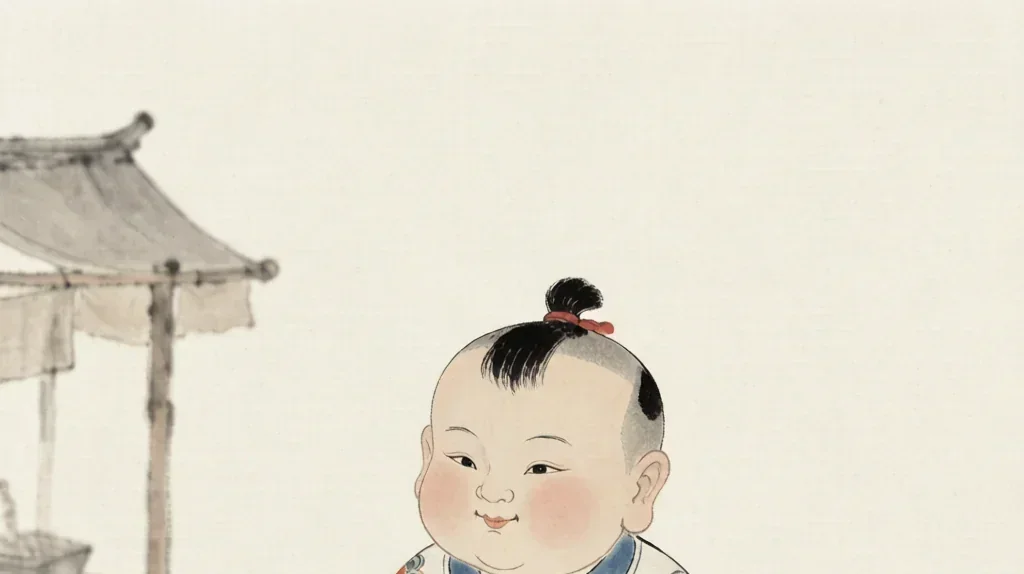
On a market stall in Wuxi, a round-cheeked clay child with a topknot and a beatific smile sits a few inches tall, painted in candy-bright pink and green, looking back at you with the calm of a small Buddha. This is the Dà Ā Fú (大阿福, "Big A-fu"), the most beloved of China's clay figurines, and it belongs to one of the country's oldest continuous folk-sculpture traditions. Ní rén (泥人, "clay people") are the small sculptures — toys, guardians, and miniature opera stars — that Chinese hands have pinched, molded, and painted from local earth for over a thousand years, turning mud into blessing.
A Beloved Folk Tradition
Clay figure-making is found wherever fine, workable earth exists, but two schools dominate the Chinese imagination: the Huishan (惠山) tradition of Wuxi in Jiangsu, near the Yangtze Delta, and the Fengxiang (凤翔) tradition of Shaanxi on the northwestern loess plateau. Both began as peasant craft — a way for farming families to earn cash in the slack winter months by molding toys to sell at temple fairs (庙会, miào huì). The figurines were never meant for museums; they were playthings and charms, stacked in baskets and carried to market by the makers themselves.
What unites the regional styles is function. A clay figure is usually a wish made solid: a chubby baby for fertility, a tiger for protection, a plump god for prosperity. Because clay is free and the skill portable, the art flourished at the humblest social level, and like paper-cutting it preserved local taste and belief that never reached the written record. Ming Dynasty texts already list "Huishan clay" as a specialty of Wuxi, and the craft was old even then, so its roots reach back past the fourteenth century.
The tradition is often divided by quality into "coarse" and "fine" wares. Coarse goods (粗货, cū huò) are mold-pressed, solid, and brightly painted — the A-fu and the animal toys. Fine goods (细货, xì huò) are individually hand-modeled, far more detailed, and often depict scenes from opera. This split, present in both Huishan and Fengxiang work, is the key to understanding how a folk toy could also become an art object.
Huishan and Fengxiang Styles
The Huishan school of Wuxi is the most famous. Its signature clay, the dark, oily "Huishan black clay" (惠山黑泥, Huìshān hēi ní), is valued because it is fine, tenacious, and barely shrinks as it dries, so figures keep their shape without cracking. The coarse branch produces the Dà Ā Fú, a paired brother-and-sister child whose legend says they tamed a beast that was devouring villagers; setting the pair in the home keeps evil out. The fine branch is the "hand-kneaded opera" (手捏戏文, shǒu niē xì wén) school, in which masters build miniature, fully three-dimensional tableaux of famous opera scenes — a general's rage, a lady's grief — in a few deft rolls of clay, then paint them with the precision of a miniature painter.
Fengxiang, by contrast, is the art of the northwestern loess. Local scholars trace its roots to the Tang and Song dynasties, and note that clay toys were buried with the Tang imperial family at the nearby Qianling (乾陵) tombs, suggesting a courtly ancestor for the folk craft. Fengxiang figures are famous for their audacious color: a white or pink ground slashed with vivid green, yellow, and red, every edge outlined in black ink. The signature subject is the clay tiger (泥虎, ní hǔ), a wide-eyed, striped guardian hung above a child's cradle or bed to scare away illness and demons. Where Huishan favors rounded, benign babies, Fengxiang favors bold, apotropaic beasts.
A third, lesser-known but important tradition is the "clay whistle" (泥哨, ní shào) and toy animals of places like Henan's Huaxian and Beijing's "shrimp-waist" (虾蟆, há má) frogs, showing how widespread the craft was. Each region tuned its clay to local earth and local fear, producing a map of China written in mud.
Subjects and Craft
The subjects fall into clear groups. Fertility and family: the A-fu babies, the "one hundred sons" (百子, bǎi zǐ) clusters, and pregnant "earth mothers." Protection: tigers, lions, and the zodiac animals, hung in nurseries. Piety and entertainment: the fine opera tableaux drawn from the same three novels — Three Kingdoms, Water Margin, Journey to the West — that feed shadow puppetry and New Year prints. And simple delight: chickens, fish, crickets, and the little painted "clay frogs" that whistle when blown.
The making itself is a small technology. At Huishan the black clay is dug, weathered through a winter, washed to remove grit, and kneaded like dough. Coarse figures are pressed into carved wooden or plaster molds (模子, mú zi) that stamp front and back in one motion; fine figures are built by hand from pellets and coils, sometimes over a hidden wire so a raised arm will not sag. The dried pieces are given a low bisque firing or simply sun-baked, then coated with white slip and painted in mineral and plant colors, with faces and costumes outlined in ink. A master of the hand-kneaded opera school can model a complete figure in minutes and finish the painting in an hour — speed born of a lifetime.
From Toy to Collectible
By the late Qing and Republican era the finest Huishan opera figurines were already being bought by connoisseurs rather than children, and the divide between toy and treasure hardened. The hand-kneaded opera pieces, with their theatrical poses and painterly faces, were recognized as miniature sculpture, and masters such as the early-twentieth-century artist Jiang Jin (蒋金) and later Yu Xiang (喻湘) raised the form's prestige. Collectors prize a complete "opera set" — a row of connected figures telling one scene — as they would a scroll painting.
The turning point for preservation came in 2006, when both the Huishan clay-figurine craft and the Fengxiang clay-sculpture craft were inscribed on China's national list of Intangible Cultural Heritage (国家级非物质文化遗产, guójiā jí fēi wùzhì wénhuà yíchǎn). This brought state support, master-inheritor titles, and museum attention. Today a fine antique A-fu or a signed Fengxiang tiger can command serious money, while mass-produced versions still cost pocket change at temple fairs — the tradition spanning both ends of the market at once.
Today
Clay-figurine making survives as a living craft in Wuxi and Fengxiang, taught in dedicated workshops, vocational schools, and inheritor studios, and demonstrated at folk-art festivals across China. Master inheritors such as the Fengxiang artist Hu Xinyi (胡深) have been honored nationally, and their children often apprentice beside them, keeping the recipes for clay and color in the family. The classic forms — A-fu, the tiger, the opera tableau — remain the core of production, valued precisely because they are old.
At the same time the art is adapting. Makers design mascots for cities and expos, model cartoon characters for tourists, and experiment with new glazes and firing that the old mud-baked toys never had. Yet the essential gesture is unchanged: a lump of local earth, a few minutes of skilled fingers, a brush of bright paint, and a small guardian or laughing child that carries a family's hopes onto the shelf. In that sense the clay figure is the most honest of folk arts — made of the very ground it blesses.