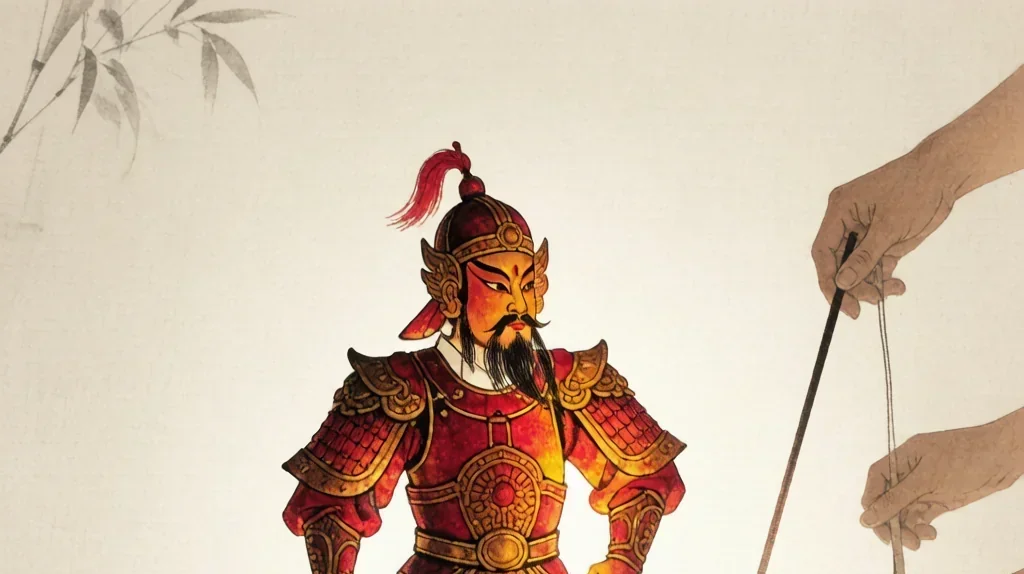
Behind a lit white screen, a translucent figure of a general raises a painted arm, his crimson armor glowing like stained glass as he charges into battle to the beat of a drum. The audience sees only his shadow, but the effect is uncanny: a flat scrap of hide has become a hero, weeping, fighting, and dying three feet tall. This is pí yǐng xì (皮影戏), Chinese shadow puppetry, one of the world's oldest forms of projected theater. For more than a thousand years it was the cinema of the Chinese countryside — cheap to stage, endlessly inventive, and capable of staging wars, ghosts, and gods with nothing but leather, light, and a singer's voice.
What Is Shadow Puppetry?
Shadow puppetry is a theatrical form in which flat, articulated figures are held between a light source and a translucent screen, so that their colored shadows are thrown onto the cloth for the audience to watch. The Chinese name pí yǐng xì means literally "leather shadow play," naming both the material (pi, hide) and the effect (ying, shadow). A typical performance takes place behind a frame stretched with bleached silk or, in modern times, fine cloth, lit from behind by an oil lamp or electric bulb; the puppeteer stands behind the screen manipulating the figures with slender rods while singing the dialogue and narration.
The art is sometimes called "the lantern-shadow play" (灯影戏, dēng yǐng xì) in reference to the lamp that gives it life. Unlike the opaque, jointed marionettes of European puppet theater, a shadow puppet is seen only as a silhouette, which frees the carver to concentrate on profile, costume, and gesture rather than three-dimensional modeling. The result is a peculiar, dreamlike beauty: faces in pure profile, robes flaring with every step, and battle scenes that a single performer can conjure with both hands.
Its exact origins are murky, but the art is popularly traced to the Han Dynasty through a famous anecdote. The Han Wu Di (汉武帝, Emperor Wu of Han, r. 141–87 BCE) was inconsolable after the death of his beloved concubine Lady Li (李夫人, Lǐ Fū Rén). A court magician named Shaoweng (少翁) is said to have hung a curtain, lit a lamp, and moved a cloth figure behind it so that the grieving emperor, seated at a distance, glimpsed her shadow swaying — the first shadow play. The story appears in the 3rd-century miscellany Xi Jing Za Ji (《西京杂记》), and while it is legend rather than history, it shows how early the Chinese imagined figures conjured from light.
The Leather Figures
The soul of the art is the puppet itself, and making one is a craft as demanding as performing with it. The finest figures are carved from donkey hide — young donkey skin is prized in the Shaanxi tradition for its thinness and clarity — though sheep and ox hide are also used. The raw hide is soaked, scraped of hair and flesh, stretched, and polished until it becomes a translucent, amber-colored membrane. Master carvers then trace the design and cut it with dozens of chisels and tiny engraving knives, punching out lacework patterns for armor, robes, and palace screens.
A figure is never one piece. The head, torso, upper arms, forearms, hands, and thighs are cut separately and joined with thread or horsehair so each limb articulates. The head alone is a work of characterization: a scholar has a calm, narrow face; a warrior a square jaw and bulging eyes; a clown a comically stretched grin. The cut surfaces are dyed with mineral and vegetable pigments — cinnabar red, malachite green, and soot black — and because the dye sits on translucent hide, the lit screen turns each puppet into glowing colored glass. A single exquisite figure can take a master carver a full working day, and troupes own cabinets of hundreds.
Not every part is colored. By convention the profile face is often left unpainted or very lightly tinted so the audience reads expression from the carved line, while the costume carries the color. Different regional schools favor different palettes: the Shaanxi (Shaanxi) style is bold and saturated, the Beijing style delicate and refined, the Sichuan style noted for its lively, sometimes comical faces. The puppets are fragile, and a touring troupe handles them like treasure.
Repertoire and Music
A shadow play is theater and concert at once. The standard repertoire overlaps almost entirely with that of Chinese opera, drawing on the great vernacular novels: the stratagems of the Romance of the Three Kingdoms (三国演义, Sān Guó Yǎn Yì), the brotherhood and rebellion of Water Margin (水浒传, Shuǐ Hǔ Zhuàn), the monsters and pilgrimage of Journey to the West (西游记, Xī Yóu Jì), and the palace tragedies of the various dynastic romances. A single troupe might know dozens of full-length plays and hundreds of short vignettes, performing an evening's show that could run three or four hours.
Music binds it together. The chief puppeteer usually sings all the roles in the local melodic style — the high, strained tones of Shaanxi's Hua'r (花儿) or the sweeter tunes of the east — while a small ensemble of drums (鼓, gǔ), gongs (锣, luó), and string instruments such as the erhu (二胡) and yueqin (月琴) sets the emotional temperature. Because one or two men may perform an entire cast of dozens, the puppeteer must switch voices, manipulate three or four figures at once, and keep the beat — a feat of concentration that veteran artists make look effortless. Special "vow-repaying" shows (还愿, huán yuàn) were once staged in the northwest to thank the gods after an illness passed or rain finally fell.
A Traveling Theater
For most of its history shadow puppetry was a poor troupe's theater. A company needed only a few wooden frames, a lamp, a bundle of puppets, and two or three musicians, so it could walk or cart from village to village, setting up in a temple courtyard, a threshing ground, or a private courtyard for a single night's wage plus a meal. This portability made it the most widespread popular entertainment in rural China, reaching regions — and dialects — that the great opera troupes never visited. In the dusty loess villages of Shaanxi and Gansu, the shadow play was the night's main event, drawing entire communities to sit on the dark side of the screen.
The troupe's social role went beyond amusement. Performances marked festivals, weddings, and funerals, and served as a kind of moving temple: the gods themselves were honored with opening sequences, and certain plays were believed to drive away pestilence or bring rain. Puppeteers were accordingly both entertainers and semi-ritual specialists, treated with a respect that sat oddly with their ragged, itinerant lives. The art traveled, too, along the Silk Road and by sea, seeding shadow traditions in Central Asia, Turkey, and ultimately Europe, where it may have informed the Turkish karagöz and, centuries later, the German and French "Chinese shadow" fashions of the 1700s.
UNESCO Heritage Today
By the late twentieth century, film, television, and migration had hollowed out the village audience that sustained shadow theater, and many regional styles risked vanishing. Recognition came in 2011, when UNESCO inscribed Chinese shadow puppetry (中国皮影戏, Zhōngguó pí yǐng xì) on the Representative List of the Intangible Cultural Heritage of Humanity. The citation praised it as a "treasure of the nation's folk culture" spanning more than twenty provinces, with distinct schools such as the Tangshan, Huanxian, and Weinan styles, each with its own carving, music, and dialect.
Today the art survives through designated master inheritors (传承人, chuán chéng rén), museum troupes, and school clubs. Contemporary experiments pair the ancient silhouettes with recorded sound, projection mapping, and new scripts, while purists keep the oil lamp and live singing alive in the villages. However it is staged, the essential magic is unchanged: a scrap of leather, a beam of light, and a storyteller's hands turning shadow into life.