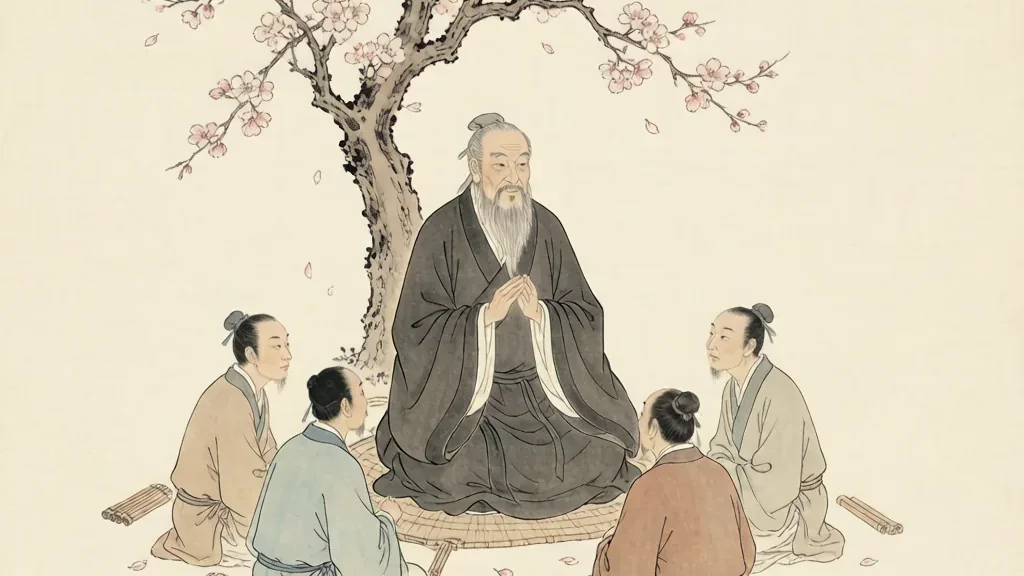
Few individuals in human history have influenced as many lives as Confucius. Born in 551 BCE in the small state of Lu, in what is now Shandong Province, Kong Qiu—later known to the world as Confucius—would grow to become the most important philosopher in Chinese history. His teachings on ethics, governance, family, and self-cultivation would shape East Asian civilization for more than two millennia, earning him the revered title "Teacher of Ten Thousand Generations."
Confucius lived during the tumultuous Spring and Autumn Period, an era when the once-mighty Zhou Dynasty had fractured into warring feudal states. It was a time of political chaos, social upheaval, and moral decay—conditions that deeply troubled the young Kong Qiu and set him on a lifelong mission to restore order and virtue to society. His solution was radical in its simplicity: if you want to fix the world, start by fixing yourself.
Humble Beginnings
Confucius was born into a family of minor nobility that had fallen on hard times. His father, Kong He, was a military officer who died when Confucius was just three years old. Raised by his mother Yan Zhengzai in poverty, the young boy developed a deep appreciation for learning and ritual from an early age. According to the Records of the Grand Historian by Sima Qian, as a child Confucius would arrange ritual vessels and imitate ceremonial gestures, showing an early fascination with the rites and traditions of the Zhou Dynasty.
Despite his family's poverty, Confucius pursued knowledge with relentless determination. He studied the Six Arts—rituals, music, archery, charioteering, calligraphy, and mathematics—and immersed himself in the ancient classics: the Book of Poetry, the Book of Documents, and the Book of Rites. He famously said, "In a hamlet of ten households, there are bound to be those who are my equal in doing their best for others and in being trustworthy in what they say, but they are unlikely to be as eager to learn as I am." This passion for learning would define his entire life.
To support himself and his family, Confucius worked various jobs in his youth—as a granary manager, a livestock keeper, and a bookkeeper. These humble occupations gave him firsthand experience with common people and their struggles, shaping his belief that good governance must serve the welfare of ordinary citizens, not just the interests of rulers.
The Wandering Teacher
By his thirties, Confucius had established himself as a respected teacher. He broke with tradition by accepting students from all social classes, not just the aristocracy. His school was open to anyone with a sincere desire to learn, and his curriculum emphasized moral development alongside practical knowledge. This democratic approach to education was revolutionary for its time and became a cornerstone of his philosophy.
Confucius did not see himself as creating new ideas but rather as transmitting the wisdom of the ancient sage-kings. He believed the early Zhou Dynasty represented a golden age of harmony and virtue, and he dedicated himself to reviving its cultural and moral traditions. "I transmit but do not create," he said. "I am faithful to and love the ancients." Yet in truth, Confucius was profoundly innovative in how he reinterpreted ancient traditions to address the problems of his own time.
In his fifties, Confucius briefly served in government positions in Lu, rising to the post of Minister of Crime. According to historical accounts, his policies were so effective that crime virtually disappeared and the state prospered. But his success aroused jealousy among rival officials, and political intrigue eventually forced him into exile. Thus began one of the most remarkable journeys in philosophical history: a fourteen-year odyssey through the warring states of ancient China.
Accompanied by a devoted band of disciples, Confucius traveled from state to state, offering his advice to any ruler who would listen. He faced hardship, danger, and rejection. On several occasions he was threatened, attacked, and nearly starved. In the state of Kuang, he was mistaken for a bandit and besieged by an angry mob. In Chen and Cai, he and his followers ran out of food and many fell ill. Yet through all these trials, Confucius remained calm and even cheerful, using every crisis as a teaching moment.
When a disciple asked him whether the Way of Heaven had abandoned them, Confucius replied: "The gentleman remains composed in the face of danger. The petty person, when in danger, will do anything to survive." These years of wandering tested and refined his philosophy, proving that virtue was not merely a matter of comfortable circumstances but a steadfast commitment that endured through the worst adversity.
The Five Core Virtues
At the heart of Confucian philosophy lie five constant virtues that form the foundation of ethical life. The most important of these is Ren (仁), often translated as benevolence, humaneness, or goodness. Confucius described Ren as loving others and treating them with compassion and respect. When asked to define it in a single word, he said: "Do not impose on others what you yourself do not desire"—a formulation remarkably similar to the Golden Rule found in many world religions.
The second virtue, Yi (义), means righteousness or justice—the moral disposition to do what is right regardless of personal cost. Confucius taught that the gentleman understands Yi, while the petty person understands only profit. This distinction between moral action and self-interest runs throughout his teachings and challenges each person to prioritize ethical conduct over material gain.
Li (礼), the third virtue, refers to ritual propriety, etiquette, and the proper performance of social roles. For Confucius, Li was not empty formalism but the external expression of inner virtue. When people perform rituals with sincerity, they cultivate their character and create social harmony. From family ceremonies to state functions, proper conduct in every situation reinforces the bonds that hold society together.
Zhi (智), wisdom or knowledge, is the fourth virtue—the ability to distinguish right from wrong and to understand the true nature of things. Confucius emphasized that true wisdom comes not from accumulating facts but from knowing what one does not know. "When you know a thing," he said, "to hold that you know it; and when you do not know a thing, to allow that you do not know it—this is knowledge."
The fifth virtue, Xin (信), means trustworthiness and integrity. Confucius compared a person without trustworthiness to a cart without a yoke—no matter how fine the cart may be, it cannot go anywhere. Keeping one's word and being reliable in all relationships is essential for both personal character and social order.
The Analects: A Living Legacy
Confucius never wrote a systematic treatise of his philosophy. Instead, his teachings were collected after his death by his disciples in a work known as the Lunyu, or Analects—a compilation of sayings, conversations, and anecdotes that has become one of the most influential books in world history. The Analects presents Confucius not as a remote sage but as a living, breathing human being: sometimes stern, sometimes playful, always thoughtful, and deeply committed to his ideals.
The book opens with one of its most famous passages: "Is it not a pleasure to learn and to practice what one has learned? Is it not delightful to have friends coming from afar? Is it not a gentleman not to take offense when others fail to appreciate his abilities?" These opening lines capture the essence of Confucian optimism: the joy of learning, the warmth of friendship, and the inner security of virtue.
Throughout the Analects, Confucius emphasizes self-cultivation as the foundation of all social improvement. The ruler who governs himself can govern others; the parent who cultivates virtue raises virtuous children; the friend who acts with integrity inspires integrity in friends. This focus on personal responsibility as the starting point for social change remains one of Confucianism's most powerful ideas.
Education features prominently in the Analects. Confucius believed that all people are fundamentally similar by nature but become different through practice and learning. He championed the transformative power of education, insisting that anyone—regardless of birth—could become a gentleman through study and self-discipline. This meritocratic ideal would later inspire China's famous civil service examination system, which for centuries selected government officials based on their knowledge of Confucian classics rather than their family connections.
The Five Relationships
Confucius taught that human society is built upon five fundamental relationships, each with reciprocal obligations that create a web of mutual responsibility. These relationships are: ruler and subject, parent and child, husband and wife, elder sibling and younger sibling, and friend and friend. Notably, four of the five are hierarchical, but all are reciprocal—the superior party in each relationship has duties to the inferior, just as the inferior has duties to the superior.
The most important of these relationships, in Confucian thought, is that between parent and child, embodied in the virtue of filial piety (孝, Xiao). Confucius taught that love and respect for one's parents is the root of all virtue. A person who is genuinely filial will naturally extend that care to siblings, friends, community members, and eventually to all humanity. This idea that moral development begins in the family and radiates outward remains central to Chinese culture today.
However, filial piety in the Confucian sense is not blind obedience. Confucius explicitly taught that children should gently remonstrate with parents who are about to do wrong. The duty is to care for parents, to respect them, and to honor them—but also to help them stay on the path of virtue. This nuanced understanding distinguishes genuine filial devotion from mere compliance.
Final Years and Enduring Influence
In 484 BCE, after fourteen years of wandering, the sixty-eight-year-old Confucius was invited back to Lu. He spent his final years teaching, editing the ancient classics, and writing a history of his home state called the Spring and Autumn Annals. According to tradition, when he learned that a mythical qilin—a creature said to appear only during the reign of a virtuous ruler—had been captured and killed, he understood that his hopes for reforming the world would not be realized in his lifetime. He died in 479 BCE at the age of seventy-two.
Confucius himself did not live to see his teachings transform China. But within a few centuries, Confucianism became the official state ideology, and the humble teacher from Lu was elevated to the status of China's greatest sage. Temples were built in his honor across the country. His descendants—the Kong family—became the longest continuously documented family line in history, maintaining their ancestral home in Qufu for over eighty generations.
The influence of Confucianism extends far beyond China's borders. Korea, Japan, Vietnam, and other East Asian societies all absorbed Confucian values and adapted them to their own cultures. The emphasis on education, family loyalty, social harmony, and moral self-cultivation has shaped the ethical framework of a civilization encompassing nearly a quarter of the world's population.
In the modern era, Confucius has experienced both condemnation and revival. Twentieth-century revolutionaries denounced him as a symbol of feudal oppression. Yet his ideas have proven remarkably resilient, and today Confucianism is experiencing a renaissance both in China and globally. Confucius Institutes around the world promote Chinese language and culture. Business leaders study the Analects for insights into ethical leadership. And ordinary people continue to find wisdom in the simple, profound teachings of a man who believed that the path to a better world begins with the cultivation of a better self.
Confucius and the Classics
Confucius saw himself not as an inventor of ideas but as a transmitter of the Zhou heritage, and he devoted his later years to editing the ancient texts. He is credited with shaping the Five Classics, the Book of Poetry, the Book of Documents, the Book of Rites, the Book of Changes, and the Spring and Autumn Annals, a body of works that became the core curriculum of Chinese education. By selecting and arranging these texts, he fixed the shape of the tradition later readers would inherit. The classics gave his ethics a scripture, and his editorial hand is why the Zhou past spoke so directly to imperial China. To study with Confucius was, above all, to study these books.
Confucius's Idea of the Gentleman
The junzi, or gentleman, stands at the center of Confucius's moral vision. Unlike the petry person who chases profit, the gentleman cultivates ren, acts from righteousness, and performs his duties with ritual propriety. He begins with self-discipline at home and extends care outward to community and state, leading by example rather than by force. Crucially, the gentleman is made, not born; anyone who studies and practices can become one, which is why Confucius opened his school to all classes. This ideal gave China a standard of character that outlasted dynasties, a measure by which officials, parents, and rulers were judged, and a quiet answer to the question of how a good society is built, one person at a time.