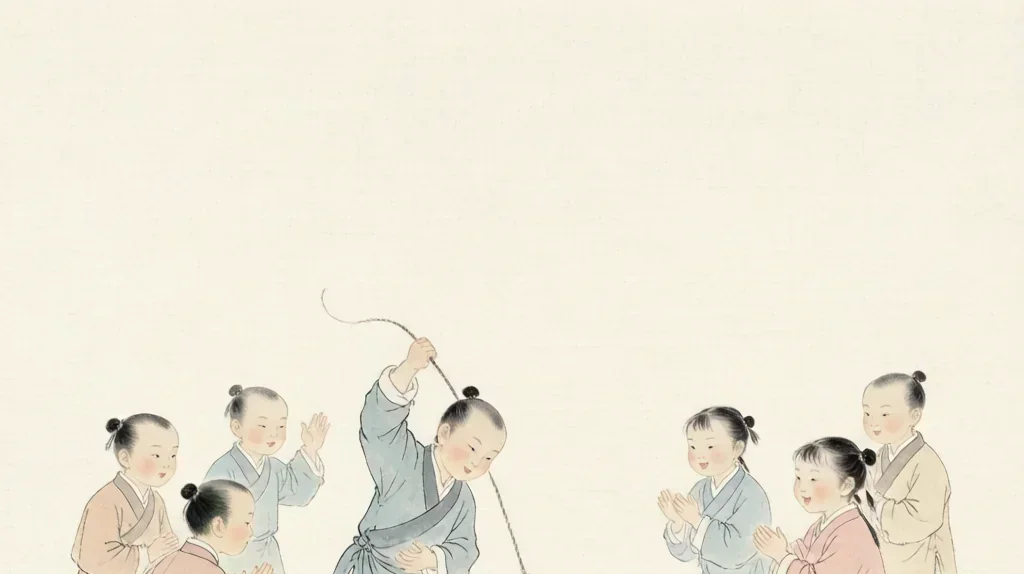
A wooden top spins on a single point, humming as it defies gravity, and a crowd of children cheers. The tuó luó (陀螺), or spinning top, is one of the oldest toys on earth and a cherished pastime in China for well over two thousand years. From humble village courtyards to the imperial court, the spinning top has delighted generations. It matters not only as play but as a living demonstration of physics—angular momentum, friction, and stability—that children absorb long before they learn the formulas.
A Very Old Toy
Spinning tops appear in the archaeological record across many ancient cultures, and in China they are documented as early as the Han dynasty, with descriptions and illustrations growing common by the Tang and Song periods. Tomb figurines and old texts show tops being whipped with a string to keep them spinning, much as children do today. The toy's simplicity—a weighted body and a pointed tip—made it easy to carve from any scrap of wood or bone.
Because a top needs no special material or technology, it spread through every stratum of society. Farmers' children turned them in dusty lanes; courtiers collected elaborately lacquered and inlaid examples. The continuity of the top across millennia is a testament to the universal appeal of watching something spin, a fascination that seems hardwired into human curiosity about motion and balance.
How a Top Is Made and Played
A traditional Chinese top is commonly pear-shaped or conical, with a heavy wooden body tapering to a metal or hardened point at the bottom. The player wraps a cord around the body, then jerks it free to set the top spinning, often on a smooth stone or paved surface. A variant called the "beat top" (抽陀螺, chōu tuó luó) is whipped repeatedly with a switch to keep it upright and moving, turning solitary play into a lively contest of endurance.
In competitive play, children try to keep a top spinning the longest, or to knock opponents' tops out of a ring, or to land a spinning top onto a narrow target. The satisfying crack of the whip and the whir of the wood have made the top a fixture of winter festivals in northern China, where hard frozen ground provides the perfect stage. The skill lies in the launch: too weak and the top topples, too wild and it flies away.
The Physics of Spinning
The top is a textbook example of rotational motion. Once spinning, it gains angular momentum, and the conservation of that momentum makes it resist toppling—a property called gyroscopic stability. As friction at the tip slowly drains energy, the spin axis begins to wobble in a slow circle, a motion physicists call precession. The faster the initial spin, the longer and steadier the top remains upright.
This is why a top seems to "stand up" as it spins yet falls the instant it stops: the live rotation is what holds it. Children who grow up whipping tops are intuitively learning about torque, friction, and stability decades before they meet those words in a classroom. The toy is, in effect, a portable physics laboratory, and cultures around the world have used it exactly that way.
Regional and Festival Traditions
In many parts of China the top is tied to seasonal play. In the north, the cold months are prime top season, since frozen earth lets tops spin fast and long; markets sell brightly painted tops before the Lunar New Year. In some regions, tops are lit from within with a small candle or glowing ember, so that at night they trace rings of fire—a magical sight that blends toy and lantern.
The top also appears in folk sayings and moral lessons, where a person "busy as a spinning top" captures the feeling of endless motion. Because the toy is cheap, robust, and social, it has long served as a bridge between ages and classes, with elders and youngsters spinning side by side during festivals. Its presence in seasonal celebration keeps the tradition alive even as electronic toys multiply.
Top Play Around the World
China is far from alone in loving the top. Similar toys appear in India, the Middle East, Europe, and the Americas, each with local names and styles—the Jewish dreidel, the Turkish dampul, the Filipino trumpo. The shared human delight in the spinning form suggests something deep about how we relate to balance and chance. Comparative play reveals both universal physics and unique cultural flourishes.
Studying tops across cultures also shows how a single idea mutates: some are launched by string, others by a pull-cord through the center, others still by a pump-action plunger. The Chinese whip-top tradition is distinctive for the active, noisy, athletic style of play it encourages. This global family of toys makes the tuó luó both a本地 treasure and a citizen of the world.
Why the Spinning Top Still Charms
In a digital age, the spinning top offers an analog joy that never goes stale: the suspense of a wobble, the triumph of a long spin, the tactile snap of the whip. It costs almost nothing, needs no screen, and works anywhere there is flat ground. For parents it is a gentle way to pull children outdoors and into motion, building coordination without a single instruction manual.
More than nostalgia, the top teaches patience and observation—you cannot rush a good launch, and you must read the surface and the wind. The tuó luó thus remains a small but profound teacher, spinning the laws of the physical world into the hands of each new generation, and reminding us that the oldest toys are often the wisest.
Top Spinning as a Contest
From the start, the top has been a competitive toy. The simplest contest is endurance: who can keep a top whirling longest before friction wins. A livelier version sets two or more tops in a ring and dares players to knock rivals out with a well-aimed launch or a stinging whip strike. In the whip-top tradition, the goal shifts to keeping a single top alive through a storm of strokes, the cracked rhythm itself a kind of music. Some games add a target—a narrow post or a marked stone—rewarding precision over power. These contests need almost nothing: flat ground, a cord, and a top. That low cost is exactly why top-spinning competitions have persisted in village lanes and schoolyards for centuries, giving children a real sport that asks only for a steady hand and a bit of open space.
The Top in Language and Folklore
The spinning top has spun its way into language as well as play. The Chinese phrase for someone frantically busy compares them to a turning top, capturing the feeling of endless, purposeless motion that anyone who has watched a wobbling toy will recognize. Folk sayings and children's rhymes across regions use the top as a tiny symbol of effort and balance, and the satisfying crack of the whip marks the rhythm of winter afternoons in the north. In some places a finely made top was a child's prized possession, handed down or won in play, carrying memories long after the wood wore smooth. Because the toy is so old and so common, it became a shared reference point—a small, humming object that generations have used to talk about hurry, steadiness, and the strange pleasure of watching something spin.
❓ Frequently Asked Questions
📝 Chinese Vocabulary
陀螺 — : spinning top.
抽陀螺 — : to whip a spinning top.
转 — : to spin; to rotate.
木 — : wood; wooden.
稳 — : steady; stable.
尖 — : the pointed tip of a spinning top
鞭 — : the whip or switch used to keep a top spinning
陀螺赛 — : a top-spinning contest
🎉 Fun Facts
- Spinning tops are documented in China as early as the Han dynasty, over two thousand years ago.
- The "beat top" is whipped with a switch to keep it spinning, turning play into a noisy athletic contest.
- Some Chinese tops carry a small candle so they draw rings of fire when spun at night.
- A top demonstrates gyroscopic stability and precession, core concepts in physics.
- Carved wooden tops are often painted with bright spirals or faces, so the pattern blurs into a spinning disc—a simple optical effect children love.
- The whip-top tradition is distinctive enough that it is demonstrated at folk-sports festivals alongside the diabolo and shuttlecock kicking.