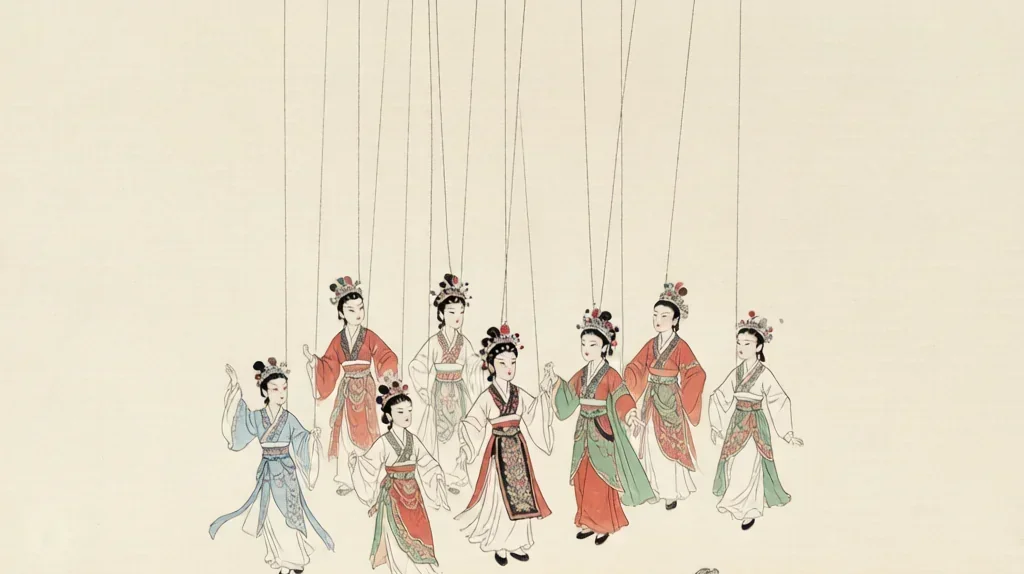
Chinese puppet theatre, known generally as mu'ouxi (木偶戏), is a theatrical tradition in which carved and costumed figures—rather than living actors—act out stories through the hands of skilled manipulators. For well over a thousand years, puppets have entertained Chinese audiences with versions of the same legends, romances, and comedies seen on the opera stage, often in towns too small to support a full troupe of human performers. The art combines sculpture, costume, music, and sleight-of-hand into one of the most beloved forms of folk entertainment.
Origins and Early History
The earliest Chinese puppets appear in records from the Han dynasty, when mechanical figures amused courts and funeral rites sometimes used effigies. By the Tang and Song dynasties, puppet shows had become a popular urban entertainment, with markets hosting performances that drew crowds of all ages.
Song-dynasty texts describe puppet troupes staging full plays with singing and dialogue, showing that the art had already grown beyond simple novelty into a narrative theatre. It traveled along trade routes and waterways, taking root in distinct regional styles.
Through the Ming and Qing dynasties, puppet theatre flourished in the countryside, where a single puppeteer and a small band could bring opera to villages that rarely saw live actors.
Three Great Families of Puppets
Chinese puppet theatre is usually divided by how the figure is controlled. Marionettes (提线木偶, tixian mu'ou) hang from strings worked above the stage; rod puppets (杖头木偶, zhangtou mu'ou) are moved by rods held from below; and glove or hand puppets (布袋木偶, budai mu'ou) are worn on the performer's hand like a mitten.
Each type suits different stories and spaces. Marionettes excel at graceful, floating motion; rod puppets can be large and bold for open-air shows; glove puppets are intimate and quick, perfect for small teahouse stages.
Regional specialties emerged: Fujian is famed for its Quanzhou marionettes, while Guangdong and Fujian both cherish glove-puppet traditions that mix speech, song, and clapper music.
Marionettes and the Quanzhou Tradition
The marionette tradition of Quanzhou in Fujian is among the most celebrated. Its figures are controlled by many fine strings, allowing subtle gestures—sipping tea, writing, or weeping—that astonish first-time viewers.
Quanzhou marionette theatre preserves ancient melodies and a repertoire of ritual and historical plays, and its performers undergo long apprenticeships to learn both the manipulation and the accompanying music. The art is recognized as a treasure of intangible heritage.
Because the puppets seem to live, audiences often forget the strings, surrendering to the illusion of miniature people with their own will.
Rod Puppets and Glove Puppets
Rod puppets, operated by a central rod and two hand rods, dominate many northern and central traditions. Their larger size and sturdy construction make them readable in big outdoor venues, and their movements can be forceful and comic alike.
Glove puppets, by contrast, fit in a single hand and are staged in a small booth, often with a single performer speaking all roles. This form thrives in the southeast, where it blends local dialect, clapper music, and snappy comic timing.
Together the three families show how one idea—the animated figure—splits into radically different performance cultures across China.
Repertoire and Stories
Puppet theatre borrows heavily from Chinese opera and folklore. Well-known tales of gods, generals, and lovers fill the programs, letting puppet troupes stage the same classics admired on the human stage.
Some plays are comic satires of officialdom or domestic life, delighting villagers with recognizable folly. Others are moral or ritual dramas performed at festivals to invite fortune or honor ancestors.
The puppet's small scale invites exaggeration: a tiny gesture reads as grand emotion, and stylized combat becomes balletic rather than brutal.
Music and Voices
Like opera, puppet shows are sung and accompanied by an ensemble of strings, winds, and percussion. The manipulator or a separate singer provides the voices, often shifting rapidly between characters of different age and sex.
In glove-puppet theatre a single artist may speak, sing, and beat percussion at once, a feat of coordination that defines the art. Regional puppet music follows local opera tunes, so a Fujian show sounds quite different from a northern one.
The close tie between puppet and opera music means the two arts have long shared musicians, melodies, and even plays.
Craft of the Puppets
A puppet is itself a work of folk art. Carvers shape the head from wood, painting features that encode character—round faces for clowns, painted patterns for warriors. Costumers dress the figure in scaled-down robes with the same symbolism as opera costume.
Hands and sometimes feet are jointed for gesture, and the internal control system—strings or rods—is engineered for the specific effects a play demands. A fine puppet can take weeks to build and is repaired and repainted across generations.
The maker's craft and the performer's skill are inseparable; a beautiful figure in clumsy hands stays lifeless, while a master can animate even a simple one.
Puppets, Ritual, and Community
In many regions puppet theatre was more than entertainment; it was part of religious and life-cycle events. Troupes were hired for temple festivals, weddings, and funerals, their plays believed to please deities or guide spirits.
This ritual role gave puppet theatre a respected place in village life and helped preserve old plays and tunes that might have faded from the opera stage. Even today some communities invite puppet shows for auspicious occasions.
The intimacy of a small booth, lit by a single lamp, made the puppet show a gathering point where a neighborhood met, laughed, and remembered its stories.
Puppet Theatre Today
Modern China supports professional puppet theatres in major cities, alongside vigorous folk traditions in the southeast. Television and film have carried puppet art to new audiences, and some troupes experiment with larger stages and contemporary scripts.
Heritage programs fund masters to teach the next generation, since string and rod technique demand years of practice. International tours have also introduced Chinese puppetry to global festivals.
Whether as village ritual or urban spectacle, the carved figure still moves audiences with the oldest magic of theatre: the illusion of life breathed into wood.
❓ Frequently Asked Questions
Q: What is Chinese puppet opera (Muouxi)?
A: Chinese puppet opera (木偶戏, mù'ǒu xì) is a traditional performing art where puppets are manipulated to act out stories accompanied by music and singing. It has a history of over 2,000 years and includes several regional styles and puppet types.
Q: What are the main types of Chinese puppets?
A: The main types are: string puppets (提线木偶, controlled by strings from above), rod puppets (杖头木偶, controlled by rods from below), glove puppets (布袋木偶, worn like hand puppets), and shadow puppets (皮影戏, flat cut-out figures against a screen).
Q: Where in China is puppet opera most popular?
A: Fujian Province is the center of Chinese puppet opera, especially Quanzhou's string puppets and Zhangzhou's glove puppets. Guangdong, Hunan, and Shaanxi also have strong puppet traditions. Quanzhou's puppetry has been recognized as a UNESCO Intangible Cultural Heritage.
Q: What stories are typically performed in puppet opera?
A: Common repertoire includes historical epics (e.g., 'Romance of the Three Kingdoms'), Buddhist tales, folk legends, and mythical adventures. Puppet operas often have moral lessons and are performed during temple festivals, weddings, and community celebrations.
Q: What is Chinese puppet theatre?
A: Mu'ouxi is a tradition in which carved, costumed puppets act out stories through skilled manipulation, accompanied by singing and music much like Chinese opera.
Q: What kinds of puppets are used?
A: The three main families are marionettes (string-controlled), rod puppets (rod-controlled from below), and glove puppets (worn on the hand).
Q: How old is the art?
A: Puppet-like figures appear in Han records, and by the Song dynasty troupes staged full narrative plays for urban audiences.
Q: What stories do they tell?
A: Repertoires borrow from opera and folklore—tales of gods, generals, lovers, and comic domestic satire—sometimes with ritual purpose.
Q: Who provides the voices?
A: A singer or the manipulator himself voices the characters, often shifting between roles, while an ensemble plays the music.
Q: Is puppet theatre still performed?
A: Yes. Professional city theatres, southeastern folk troupes, and heritage programs keep it alive, with tours and media reaching new audiences.