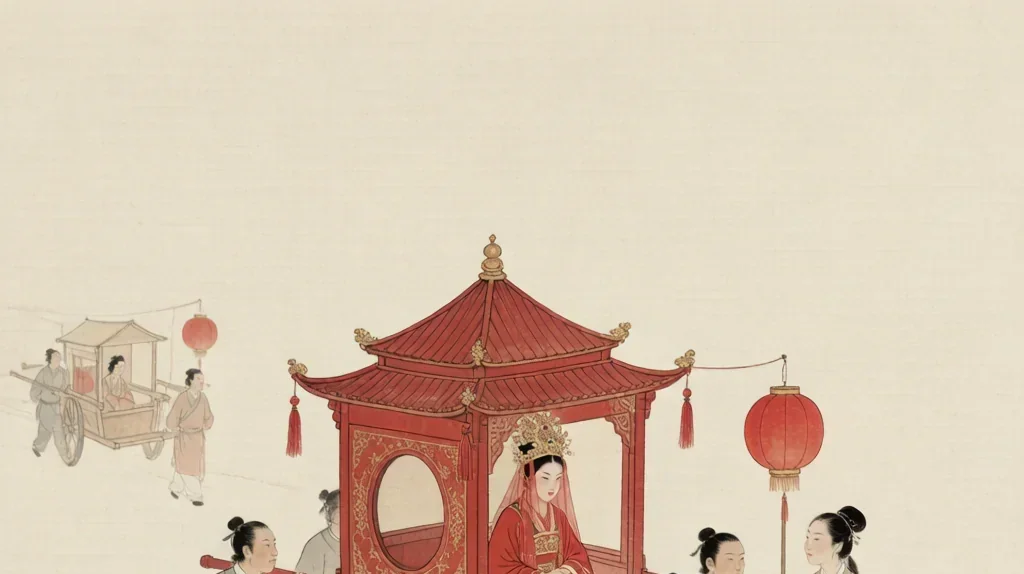
Among the life rituals of China, none is more lavishly staged than the wedding (婚礼, hūn lǐ). For most of Chinese history marriage was not a private romance but a bond between two lineages, charged with the duty of continuing the family line and honoring ancestors. The classical framework was the "Three Letters and Six Rites" (三书六礼, sān shū liù lǐ), a sequence of negotiations, gifts, and ceremonies that could stretch over a year. Although urban couples today often condense or skip steps, the visual grammar of the Chinese wedding — red everywhere, a weeping bride, a feast of meaning-laden dishes — survives in both village courtyards and five-star hotel ballrooms. This article follows the journey from the first matchmaker's visit to the modern hybrid ceremony, showing how each custom carries a wish for fertility, harmony, and prosperity.
Matchmaking and Fortune
In imperial and early republican China, the initiative for a marriage seldom came from the young couple. Instead a matchmaker (媒人, méi rén) — usually a garrulous older woman who knew every eligible son and daughter in the district — carried proposals between families. Her first task was to compare the eight characters (八字, bā zì) of the bride and groom: the year, month, day, and hour of each birth, written in heavenly stems and earthly branches. A fortune teller (算命先生, suàn mìng xiān sheng) examined whether the couple's elements clashed. A famous superstition held that a bride born in the "zhen" year and groom in the "shu" year were incompatible, and many a match was broken on such arithmetic.
The families weighed more than chemistry. They assessed the four pillars of a good match: family standing (门当户对, mén dāng hù duì, literally "matching doors and facing households"), the bride's industriousness, the groom's exam prospects or trade, and the absence of taboo surnames — marriage between people sharing a surname was long forbidden as tantamount to incest. Once both sides agreed in principle, the groom's family dispatched the first of the three letters, the "Request for the Girl's Name" (纳采, nà cǎi), often accompanied by a live goose, a bird famed for its lifelong pairing. The goose (雁, yàn) became a standard betrothal token because wild geese mate for life and fly in orderly formation, modeling the loyalty and hierarchy expected of a wife.
Fortune also dictated the wedding date. The "almanac" (通胜, tōng shèng) listed auspicious days, and families avoided months containing the Qingming tomb-sweeping festival or the couple's own birth months. Even today many Chinese couples in Hong Kong, Taiwan, and mainland cities consult a fortune teller or a Tong Shu app to pick the hour of the tea ceremony and the direction from which the bride should enter.
Betrothal Gifts (Guo Da Li 过大礼)
The formal betrothal culminates in Guo Da Li (过大礼, guò dà lǐ), the "grand presentation of gifts," in which the groom's family delivers a carefully enumerated trousseau to the bride's home. The centerpiece is the bride price (聘金, pìn jīn), cash in a lucky red packet, but the symbolic goods matter more. A roasted pig (烧猪, shāo zhū) signals that the bride is virtuous; if returned whole, it confirms her family's pride. Families also exchange pairs: a pair of longan (龙眼, lóng yǎn) and red dates (红枣, hóng zǎo) for fertility, a pair of lotus seeds (莲子, lián zǐ) for sons in succession, and a pair of "hair-growing" items such as a comb set.
The gift list follows an old numerical code. Six, eight, and nine are favored — six for smooth progress (六六顺, liù liù shùn), eight for prosperity (发, fā), nine for longevity (久, jiǔ). The bride's return gifts (回礼, huí lǐ) are equally choreographed: she sends back a portion of the roast pig, a set of man's clothing to show she will clothe her husband, and a pair of shoes, sealing the reciprocity. In Cantonese communities the exchange is so formal that specialist shops in Hong Kong's Mong Kok sell pre-packed "Guo Da Li" baskets with every required item labeled in gold calligraphy.
The dowry (嫁妆, jià zhuāng) the bride brings is displayed publicly, sometimes carried in a procession of lacquered cases. It includes bedding embroidered with double happiness (喜, xǐ), a pair of red candles, and — in northern villages — a "daughter's trunk" (嫁妆箱, jià zhuāng xiāng) filled with her own clothes and sewing. The display is a quiet competition of family honor: the richer the dowry, the more face (面子, miàn zi) the bride's family earns.
The Wedding Day Rituals
On the morning of the wedding the bride's "good-luck woman" (好命婆, hǎo mìng pó) — a relative with living parents, a husband, and children — dresses her and combs her hair in four strokes, chanting: "May you be united in marriage from now till old age." The bride's face is sometimes painted with a red "mandarin duck" (鸳鸯, yuān yāng) pattern, and she may wear a "phoenix crown and robes of glory" (凤冠霞帔, fèng guān xiá pèi), a costume borrowed from Ming-dynasty court dress. In southern Fujian the bride's feet must not touch the ground between her old home and the sedan, so she is carried on a "sedan board" (筛, shāi).
The departure is staged as reluctance. Traditional brides weep at the gate to show gratitude to their parents (哭嫁, kū jià), and in some Tujia communities of Hunan the weeping song is an improvised poetry performed for days. The groom's procession arrives with a red bridal sedan (花轿, huā jiào) borne by four or eight men, led by a suona (唢呐) horn player whose piercing music is said to drive off jealous spirits. At the groom's gate the couple performs the central rite: the bow to heaven and earth (拜天地, bài tiān dì), followed by bows to the groom's parents and to each other. Only after these three bows is the marriage socially real.
One beloved comic episode is the "door games" (闹门, nào mén) or "bridal chamber mischief" (闹洞房, nào dòng fáng), in which the groom's friends bar the wedding chamber and subject the couple to teasing riddles and silly tasks before letting them in. Far from crude, the custom was justified as a way to break the strangers' awkwardness and, in a practical vein, to ensure many witnesses to the union. The night ends with the couple sharing "wedding noodles" (喜面, xǐ miàn) and the bride secretly slipping a dollar or a red thread into the groom's shoe for luck.
Colors and Symbols (Red, Dragon & Phoenix)
No Chinese wedding is conceivable without red (红, hóng). The color has denoted celebration and warded off malevolence since the Han dynasty; at a wedding it saturates the invitations, the gate couplets, the bride's gown, and the bed curtains. The double-happiness character (囍, shuāng xǐ) — two 喜 joined — is pasted on doors and stitched into linens, invented according to legend by the Tang scholar Guo Li during a royal wedding when he saw two magpies alight on a plum branch.
The ruling iconography pairs the dragon and phoenix (龙凤, lóng fèng): the dragon (龙, lóng) stands for the groom's active yang energy and imperial authority, the phoenix (凤, fèng) for the bride's graceful yin. Embroidered together on the wedding jacket (龙凤褂, lóng fèng guà) or printed on the banquet menu, they announce a balanced union. Pomegranate, with its many seeds, and the mandarin duck (鸳鸯, yuān yāng), which pairs for life, repeat the fertility wish on everything from pastries to paper cuttings (剪纸, jiǎn zhǐ) decorating the windows.
Food carries the same code. The banquet opens with a whole fish (鱼, yú), homophone for surplus (余, yú), served intact to promise abundance. Lotus seeds and lily bulbs (百年好合, bǎi nián hǎo hé, "a hundred years of harmony") appear in sweet soups, while the "dragon and phoenix soup" pairs prawns and chicken. Even the wedding cake, in modern Sino-Western receptions, is often a red velvet or a "double happiness" fondant tier.
Modern Blends
Since the late 20th century Chinese weddings have become a fertile hybrid. In major cities a couple may register at the civil affairs bureau (民政局, mín zhèng jú) in the morning, wear Western white at a church-style ceremony at noon, and change into a red qipao (旗袍, qí páo) for the evening banquet — sometimes all three outfits in a single day. The white gown, once a taboo, is now embraced as fashion, while the red dress remains the non-negotiable banquet look.
Technology has rewritten the customs without erasing them. Digital red envelopes (微信红包, wēi xìn hóng bāo) flow through group chats, and "cloud weddings" (云婚礼, yún hūn lǐ) broadcast on livestream during the 2020 pandemic let overseas relatives witness the tea ceremony. Yet the old bones persist: a 2023 survey in Shanghai found that over 80 percent of couples still held a formal tea ceremony and served the four-joy dumplings (四喜饺, sì xǐ jiǎo). The rituals have loosened, but their grammar — red, family, fertility, and face — remains the emotional core of a Chinese wedding.