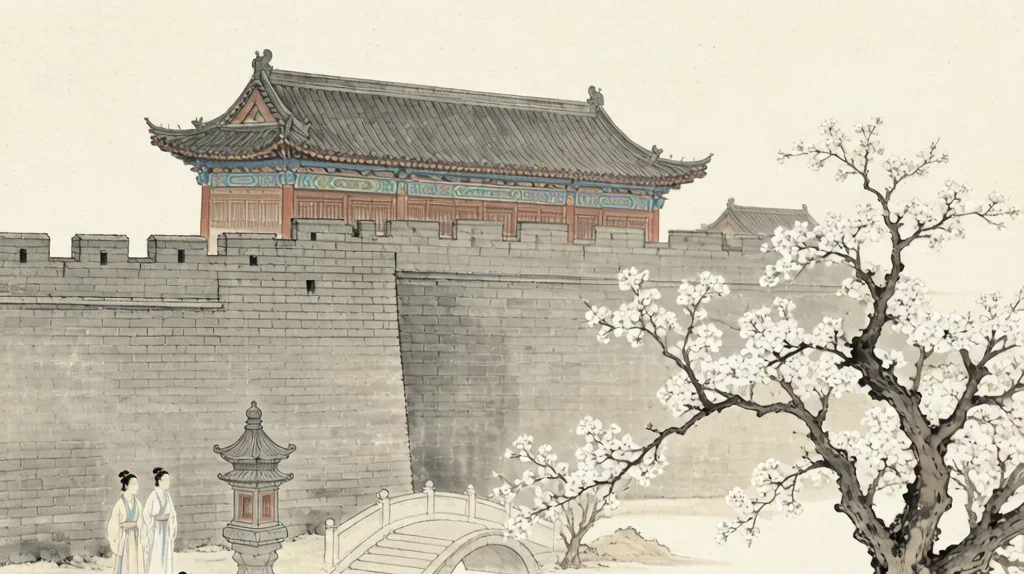
Walk through any major Chinese city today, and you might spot something unexpected among the sea of jeans and T-shirts: young people gliding through parks and ancient streets in flowing robes with wide sleeves and crossed collars. This is hanfu (汉服), the traditional clothing of the Han Chinese people, and it is experiencing one of the most remarkable cultural revivals of the twenty-first century. But hanfu is far more than a fashion trend — it is a garment system with over four thousand years of history, deeply embedded with Chinese philosophy, social structure, and artistic expression.
Legendary Origins: From the Yellow Emperor to Ritual Order
According to Chinese tradition, hanfu traces its origins to the Yellow Emperor (黄帝, Huáng Dì), the mythical sage-king who is said to have ruled around 2700 BCE. Ancient texts credit the Yellow Emperor's consort, Leizu (嫘祖), with the invention of sericulture — the cultivation of silkworms for silk production — which provided the material foundation for Chinese clothing. The Yellow Emperor himself is described as having "hung down his garments and the world was governed" (垂衣裳而天下治), a phrase from the I Ching (易经) that connects proper dress with cosmic order and effective rule.
During the subsequent Shang Dynasty (1600–1046 BCE), archaeological evidence from royal tombs reveals that the basic silhouette of hanfu was already taking shape: a wrapped robe secured with a sash, featuring the distinctive cross-collar (交领, jiāo lǐng) that folds from left to right across the chest. This right-over-left closure, known as yòu rèn (右衽), became one of the most enduring and culturally significant features of hanfu. In fact, left-over-right closure (zuǒ rèn, 左衽) was associated with non-Han peoples and with dressing the dead for burial — a distinction so important that Confucius himself remarked upon it.
The Zhou Dynasty: Codifying Clothing as Civilization
The Western Zhou Dynasty (1046–771 BCE) saw the systematic codification of clothing as an instrument of social order. The Rites of Zhou (周礼, Zhōu Lǐ) established detailed dress codes that governed every aspect of attire: colors, fabrics, patterns, and accessories all corresponded to rank, occasion, and season. This was the birth of the Chinese concept that clothing was not merely functional or decorative, but an expression of lǐ (礼) — ritual propriety and civilized behavior.
Two foundational garments emerged during this period. The upper garment was the yī (衣), a loose, open-sleeved jacket. The lower garment was the cháng (裳), a narrow, ankle-length wrap skirt. Together, yī cháng (衣裳) became the basic vocabulary of Chinese dress, and the word yī shang eventually evolved into the general term for clothing in modern Chinese. The two-piece construction also reflected the Chinese cosmological view: the upper garment represented Heaven (天, tiān), while the lower garment represented Earth (地, dì).
Evolution Through the Dynasties
The basic hanfu silhouette evolved significantly over successive dynasties, absorbing foreign influences while maintaining core design principles. During the Han Dynasty (206 BCE–220 CE) — from which the term "hanfu" derives — the shēn yī (深衣, "deep clothing") became popular. This was a one-piece robe where the upper jacket and lower skirt were sewn together into a single garment, wrapped deeply around the body. The qu jū (曲裾) variant featured an extended front panel that spiraled around the body, creating elegant, overlapping lines.
The Tang Dynasty (618–907 CE) represented a high point of cosmopolitan fashion. Tang women wore high-waisted skirts tied above the bust with short, open-front jackets, and the period's openness to foreign influence brought Persian and Central Asian motifs into Chinese clothing. Court ladies' attire from Tang paintings shows extraordinary boldness of color and pattern — crimson silks, golden embroidery, and diaphanous outer robes that spoke of confidence and cultural flourishing.
The Song Dynasty (960–1279 CE) swung the pendulum toward restraint and refinement. Song scholars favored simple, elegant robes in muted colors, reflecting the neo-Confucian emphasis on inner virtue over outward display. The bèi zǐ (褙子), a long, straight-collared outer jacket, became a staple of Song women's fashion. Meanwhile, the Ming Dynasty (1368–1644 CE) restored Han clothing traditions after the Mongol-led Yuan period and produced some of the most elaborate hanfu in history, with intricate rank badges (补子, bǔ zǐ) that identified officials' positions through embroidered animal symbols.
Design Elements and Their Meanings
Several key design elements distinguish hanfu from other East Asian clothing traditions. The cross-collar (交领, jiāo lǐng) is perhaps the most recognizable feature — two diagonal bands of fabric that cross at the chest, with the right side wrapping over the left. This design was believed to follow the natural flow of energy in the body and symbolized the wearer's participation in civilized order. Wide sleeves (广袖, guǎng xiù) served both aesthetic and practical functions: they created elegant lines when in motion and could hold small objects, functioning almost like pockets. The sash (腰带, yāo dài) secured the garment and often carried symbolic ornaments such as jade pendants, which served as audible reminders to walk with dignity — the jade pieces would clink together if one moved too hastily.
Colors in hanfu were never arbitrary. The Five Colors corresponded to the Five Elements (五行, wǔ xíng): blue-green for Wood, red for Fire, yellow for Earth, white for Metal, and black for Water. Yellow was reserved for the emperor, while officials' rank determined which colors and patterns they could wear. Common people typically wore undyed hemp or cotton in natural tones, though sumptuary laws were often honored more in breach than observance as the merchant class grew wealthier.
The Modern Hanfu Revival
The story of hanfu took a dramatic turn during the Qing Dynasty (1644–1912), when the Manchu rulers imposed their own clothing styles — including the qipao and the magua jacket — and Han Chinese clothing traditions were suppressed. For centuries afterward, hanfu survived only in theatrical costumes, religious vestments, and historical reenactments. Many people in China grew up without ever seeing hanfu worn in daily life.
That changed in the early 2000s, when a grassroots movement began advocating for the revival of hanfu as everyday wear. What started as a niche interest among history enthusiasts and college students has exploded into a nationwide phenomenon. Today, hanfu enthusiasts — known as tóng páo (同袍, "fellow robe-wearers") — gather for festivals, photo shoots, and cultural events. Major cities host hanfu fashion weeks, and the industry has grown into a multi-billion-yuan market. Young Chinese wear hanfu not as costume but as a statement of cultural identity and pride.
The revival is not without controversy. Debates rage within the community about historical accuracy versus modern adaptation, about which dynastic styles are "authentic," and about whether hanfu should remain ceremonial or truly become streetwear. Yet these very debates reveal something essential: hanfu is alive again, a living tradition rather than a museum piece. Whether worn to a tea ceremony, a wedding, or simply a Sunday stroll through the park, each hanfu robe connects its wearer to four millennia of Chinese civilization — one crossed collar at a time.
Men's and Women's Hanfu: Different Silhouettes
Although hanfu shares a grammar of cross-collar and sash, men's and women's dress followed different lines. Men typically wore a jacket and trousers or a full robe that projected dignity and ease of movement, suitable for office, study, or travel. Women's dress favored a jacket above a long wrap skirt, and in the Tang period a high-waisted skirt tied above the bust with a short open jacket, a silhouette famous from tomb figures and paintings. The robes of court men and women also diverged in length, color, and ornament according to rank. These differences were not casual; they announced gender, age, and station at a glance, so that the same basic garment could be tuned, like an instrument, to play many social notes without ever leaving the hanfu tradition.
Adornment and Accessories: Jade, Sashes, and Crowns
Hanfu was never complete without what hung from it. The sash often carried jade pendants whose pieces clinked if the wearer walked too fast, a gentle acoustic reminder to move with composure. Hats and crowns marked official rank and ritual role, from the scholar's soft cap to the emperor's elaborate headdress, while embroidered shoes and patterned socks finished the silhouette. Fans, tablets, and rosary-like strings of beads completed the picture of a person properly dressed for their place in the world. These accessories mattered because hanfu itself was loose and unshaped; the objects at the waist and head supplied the signals of identity that the robe alone left open. To dress in hanfu was therefore to arrange a small system of meaning around the body.
Hanfu in Rite and Celebration
More than daily wear, hanfu marked the great moments of a life. Coming-of-age ceremonies dressed young men and women in their first adult robes; weddings wrapped bride and groom in prescribed colors and ornaments; and festivals such as the New Year called for the finest clean garments as a sign of renewal. At ancestral rites and temple visits the correct robe was a gesture of respect toward family and heaven, its very form an act of participation in ritual order. Because clothing was tied to li, or proper conduct, wearing the right thing at the right rite was itself a kind of observance. Today's revival has reclaimed some of this: enthusiasts choose hanfu for graduations, weddings, and holiday strolls, reattaching the garment to the calendar of Chinese life it once governed.
❓ Frequently Asked Questions
📝 Chinese Vocabulary
- 汉服 (hàn fú) — Hanfu; traditional clothing of the Han Chinese people
- 交领 (jiāo lǐng) — Cross-collar design where two diagonal bands of fabric cross at the chest
- 右衽 (yòu rèn) — Right-over-left closure, the proper way to wear hanfu
- 衣裳 (yī shang) — General term for clothing, originally referring to upper and lower garments
- 同袍 (tóng páo) — Literally "same robe"; term used by hanfu enthusiasts for fellow community members
🎉 Fun Facts
- Hanfu sleeves were sometimes used as pockets — scholars would store scrolls, small books, and even snacks in their wide sleeves.
- The Chinese idiom "两袖清风" (liǎng xiù qīng fēng, "both sleeves filled with clean wind") refers to an honest official who has nothing hidden in his sleeves — meaning he takes no bribes.
- During the Ming Dynasty, an official's rank could be read instantly by looking at the embroidered animal badge on his chest: cranes for civil officials, lions and leopards for military officers.
- Legend credits Leizu, wife of the Yellow Emperor, with discovering sericulture, the rearing of silkworms that supplied hanfu's signature material, silk.
- Yellow was reserved exclusively for the emperor, while the five traditional colors were tied to the Five Elements, blue-green for Wood, red for Fire, yellow for Earth, white for Metal, and black for Water.
- During the Qing dynasty, Manchu rulers discouraged Han clothing and promoted their own styles, so for centuries hanfu survived mainly in opera costumes and religious robes before its modern comeback.