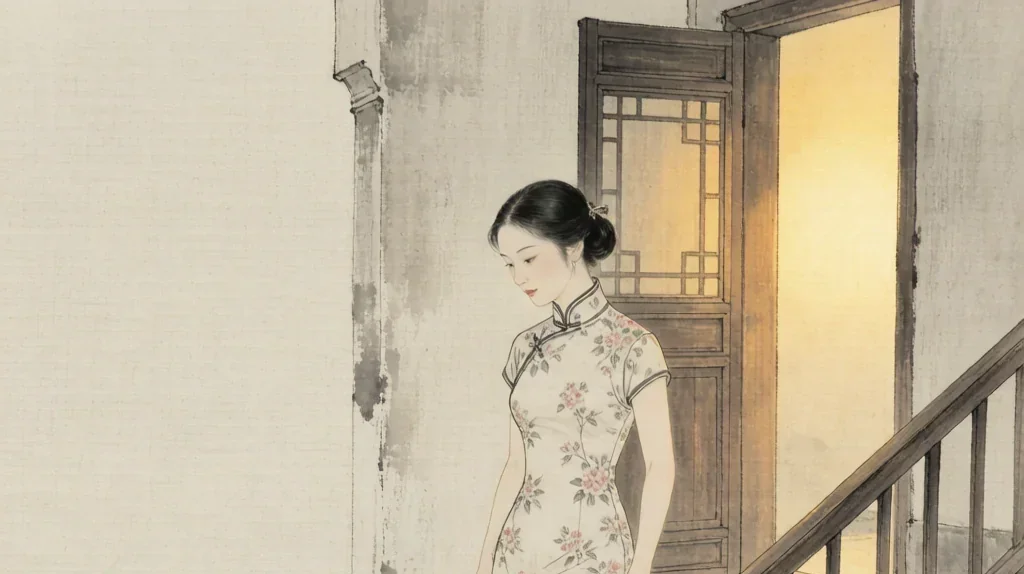
There is a moment in Wong Kar-wai's 2000 masterpiece In the Mood for Love (花样年华) when Maggie Cheung descends a narrow staircase in a hallway of shadows, wearing a qipao of impossible beauty — high-collared, form-fitting, printed with blooms that seem to pulse with color even in the dim light. She wears twenty-three different qipaos in that film, each one a character in its own right, and together they reignited the world's fascination with this most iconic of Chinese garments. But the qipao's story stretches far beyond the silver screen — it is a tale of empire and revolution, of tradition shattered and remade, and of a single dress that came to embody an entire era of Chinese modernity.
Manchu Origins: The Qipao Before the Qipao
The garment we know as the qipao (旗袍) traces its origins to the Manchu people, the same northeastern ethnic group that gave us the tangzhuang jacket. The name itself reveals this heritage: qí (旗) means "banner," referring to the Eight Banners (八旗, bā qí) — the military-administrative divisions of Manchu society — and páo (袍) means "gown" or "robe." The original qipao, known more precisely as the qí páo (旗袍, "banner gown"), was a long, loose robe worn by both Manchu men and women.
This early qipao was a practical garment, designed for a nomadic people who spent much of their lives on horseback. It was cut straight and generously, hanging from the shoulders without a defined waistline, and fell to the ankles. The sleeves were wide and the collar was a simple round neckline. Manchu women wore the qipao over trousers, and the silhouette was modest and unshaped — a world away from the body-hugging dress that would later scandalize and captivate Shanghai society. Under Qing Dynasty rule, the qipao was essentially a uniform of conquest, imposed alongside the queue hairstyle for men as a marker of Manchu dominance over the Han Chinese population.
The Shanghai Revolution: 1920s Reinvention
The qipao's transformation from ethnic marker to fashion icon began in the 1920s, in the electrifying atmosphere of Shanghai — then the most cosmopolitan city in Asia, a crucible where Chinese tradition met Western modernity. As the Qing Dynasty receded into memory and the Republic of China embraced reform, young Chinese women began to reimagine what their clothing could be. The old, loose qipao suddenly seemed like a relic of a bygone age, incompatible with the new ideals of female education, independence, and self-expression.
Shanghai's tailors — many of whom had studied Western dressmaking techniques — began to modify the qipao radically. They took in the waist, creating a silhouette that followed the contours of the body. They raised the hemline from the ankle to the calf, and eventually — scandalously — to the knee. They introduced the high, stiff standing collar that framed the face and elongated the neck. They added side slits that revealed a glimpse of leg with each step, a detail that was simultaneously practical for walking and provocatively modern. The sleeves shrank from wide and flowing to tight and short, and finally disappeared altogether in sleeveless designs.
By the 1930s, the qipao had become the uniform of the modern Chinese woman — worn by students, socialites, actresses, and even political figures. Soong Mei-ling, the wife of Generalissimo Chiang Kai-shek, was frequently photographed in elegant qipaos that projected an image of refined Chinese modernity to the world. The garment had completed its journey from Manchu riding robe to the defining silhouette of Chinese femininity.
The Golden Age: 1930s–1940s Shanghai Glamour
The qipao reached its aesthetic zenith in the Shanghai of the 1930s and 1940s. This was the era of the "Shanghai qipao" (海派旗袍, hǎi pài qí páo), distinguished by its body-conscious cut, high side slits, and luxurious materials. Shanghai tailors competed to create ever more daring and elaborate designs, and a well-dressed woman might own dozens of qipaos for different occasions — morning dresses in light cottons, afternoon dresses in printed silks, and evening dresses in sumptuous brocades and velvets trimmed with fur.
The qipao of this golden age was a garment of extraordinary craftsmanship. Each dress was custom-made for its wearer, requiring dozens of precise measurements to achieve the perfect fit. The construction involved complex darting and seaming that was more akin to Western haute couture than traditional Chinese dressmaking. The side closure, running from the collar to under the right arm, was fastened with pán kòu (盘扣) — the same knotted buttons that adorn tangzhuang jackets — but on a qipao they were often miniature works of art, shaped like flowers, butterflies, or lucky symbols in silk cord.
The fabrics were equally exquisite. Silk satin, crepe de chine, and brocade were the most common choices, but the most prized qipaos featured fabrics printed or embroidered with traditional Chinese motifs reinterpreted through an Art Deco lens. Geometric patterns, stylized floral designs, and bold color combinations reflected the hybrid aesthetic of 1930s Shanghai — thoroughly Chinese in essence, yet unmistakably modern in execution.
Decline, Survival, and Cinematic Resurrection
The qipao's reign as everyday wear ended abruptly after 1949, when the founding of the People's Republic of China brought a new emphasis on proletarian simplicity. In mainland China, the qipao was increasingly seen as bourgeois and decadent, incompatible with the ideals of socialist construction. It survived in Hong Kong, Taiwan, and overseas Chinese communities, where it remained a garment for formal occasions, but in the mainland it largely disappeared from public view for decades.
The garment's fortunes began to reverse in the 1990s, driven largely by the power of cinema. Wong Kar-wai's In the Mood for Love (2000) was the watershed moment: Maggie Cheung's qipaos — each one a masterwork of fabric and form — reminded the world of the garment's extraordinary beauty. The film sparked a qipao revival that continues to this day. Designers in Shanghai, Hong Kong, and beyond began creating contemporary interpretations, and the qipao re-entered the vocabulary of global fashion.
The Qipao Today: Tradition Meets Modern Fashion
Today, the qipao occupies a unique position in the fashion landscape. It is simultaneously a formal garment for weddings and ceremonies, a stylish choice for cocktail parties and red-carpet events, and a canvas for avant-garde designers who push the form in unexpected directions. Modern qipaos come in every conceivable variation: mini-length party dresses, asymmetrical designs with one long sleeve, backless evening gowns, and even qipao-inspired jumpsuits and tops paired with jeans.
International luxury brands have embraced the qipao aesthetic, with designers from Dior to Ralph Lauren incorporating mandarin collars, side slits, and frog-button closures into their collections. Chinese designers, meanwhile, are reclaiming the form with fresh eyes, creating qipaos that honor tradition while speaking fluently to contemporary sensibilities. The garment has also become a powerful symbol of Chinese cultural identity abroad, worn with pride by diaspora communities and adopted by non-Chinese admirers who appreciate its elegance.
The qipao's journey — from Manchu riding robe to Shanghai scandal, from revolutionary relic to cinematic icon, from formal wear to fashion-forward statement piece — mirrors China's own turbulent path through the twentieth century. Each qipao tells a story, and every woman who wears one becomes part of a tradition that has been continuously reinvented for over a century. In the end, the qipao is not just a dress; it is a living record of Chinese women's evolving relationship with tradition, modernity, and their own bodies — sewn into silk, one stitch at a time.
The Tailor's Art: Measuring and Making a Qipao
The qipao's elegance rests on the tape measure. Because the dress is meant to hug the figure, a tailor takes dozens of measurements of neck, shoulder, bust, waist, hip, and limb, then drafts a pattern unique to one body. Darts shape the bodice, curved seams pull the silk close at the waist and release it at the hip, and the side slits are placed so the wearer can step and sit with composure. The frog buttons, pankou, are themselves small sculptures of coiled silk cord, often finished as flowers or lucky symbols. None of this can be rushed, which is why the finest qipaos were always bespoke. The craft sits at the meeting point of Chinese ornament and Western construction, and it is precisely that hybrid skill that gives the Shanghai qipao its famous, unforced glamour.
A Garment of Words: The Qipao in Literature
Beyond film, the qipao has lived in Chinese writing. Eileen Chang made dress a lens on society, tracing the nation's politics through changing fashions and treating her own qipao choices as seriously as her prose. Later authors such as Hong Ying and Li Yiyun have used the garment as a symbol of femininity, memory, and displacement, letting a single dress carry a whole emotional argument. In these works the qipao is never merely clothes; it is a way of speaking about constraint and freedom, tradition and rebellion, the body and the self. Where cinema gave the qipao its global face, literature gave it its inner life, a second wardrobe of meaning worn by characters on the page. To read the qipao in fiction is to see the garment think.
East Meets West: The Art Deco Qipao
The golden-age qipao was a hybrid object. Its cut came from Western tailoring, but its surface spoke Chinese, and Shanghai designers of the 1930s ran the two together through an Art Deco sensibility. Traditional motifs, dragons, peonies, and clouds, were redrawn as geometric, stylized patterns in bold color blocks, so that a dress could feel thoroughly Chinese and thoroughly modern at once. Crepe de chine, silk satin, and brocade carried these prints with a sleek confidence suited to a cosmopolitan port. The result was a style that belonged to no single culture, a visual treaty between East and West negotiated on the body of a woman. That mingled identity is the secret of the qipao's lasting appeal: it has always been a garment of translation, fluent in more than one language of dress.
❓ Frequently Asked Questions
📝 Chinese Vocabulary
- 旗袍 (qí páo) — Qipao; the iconic form-fitting Chinese dress with a standing collar and side slits
- 海派旗袍 (hǎi pài qí páo) — Shanghai-style qipao; the glamorous, body-conscious version developed in 1930s Shanghai
- 盘扣 (pán kòu) — Knotted buttons made from silk cord, used as decorative fastenings on qipao and tangzhuang
- 八旗 (bā qí) — The Eight Banners; the military-administrative divisions of Manchu society from which the qipao takes its name
- 花样年华 (huā yàng nián huá) — "In the Mood for Love"; the 2000 film by Wong Kar-wai that sparked a global qipao revival
🎉 Fun Facts
- Maggie Cheung wore 23 different qipaos in the film In the Mood for Love, each one custom-made from vintage fabrics. The costume designer, William Chang, spent over a year sourcing the materials.
- In 1930s Shanghai, the most fashionable qipao side slits reached scandalously high — sometimes up to the upper thigh — prompting conservative critics to warn of moral decay. The government briefly attempted to regulate slit heights by law.
- A traditional qipao is always fastened on the right side with a diagonal row of buttons running from the collar to under the arm — this right-side closure echoes the ancient hanfu tradition of yòu rèn (右衽).
- The writer Eileen Chang, who called life a gorgeous gown full of lice, kept a legendary collection of qipaos and read China's political history through changing fashions.
- Each qipao was custom-made to its wearer, requiring dozens of precise body measurements to achieve the sculpted fit that defined the Shanghai look.
- Madame Soong Mei-ling wore elegant qipaos at diplomatic events, helping project an image of refined Chinese modernity to the world.