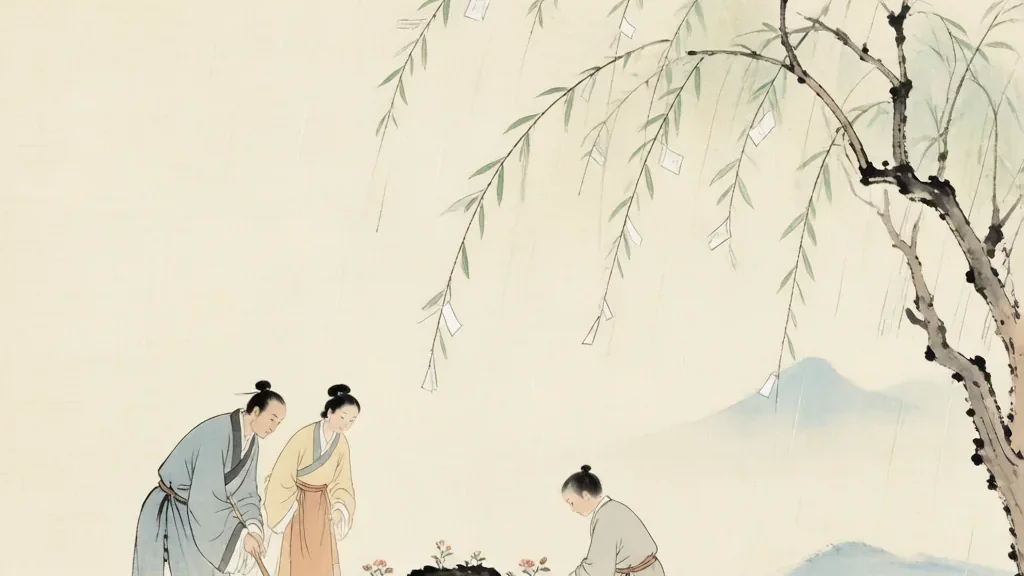
In early April, when willow branches unfurl their first tender green and the air carries the soft warmth of spring, millions of Chinese families make a journey they have made for centuries. They travel to hillside cemeteries and ancestral graves, carrying flowers, incense, paper money, and offerings of food. They sweep the tombstones clean, pull weeds from the earth, and bow in silent reverence. This is Qingming Festival (清明节, Qīngmíng Jié) — Tomb Sweeping Day — a solemn yet profoundly beautiful tradition that connects the living to those who came before.
But why do families sweep tombs? Why is cold food sometimes eaten on this day? And what is the origin of a festival that blends grief and gratitude, mourning and the celebration of spring? The answers lie in a story of extraordinary loyalty, tragic sacrifice, and the remorse of a king — a story that took place over 2,600 years ago during China's Spring and Autumn Period.
The Story of Jie Zitui and Duke Wen of Jin
The year was approximately 636 BCE. Chong'er (重耳), a prince of the state of Jin, had been forced to flee his homeland after his father's concubine orchestrated a coup against him. For nineteen long years, Chong'er wandered through hostile territories with a handful of loyal followers, enduring hunger, cold, and the constant threat of assassination. Among these followers was a man named Jie Zitui (介子推) — a minister of unshakeable loyalty and quiet dignity.
During the darkest period of their exile, the group found themselves stranded in a desolate wilderness with no food. Chong'er, weak from starvation, collapsed and could go no further. His followers searched desperately for something — anything — to feed their prince, but the land offered nothing. They were miles from the nearest village, and the prince was fading fast.
Then Jie Zitui did something that would echo through Chinese history for millennia. He withdrew from the group, found a secluded spot, and cut a piece of flesh from his own thigh. He cooked the meat into a broth and brought it to his starving prince. Chong'er devoured the soup gratefully, too weak to question where the meat had come from. Only later did he learn the horrifying truth: his most loyal minister had fed him with his own body.
Chong'er wept. He swore that if he ever regained his rightful position, he would reward Jie Zitui beyond measure. Jie Zitui, however, asked for nothing. He had not acted for reward — he had acted out of pure, selfless loyalty to his prince and his state.
The Return to Power and a Fateful Omission
After nineteen years of exile, Chong'er finally returned to Jin. With the support of the neighboring state of Qin, he overthrew the usurper and ascended the throne as Duke Wen of Jin (晋文公). He would go on to become one of the most celebrated rulers of the Spring and Autumn Period — one of the legendary Five Hegemons who dominated the era.
Upon taking power, Duke Wen generously rewarded all who had stood by him during his years of exile. Titles, lands, and riches were distributed to his loyal followers. But in the chaos of consolidating power and governing a recovering state, Duke Wen forgot one man — the man who had literally given a piece of himself to keep the prince alive.
Jie Zitui, true to his character, did not complain. He did not petition the court or remind the Duke of his sacrifice. Instead, he quietly withdrew from political life. He took his elderly mother on his back and retreated deep into the remote Mian Mountain (绵山), where they lived as hermits, far from the intrigues of the court.
The Fire on the Mountain
Eventually, someone reminded Duke Wen of Jie Zitui's sacrifice. Stricken with guilt and shame, the Duke immediately set out to find his forgotten benefactor. He sent messengers to summon Jie Zitui back to court with promises of wealth and high office. Jie Zitui refused. The Duke went in person to the foot of Mian Mountain and called for his old friend. Jie Zitui, carrying his mother, climbed higher into the mountain's dense forests and did not respond.
Frustrated and desperate to force Jie Zitui out of hiding, Duke Wen made a catastrophic decision — one he would regret for the rest of his life. On the advice of a misguided advisor, he ordered his soldiers to set fire to the mountain on three sides, leaving only one escape route. The logic was brutal but seemed sound: Jie Zitui, a filial son, would surely flee the flames to save his elderly mother, and the waiting soldiers would receive him with honor.
The fire raged for three days and three nights. When the smoke finally cleared and the Duke's men climbed the scorched mountain, they found a scene that would haunt the annals of Chinese history. Jie Zitui and his mother had not fled. They had chosen to stay together. They were found dead beneath a willow tree, their bodies embracing, having refused to abandon each other or compromise Jie Zitui's principles.
Inside the hollow of the willow tree, the soldiers discovered a letter written in Jie Zitui's blood on a piece of cloth:
"I cut my flesh to serve my lord with a loyal heart. I hope my lord will always be clear-minded. To be a virtuous minister who does not seek reward — this is what I have learned."
A King's Remorse and a Nation's Tradition
Duke Wen was devastated. The man who had saved his life had died because of his own impatience and poor judgment. Overcome with grief and remorse, the Duke issued a decree that would transform personal tragedy into an enduring cultural tradition.
First, he ordered that no fire should be lit on the anniversary of Jie Zitui's death. For one day each year, all households in Jin would eat only cold food — a practice that became known as the Cold Food Festival (寒食节, Hánshí Jié). People prepared food in advance and ate it without reheating, in memory of the loyal minister who had perished in flames.
Second, he declared that the day following Cold Food would be a day for visiting and tending to ancestral graves — sweeping tombs, offering sacrifices, and honoring the dead. This practice evolved into Qingming Festival, which absorbed the Cold Food traditions over time.
Duke Wen ordered the charred willow tree beneath which Jie Zitui died to be carved into a pair of clogs. He wore them every day, and whenever he looked down, he would say, "This is my sorrowful foot" (悲乎足下, bēi hū zúxià). According to legend, this is the origin of the Chinese honorific "zúxià" (足下), a respectful way of addressing someone — literally "beneath your feet."
The following year, when Duke Wen returned to Mian Mountain to pay his respects, he discovered that the burned willow tree had miraculously sprouted new green leaves. Taking this as a sign of Jie Zitui's forgiving spirit, the Duke named the tree the "Pure Brightness Willow" (清明柳) and declared the day Qingming — "pure brightness" — a name that evokes both the clarity of spring and the clarity of moral conscience.
Qingming Traditions: More Than Tomb Sweeping
While tomb sweeping is the central ritual of Qingming, the festival encompasses a rich tapestry of customs that reflect its dual nature: reverence for the dead and celebration of life. The Chinese have long understood that honoring ancestors and embracing spring are not contradictory — they are complementary expressions of the same profound awareness: that life is precious, fleeting, and part of an unbroken chain connecting past, present, and future.
Spring Outings (踏青, tàqīng) are an essential part of Qingming. After paying respects at ancestral graves, families often enjoy the blossoming countryside together. They fly kites, picnic under cherry trees, and appreciate the renewal of nature. Some traditions hold that flying a kite on Qingming and then cutting the string — letting the kite drift away — can carry away illness and bad luck.
Planting Willow Branches is another widespread custom. Families place fresh willow branches on their gates or wear them in their hair. Willow is believed to have protective properties, warding off evil spirits. The custom may also connect to the willow tree under which Jie Zitui died, making it a symbol of both protection and remembrance.
Eating Cold Foods remains a tradition in many regions. Qingtuan (青团) — vibrant green glutinous rice dumplings made with mugwort juice and filled with sweet red bean paste — are a seasonal delicacy associated with the festival. Their bright green color embodies the vitality of spring.
The Meaning of Qingming Today
Qingming is one of the most important festivals in the Chinese calendar — so significant that it became a public holiday in mainland China in 2008. On this day, cemeteries across the country fill with families. They clean graves, offer flowers (chrysanthemums are traditional for mourning), burn joss paper (spirit money) so ancestors can live comfortably in the afterlife, and share a meal near the gravesite — symbolically dining with those who have passed.
But Qingming is not a morbid occasion. It is a festival that embodies one of the most beautiful concepts in Chinese philosophy: that death is not an ending but a transformation, and that the living have a sacred duty to remember. By remembering, we keep the dead alive within us. By sweeping tombs, we affirm that we are part of a family line stretching back through countless generations — and forward into a future we will not see but help to shape.
In a rapidly modernizing China, where young people migrate to cities and traditional family structures evolve, Qingming serves as a powerful anchor — a designated time each year when millions return to their ancestral homes, reconnect with family roots, and honor the unbroken thread of kinship that defines Chinese identity. It is a festival of tears and laughter, of grief and gratitude, of cold food eaten in memory of a fire that should never have been lit.