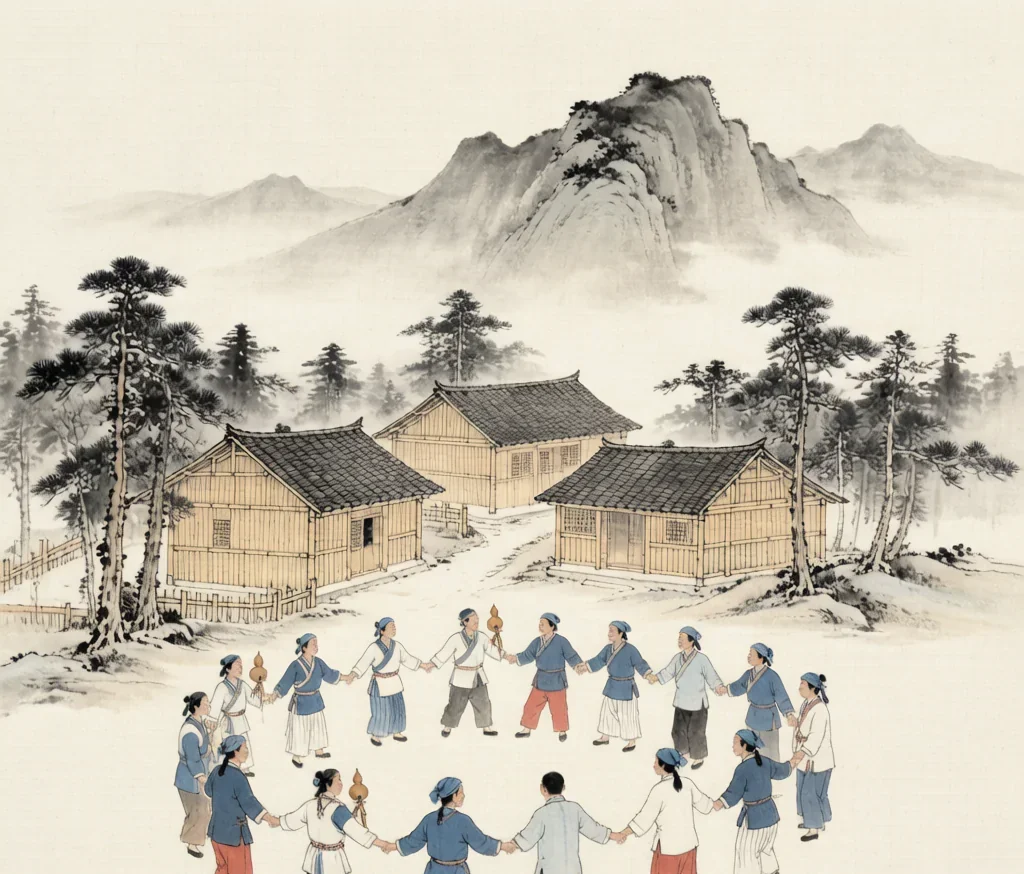
The Lahu people, or Lahuzu (拉祜族), are a Tibeto-Burman ethnic group of about 450,000 in China, concentrated in the mountainous southwest of Yunnan and extending across the borders into Myanmar, Thailand, and Laos. Famous for a founding myth in which humanity emerged from a gourd, the Lahu have long been shifting cultivators and hunters who today increasingly practice wet-rice agriculture. Their social life revolves around village councils, vibrant antiphonal song, and the Gourd Festival that celebrates their mythic origin — a culture at once rooted in the highlands and woven into the wider Southeast Asian hill peoples.
Origins and the Gourd Myth
Lahu oral tradition holds that the first humans were born from a giant gourd (hulu) that split open, releasing the ancestors of all peoples. This origin story is not merely folklore but a charter for identity: the gourd appears in ritual, ornament, and the very name of their great festival.
Linguistically and culturally the Lahu belong to the broad family of Tibeto-Burman hill peoples, and their dispersal across the borders of several countries reflects centuries of migration in search of arable land in the rugged borderlands of Yunnan. The same gourd myth and the same lusheng music can thus be heard from the Salween to the Mekong, linking Lahu communities that modern borders have separated. This transnational spread makes the Lahu both a Chinese minority and a thread in a wider Southeast Asian highland world.
Homeland in Yunnan
Within China the Lahu are concentrated in Lancang Lahu Autonomous County and the surrounding counties of Menglian, Shuangjiang, and Cangyuan in southwestern Yunnan. The terrain is a mosaic of steep ridges, river valleys, and monsoon forest.
This border location has made the Lahu a trans-national people, with kindred communities in the Shan State of Myanmar and in northern Thailand and Laos, linked by language, kinship, and shared agricultural rhythms despite modern borders.
Language
The Lahu language is a Tibeto-Burman tongue with several dialects, the most widely spoken being Lahu Na (Black Lahu) and Lahu Shi (Yellow Lahu). A romanized script was devised by missionaries in the early twentieth century and remains in use for hymnals and literacy.
As in many minority areas, Mandarin Chinese is the language of school and government, and younger Lahu are often bilingual. The traditional script, however, anchors the community's written religious and musical life.
Traditional Subsistence
Historically the Lahu practiced swidden (slash-and-burn) cultivation of dry rice, maize, and vegetables on forest slopes, supplemented by hunting and gathering. The crossbow and dog were essential to the hunt, and forest products supplemented the diet.
In recent decades state programs and market access have encouraged a shift to terraced wet-rice and cash crops such as tea and sugarcane. While swidden persists in remoter zones, settled agriculture now dominates Lahu economic life.
Social Organization
Traditional Lahu villages were governed by a council of elders and a headman, with decisions reached by consensus rather than by a single chief. Kinship was reckoned bilaterally, and households formed the basic productive unit.
The Lahu have a reputation for egalitarian ethos; early observers noted the relative absence of sharp class distinctions compared with neighboring polities. This communal spirit survives in mutual-aid labor at planting and harvest time.
Religion and Christianity
Ancestor worship and nature spirits long structured Lahu religion, with shamans conducting healing and agricultural rites. From the early twentieth century, Protestant and Catholic missionaries were notably successful among the Lahu, and a substantial portion of the community is Christian today.
Christian Lahu worship in their own language, singing hymns from romanized hymnals, while other Lahu maintain Buddhist or animist practice. This religious duality gives the group an internally varied profile.
The Gourd Festival
The Hulu Jie, or Gourd Festival, is the Lahu's signature celebration, held around the lunar new year. It reenacts the gourd-origin myth through song, dance, and the display of gourd motifs, and it serves as the principal occasion for courting and reunion.
During the festival, villagers perform the "Kuoshi" dance in great circles, accompanied by lusheng (reed pipes) and gourd fiddles. Offerings thank the gourd ancestors, and elders recount the origin story to the young.
Music and Dance
Lahu music centers on the lusheng and the hulu sheng (gourd reed instrument), whose buzzing tone is emblematic of the culture. Circle dances led by musicians are performed at every major gathering, with participants linking arms in rhythmic steps.
Antiphonal singing between young men and women is a courtship art, and epic songs preserve migration history. The gourd fiddle, crafted from a dried gourd, is both a folk instrument and a symbol of Lahu identity.
Clothing and Craft
Lahu dress is distinctive and practical: women wear long black tunics with bands of silver and brightly embroidered cuffs, while men favor short jackets and leggings suited to forest travel. The dominant color is black, whence the "Black Lahu" designation.
Hand-weaving, silverwork, and the carving of gourd instruments are esteemed skills. Cloth is dyed with indigo, and ornament often encodes clan and regional identity in its patterns.
Modern Life and Preservation
Highland roads, schools, and tourism have transformed Lahu life in recent decades. The Gourd Festival has been promoted as a cultural attraction, and Lahu handicrafts and music feature in Yunnan's ethnic-tourism economy.
Yet out-migration for wage work and language shift pose challenges to transmission. Local cultural workers record songs and revive rituals, seeking to keep the gourd myth alive as both heritage and living practice.
Relations with Neighboring Peoples
In the multi-ethnic hills of Yunnan the Lahu have long interacted with the Dai, Han, Wa, and Jingpo, exchanging crops, rituals, and marriage ties. The Dai calendar and Theravada influence, for instance, have shaped Lahu festival timing in some valleys.
These ties are pragmatic as well as cultural: shared labor at harvest and joint markets knit the highlands together. The Lahu's gourd myth, however, keeps their own origin distinct even as they participate in a broader frontier society.
❓ Frequently Asked Questions
Where do the Lahu live?
Mainly in Lancang and neighboring counties of southwestern Yunnan, with related communities in Myanmar, Thailand, and Laos.
What is the gourd myth?
It holds that the first humans emerged from a gourd that split open, releasing the ancestors of all peoples — the basis of the Gourd Festival.
What language do they speak?
A Tibeto-Burman language with dialects like Black and Yellow Lahu; a missionary romanization is used for hymns and literacy.
What is their traditional economy?
Historically swidden cultivation, hunting, and gathering; today increasingly wet-rice and cash crops such as tea.
What religion do they follow?
A mix of ancestor worship, animism, Buddhism, and Christianity, the last introduced by early twentieth-century missionaries.
What is the Gourd Festival?
A lunar new year celebration reenacting the origin myth with gourd dances, music, and offerings of thanks to the gourd ancestors.