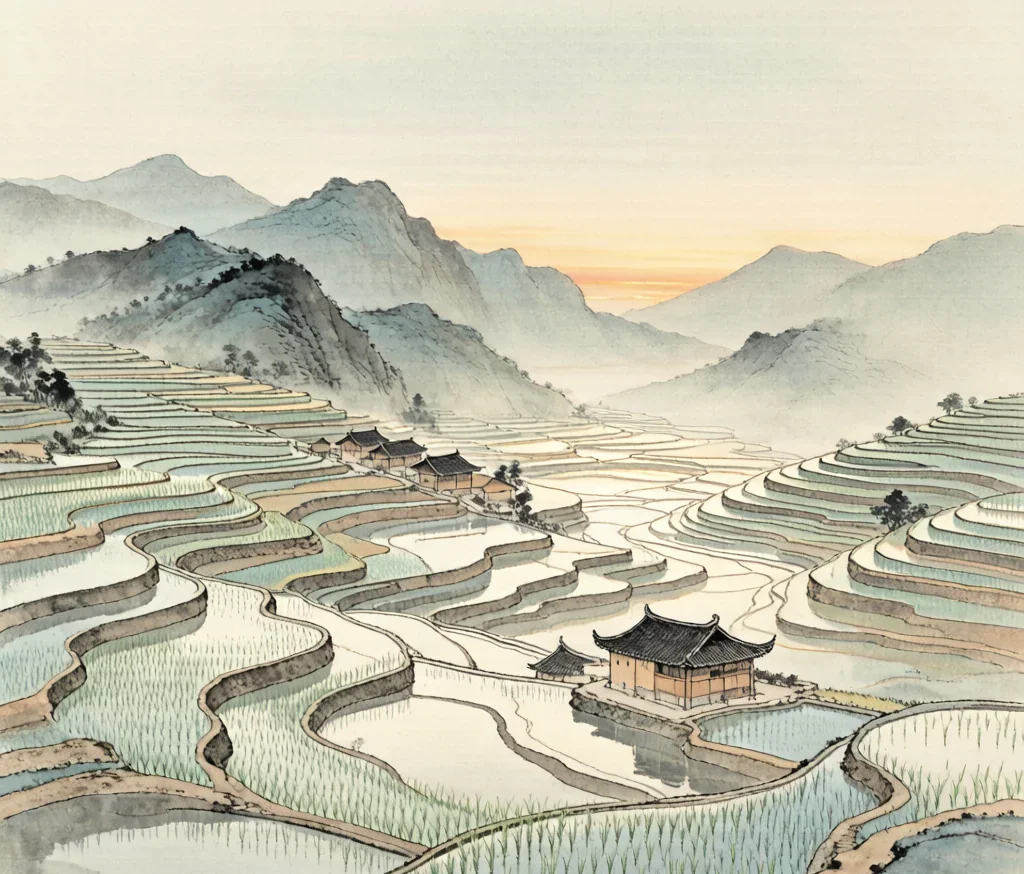
Carved into the slopes of the Ailao Mountains in southern Yunnan, the Hani Rice Terraces represent one of humanity's most magnificent collaborations with nature. The Hani people (哈尼族, Hā ní zú), numbering approximately 1.7 million, have transformed precipitous mountain slopes into a cascading staircase of rice paddies stretching from river valleys at 800 meters to mountain summits at nearly 2,000 meters. In 2013, the Cultural Landscape of Honghe Hani Rice Terraces was inscribed as a UNESCO World Heritage Site, recognizing it as an outstanding example of a sustainable agricultural system that has supported Hani civilization for over 1,300 years.
The Terraced Landscape
The Hani rice terraces are a complete engineered ecosystem. The system begins in the forested mountain summits, which the Hani consider sacred. These forests capture rainfall and release it gradually through springs and streams. The water flows down through the terraces, carrying nutrients to the paddies. Below the paddies, water continues to villages and eventually to the river, completing a hydrological cycle sustained for millennia. Each terrace must be precisely leveled to hold water at a uniform depth, with channels and sluices distributing water equitably — a complex system of water rights and rotation schedules that prevent conflict.
The Hani Calendar and Agricultural Cycle
Hani culture is organized around the agricultural calendar. The Kuzhazha Festival (苦扎扎节, kǔ zhā zhā jié) in the sixth lunar month marks a lull between planting and harvest, with villages erecting swings and hosting bullfighting, singing, and dancing. The Angmatu Festival (昂玛突节) in the first lunar month honors the village guardian spirit with a "long street banquet" (长街宴, cháng jiē yàn) — tables set in a continuous line through the village, with every household contributing dishes to a communal feast that can stretch for hundreds of meters.
Hani Cosmology and the Origin Epic
Hani traditional religion involves ancestor worship, nature spirit veneration, and agricultural ritual. Ritual specialists called mopi (莫批) or beima (贝玛) serve as intermediaries, performing ceremonies and reciting sacred texts. The "Hani Migration Epic" (哈尼阿培聪坡坡), which can take days to recite, recounts the origins and migrations of the Hani people, serving as their collective memory. At funerals, the epic guides the soul of the deceased back through the migration route to join the ancestors.
Mushroom Houses and Village Life
Traditional Hani villages feature "mushroom houses" (蘑菇房, mó gū fáng) — so called because their thick thatched roofs resemble mushroom caps. The walls are built of rammed earth, and the thatch provides excellent insulation. Villages are located midway up mountain slopes, between forested summits above and terraced paddies below. Each village has a sacred gate (寨门) decorated with carved wooden figures protecting against evil spirits. This spatial organization — forest above, village in middle, terraces below, river at bottom — represents the Hani understanding of the proper relationship between human settlement and the natural environment.
More About This Ethnic Group
The ethnic minority groups of China represent an extraordinary tapestry of cultural diversity, stretching across the vast landscapes of this ancient land. With 55 officially recognized minority nationalities alongside the Han majority, each group contributes unique traditions, languages, and customs that have been carefully preserved and passed down through countless generations. These communities are primarily concentrated in the autonomous regions of Tibet, Xinjiang, Inner Mongolia, Ningxia, and Guangxi, as well as in the culturally rich provinces of Yunnan, Guizhou, Sichuan, and Qinghai, where some of the most diverse concentrations of ethnic cultures in the world can be found.
China's ethnic minority policies provide important protections for minority languages, cultural practices, and regional autonomy. Many minority communities have autonomous prefectures or counties where their languages are used in local government, education, and media. Traditional festivals, such as the Dai Water-Splashing Festival, the Yi Torch Festival, and the Mongolian Naadam, are celebrated with government support and draw visitors from around the world. These celebrations are not merely tourist attractions but living expressions of cultural identity that reinforce community bonds and transmit cultural knowledge to younger generations.
The cultural heritage of these communities extends to every aspect of daily life — from distinctive architectural styles adapted to local environments, to colorful traditional costumes that encode social information through their patterns and designs, to unique musical instruments and dance forms that express the community's relationship with nature and the cosmos. Embroidery, silverwork, textile weaving, paper-cutting, and countless other handicrafts continue to thrive in minority regions, with many recognized as national or even UNESCO Intangible Cultural Heritage. These crafts are not frozen museum pieces but living traditions that evolve while maintaining their essential character.
In recent decades, concerted efforts to document and preserve minority languages and oral traditions have intensified across China. Scholars and cultural workers collaborate with community elders to record epic poems, folk songs, creation myths, and traditional ecological knowledge before they fade from living memory. Many minority languages that once had no written form now have standardized writing systems, and bilingual education programs help ensure that children can learn both their mother tongue and Mandarin Chinese. Museums, cultural centers, and digital archives have been established to safeguard this heritage for future generations.
Tourism has also played a significant role in the revitalization of minority cultures, offering economic opportunities while raising awareness of the importance of cultural preservation. Ethnic tourism allows visitors to experience traditional architecture, sample distinctive cuisines, purchase handmade crafts directly from artisans, and participate in local festivals. When managed responsibly, this engagement provides income that supports the continuation of traditional practices and gives communities a stake in preserving their cultural heritage. For travelers and culture enthusiasts, visiting minority villages and participating in local festivals offers an authentic window into China's remarkable cultural mosaic and the enduring vitality of its ethnic traditions.