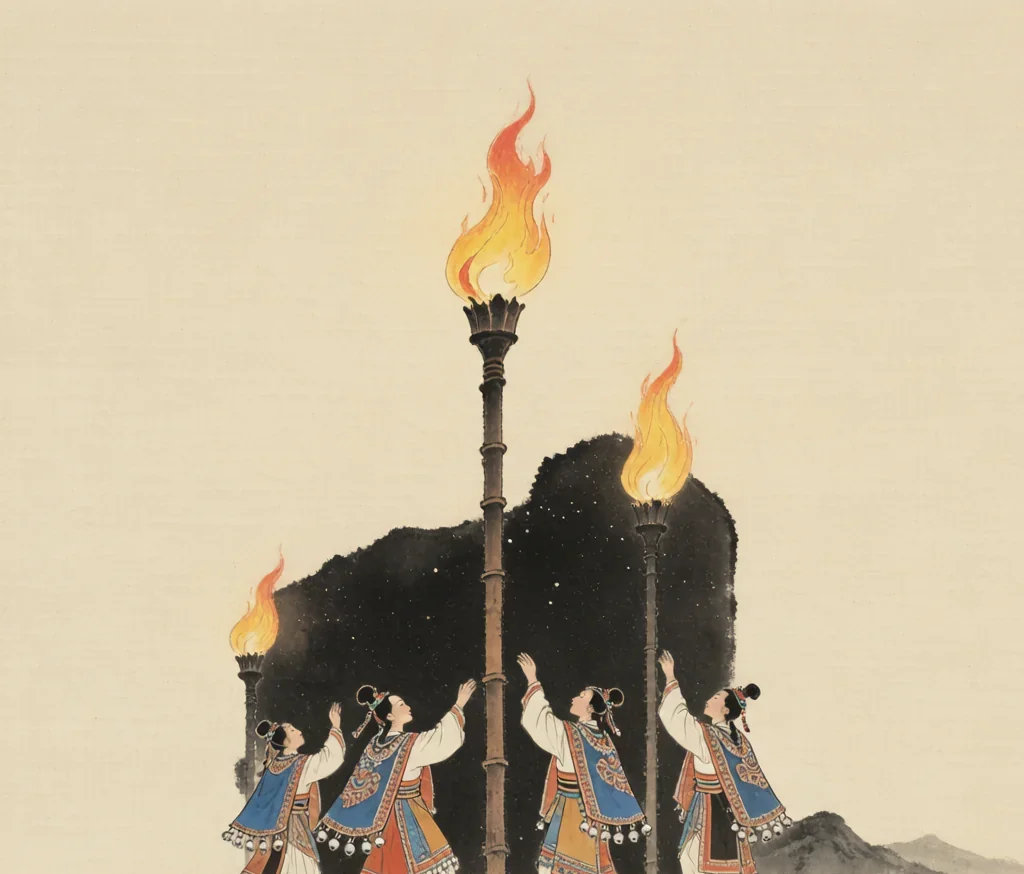
When night falls on the twenty-fourth day of the sixth lunar month, the mountains of southwestern China come alive with fire. On hillsides across Yunnan, Sichuan, and Guizhou, thousands of torches blaze to life, their flames tracing serpentine paths as villagers carry them through the darkness. This is the Torch Festival (火把节, huǒ bǎ jié), the most important celebration of the Yi people, and it transforms the landscape into a vision of primal beauty — humanity's ancient relationship with fire, celebrated on a scale that must be seen to be believed.
The People of the Mountains
The Yi, known in Chinese as 彝族 (Yí zú), are one of China's largest ethnic minorities, numbering over nine million people spread across the rugged highlands of the southwest. Their origins trace back to the ancient Qiang people who inhabited the upper reaches of the Yellow River, and over millennia they migrated southward into the mountains where they developed a distinctive civilization adapted to high-altitude living. The Yi are not a single, homogeneous group but a constellation of subgroups — the Nuosu, Nasu, Sani, and others — each with their own dialects, customs, and variations of the shared Yi culture.
The Yi homeland is defined by dramatic topography. The Greater and Lesser Liangshan (Cool Mountains) ranges, with peaks exceeding four thousand meters, create isolated valleys where different Yi communities developed their distinct traditions. This mountainous environment shaped Yi society in fundamental ways. Villages were built on defensible hilltops. Agriculture adapted to steep slopes through terracing. The clan-based social structure, with its emphasis on lineage and mutual defense, reflected the need for solidarity in a challenging environment.
Historically, Yi society was highly stratified, with a complex caste system that divided people into hereditary classes. The Black Yi (黑彝, hēi yí) formed the aristocratic elite, while the White Yi (白彝, bái yí) constituted the commoner class, and slaves occupied the lowest rung. This system, which persisted in some areas into the mid-twentieth century, shaped Yi social relations, marriage patterns, and even the color symbolism that pervades Yi culture.
The Torch Festival: Fire Against the Darkness
The Torch Festival is the defining event of the Yi calendar. For three days and nights, Yi communities suspend normal life for a celebration that combines religious ritual, athletic competition, social gathering, and sheer spectacle. The origins of the festival lie in multiple layers of Yi mythology — stories of using fire to drive away plague-carrying insects, tales of a hero who used torches to defeat a demon, and agricultural rituals praying for a good harvest.
The first day of the festival is devoted to preparation. Families clean their homes, prepare special foods — roasted lamb, buckwheat cakes, and the potent Yi liquor made from corn or buckwheat — and construct the torches that will be burned. The torches are traditionally made from pine or other resinous wood, split and bound into bundles that will burn brightly and long. In some regions, a massive central torch, several meters tall, is constructed in the village square.
On the second day, the festival reaches its peak. As darkness falls, the torches are lit. Young men carry flaming brands through the fields, the fire believed to drive away pests and ensure a bountiful harvest. Processions of torch-bearers wind through villages and across hillsides, creating rivers of fire in the mountain darkness. The central bonfire is lit, and around it, the community gathers for dancing, singing, and celebration that continues through the night.
The third day features the festival's athletic competitions — wrestling, horse racing, and bullfighting. Yi wrestling is a distinctive style, with competitors wearing special wrestling belts and attempting to throw each other to the ground. Horse racing on the mountain grasslands demonstrates the equestrian skills that have been central to Yi culture for centuries. And bullfighting, in which two bulls are pitted against each other, draws passionate crowds who cheer for the animals representing their villages.
The Bimo: Keepers of Ancient Wisdom
At the heart of traditional Yi religion stands the Bimo (毕摩, bì mó), a priest-scholar who serves as the custodian of Yi sacred knowledge. Unlike shamans, who are chosen by spirits and enter trance states, the Bimo inherits his position through patrilineal descent and undergoes years of rigorous training. He must memorize vast quantities of sacred texts, learn the complex rituals for every occasion from birth to death, and master the Yi script in which the sacred literature is written.
The Yi script is one of the few indigenous writing systems in East Asia not derived from Chinese characters. It is a syllabary — each character represents a syllable rather than a concept — and its origins may date back thousands of years. The Bimo scriptures, written in this script on handmade paper or parchment, encompass Yi cosmology, mythology, history, medicine, and ritual practice. The texts describe a universe divided into multiple realms, inhabited by gods, spirits, ancestors, and demons, all of which the Bimo must navigate on behalf of his community.
The Bimo's functions are comprehensive. He performs rituals to ensure good harvests, heal the sick, and protect against misfortune. He conducts funerals, guiding the soul of the deceased through the dangerous journey to the land of the ancestors. He exorcises demons, divines the future, and mediates disputes. In traditional Yi society, no significant event occurred without Bimo involvement, and the priest's authority was second only to that of the clan chief.
The Creation Epic and Yi Literature
The Yi possess one of the world's great creation epics, the "Meige" (梅葛, méi gě), a vast oral poem that recounts the origin of the universe, the creation of humanity, and the early history of the Yi people. Passed down through generations by Bimo priests and folk singers, the epic is not a fixed text but a living tradition, varying in detail from region to region and performer to performer while maintaining its essential narrative structure.
The "Meige" describes a universe that emerges from primordial chaos through the actions of divine beings. The sky and earth are separated, the sun and moon are hung, and humanity is created from various materials — wood, clay, and finally the flesh of a primordial giant. The epic then follows the Yi ancestors through floods, migrations, and the establishment of the social institutions that govern Yi life. Like the epics of other cultures, the "Meige" is simultaneously a religious text, a historical record, and a literary masterpiece.
Beyond the "Meige," Yi oral literature includes a vast repertoire of folk tales, love songs, work songs, and ritual chants. The tradition of antiphonal singing — in which two groups, often young men and women, trade verses back and forth — is a central feature of Yi social life, serving as entertainment, courtship ritual, and vehicle for transmitting cultural knowledge. A skilled singer can improvise verses for hours, drawing on a deep reservoir of traditional formulas while adapting to the specific occasion.
The Colors of Yi Identity
Color symbolism pervades Yi culture, with black, red, and yellow forming a sacred triad that appears in clothing, ritual objects, and art. Black represents the earth, dignity, and the aristocratic class. Red represents fire, life force, and courage. Yellow represents the sun, prosperity, and beauty. These three colors dominate Yi traditional dress, lacquerware, and ceremonial objects, creating a visual language that is instantly recognizable.
Yi clothing varies dramatically among subgroups but consistently features bold colors, intricate embroidery, and distinctive headdresses. The women of the Liangshan region wear enormous black hats or headdresses that can be a meter wide, balanced with extraordinary grace. Silver ornaments, though less profuse than among the Miao, are important markers of status and beauty. The famous Yi cape, made of felted wool and worn by both men and women, provides warmth in the mountain climate and serves as a blanket at night.
Yi lacquerware represents one of China's great craft traditions. Wooden bowls, plates, cups, and ritual vessels are coated with layers of lacquer derived from the sap of the lacquer tree, then decorated with intricate patterns in black, red, and yellow. The designs — spirals, sunbursts, geometric borders — echo the patterns found in Yi embroidery and reflect a unified aesthetic sensibility that permeates all Yi art forms. A fine piece of Yi lacquerware is not merely a utilitarian object but a bearer of cultural meaning.
The Yi in Modern China
The twentieth century brought profound changes to Yi society. The abolition of the slave system, the establishment of modern education, and the integration of Yi regions into the national economy have transformed traditional ways of life. Many Yi have migrated to cities for work, and the clan-based social structure has weakened. Yet Yi culture has shown remarkable resilience, adapting to new circumstances while maintaining its core identity.
The Torch Festival, once a purely local celebration, has become a major tourist attraction, drawing visitors from across China and around the world. This has brought economic benefits to Yi communities but also challenges — the pressure to package culture for consumption, to turn living tradition into performance. Yi communities navigate these challenges in various ways, some embracing tourism as an economic strategy, others working to protect the sacred core of their traditions from commercialization.
Through it all, the fires continue to burn. Each year, on the twenty-fourth day of the sixth lunar month, the torches are lit, and the mountains of the southwest blaze with light. The Yi people, descendants of an ancient civilization, continue to celebrate their identity with fire — the element that drives away darkness, purifies the land, and connects the human world to the realm of gods and ancestors.
Yi Music and Dance
Yi performance centers on the Torch Festival's communal dancing and on regional forms such as the Axi moon dance (阿细跳月, Ā xì tiào yuè), in which rings of dancers step and hop to fiddle and flute. Antiphonal singing between young men and women is a beloved social art, used for courtship and for passing on legend. Music and dance remain the most visible expression of Yi identity at both village and tourist celebrations.
Yi Architecture and Village Life
The Yi traditionally settle on hilltops and terraced slopes, building with timber, stone, and packed earth against the cold of the highlands. In Liangshan (凉山, Liáng shān), clustered villages express a clan-based social order, with the felted wool cape (worn by men and women alike) answering the mountain climate. These settlements balance defense, agriculture, and community, and many retain their highland character even as modern housing spreads.
❓ Frequently Asked Questions
The Yi people (彝族, Yí zú) live mainly in Yunnan, Sichuan, Guizhou, and Guangxi provinces, with the largest concentration in the Liangshan Yi Autonomous Prefecture of Sichuan.
The Yi have their own unique syllabic script (彝文, Yí wén), with over 1,000 characters that have been used for centuries to record their texts.
Yi culture is known for their spectacular 'Torch Festival' (火把节, Huǒbǎ Jié), their intricate silver jewelry, and the classic epic 'Ashima'.
The most important festival is the Torch Festival (火把节, Huǒbǎ Jié), where people light huge torches, dance, and hold horse races and wrestling matches.
Besides the great dances of the Torch Festival, the Yi are known for the Axi moon dance (阿细跳月, Ā xì tiào yuè), a lively circle dance with fiddle and flute, performed at gatherings across Yunnan and Sichuan.
Yi homes are hilltop and mountainside dwellings of timber and stone, built to suit the cool, steep highland environment. In Liangshan (凉山, Liáng shān) the clustered villages reflect a history of defensible settlement and clan-based community life.
📝 Chinese Vocabulary
- 彝族 (Yí zú) — The Yi ethnic group
- 火把节 (huǒ bǎ jié) — The Torch Festival; the most important Yi celebration
- 毕摩 (bì mó) — Bimo; the Yi priest-scholar and keeper of sacred knowledge
- 梅葛 (méi gě) — "Meige"; the great Yi creation epic
- 黑彝 (hēi yí) — Black Yi; the traditional aristocratic class in Yi society
🎉 Fun Facts
- The Yi script is one of the few indigenous writing systems in East Asia not derived from Chinese characters, with some scholars arguing its origins may date back over 6,000 years.
- During the Torch Festival, some Yi communities construct a central torch over 20 meters tall, which burns throughout the night and can be seen from miles away across the mountain landscape.
- Yi lacquerware is made using a technique that requires over 40 separate steps, with each layer of lacquer taking days to cure — a single bowl can take months to complete.
- The Yi are one of China's largest ethnic groups, with a population exceeding eight million spread across several southwestern provinces.
- Yi villages are traditionally built on hilltops and mountain slopes using local timber and stone suited to the highland climate.
- Yi men and women wear a felted wool cape that serves both as daily clothing and, at night, as a blanket in the cool mountain air.