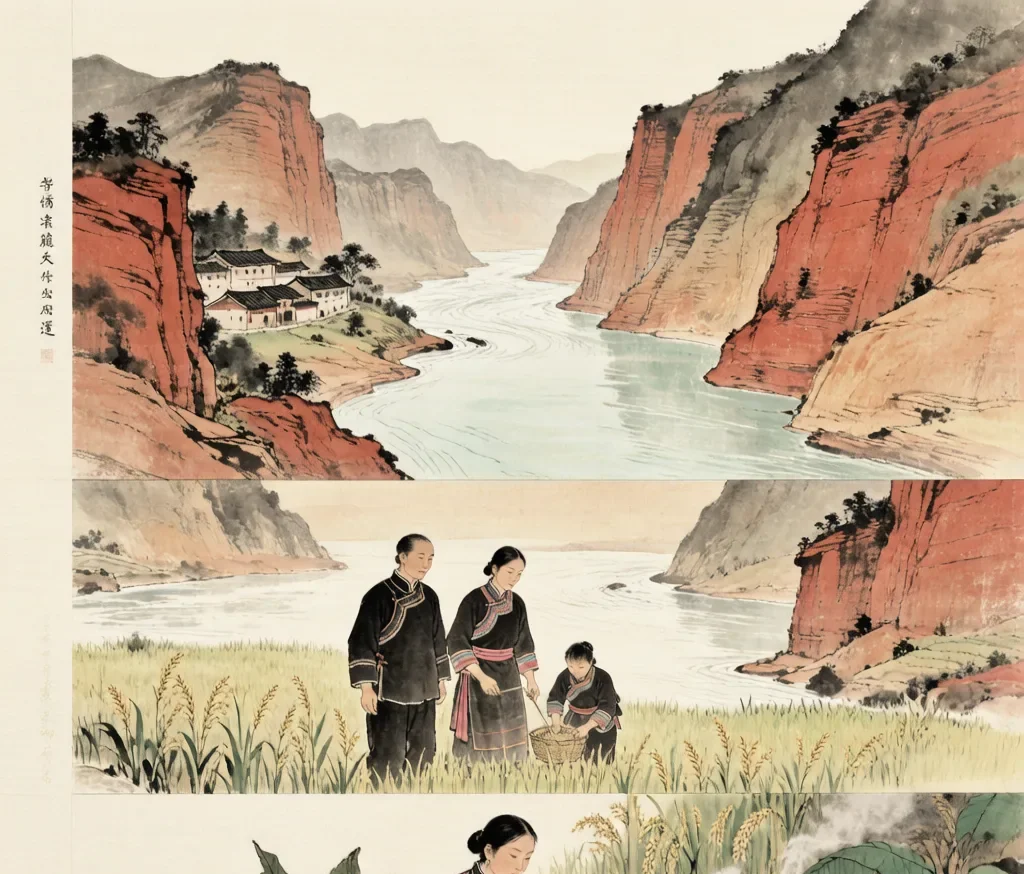
The Nu people, known in Chinese as the Nuzu (怒族), are one of the lesser-known indigenous minorities of southwest China, with a population of roughly 27,000 concentrated in the deep river valleys of northwest Yunnan. Centered in the Nujiang Lisu Autonomous Prefecture along the upper Salween River (Nujiang, or "Angry River," from which they take their name), the Nu have adapted to some of the most rugged terrain in the country. Their culture blends ancient animist and nature-worshipping traditions with later influences of Tibetan Buddhism and Christianity, and their material life — built around terraced agriculture, hunting, and the famed Nu crossbow — reflects a close, hard-won relationship with the mountains.
Origins and Homeland
The Nu are believed to be among the earliest inhabitants of the Nujiang valley, with oral tradition and linguistic evidence placing their ancestors in the eastern Himalayas long before the arrival of neighboring groups. The name "Nu" is thought to derive from the river that defines their homeland, a torrential waterway that both sustains and isolates the communities along its banks.
Today the Nu live primarily in Gongshan, Fugong, and Lushui counties of Yunnan, often sharing mountain slopes with the Lisu, Tibetan, and Derung peoples. The steep gorges of the Nujiang, hemmed in by the Gaoligong and Biluo snow mountains, have historically limited outside contact and helped preserve distinct local customs.
Language and Dialects
The Nu speak languages belonging to the Tibeto-Burman family, but the group is not linguistically uniform. The two principal branches are the Central Nu dialect (sometimes called Nusu) and the Northern dialect spoken near Gongshan, with additional local varieties that can be mutually unintelligible.
Crucially, the Nu have no traditional indigenous writing system. For daily literacy and administration they use Chinese characters, while in recent decades linguists have developed romanized scripts to record folk songs and rituals. This oral character means that much of Nu heritage survives through sung poetry and memorized chant rather than written text.
Traditional Belief Systems
Historically the Nu practiced a form of animism in which mountains, rivers, rocks, and trees were understood to host spirits that required respect and periodic appeasement. Shamans and ritual specialists mediated between the human and spirit worlds, conducting offerings to secure good harvests and safe passage.
From the north, Tibetan Buddhism spread among some Nu communities, especially those bordering Tibetan areas, layering monastery practices over older customs. In the early twentieth century, missionaries introduced Christianity to parts of the Nujiang, and a minority of Nu today identify as Christian, singing hymns in their own language.
The Fairy Festival
The most distinctive Nu celebration is the Xiannü Jie, or Fairy Festival, held in the third lunar month. It honors a legendary mountain fairy who, according to myth, descended to help the suffering people and was later venerated as a protector of the valley.
During the festival, villagers climb to a sacred cave, offer sacrificial foods, and sprinkle conifer branches with spring water while praying for health and abundance. Young people sing antiphonal love songs, and communities share feasts of cured pork, buckwheat cakes, and homemade liquor distilled from grain.
Livelihood and Subsistence
Traditional Nu subsistence combines slash-and-burn cultivation on mountain slopes with hunting and gathering. Maize, buckwheat, and millet are staple crops, supplemented by mountain herbs, wild vegetables, and game. The steep terrain makes irrigation difficult, so fields are often terraced or carved into narrow benches.
Fishing in the Nujiang, though dangerous because of the rapids, provides an important seasonal protein. In recent decades, the introduction of new crops and road access has shifted many Nu toward settled agriculture and wage labor, though subsistence habits persist in remoter villages.
The Nu Crossbow
The Nu are renowned makers and marksmen of the crossbow, an instrument central to both hunting and cultural identity. Crafted from hardwood and seasoned bamboo with hemp bowstrings, Nu crossbows are prized for accuracy at short range in dense forest.
Beyond its practical use, the crossbow features in courtship and sport: traditional contests test marksmanship, and a finely made bow may be presented as a token between families. The skill of fashioning and firing the crossbow remains a point of pride passed from father to son.
Clothing and Adornment
Nu dress varies by locality but generally features homespun linen and woven hemp in muted natural tones. Women wear long tunics with belts and embroidered aprons, while both sexes favor practical garments suited to the damp, cool mountain climate.
Ornament includes beaded necklaces, silver earrings, and, in some areas, woven bands worn across the chest. Cloth is traditionally dyed with indigo and decorated with simple geometric embroidery that signals community affiliation rather than elaborate status display.
Music, Song, and Oral Literature
Song is the backbone of Nu expressive culture. Work songs, lullabies, and epic narratives are performed without instruments or with simple flutes and stringed zithers. The antiphonal "dueting" style, in which a man and woman exchange lines, is especially associated with courtship.
Oral epics recount the origin of the people, the deeds of culture heroes, and the story of the mountain fairy. Because the Nu lack a native script, these performances are the principal vessel for historical memory and moral teaching.
Architecture and Settlement
Nu villages are typically strung along the river terraces or tucked into side valleys, with houses built of timber, stone, and packed earth. The traditional dwelling is a two-story structure: livestock occupy the lower level while the family lives above, close to the hearth that warms the living space.
Suspension bridges of twisted vine and, later, steel cable span the Nujiang's gorges, linking isolated hamlets to markets and schools. Such bridges are both engineering necessities and enduring symbols of Nu resilience in a fractured landscape.
Modern Changes and Preservation
Road construction, tourism along the Nujiang, and migration for work have brought rapid change to Nu life since the late twentieth century. Younger Nu increasingly speak Chinese as their first language, and many traditional practices are documented more by researchers than performed daily.
At the same time, county cultural bureaus and local elders have worked to record Nu songs, preserve the Fairy Festival, and promote handicrafts as a source of income. The tension between integration and preservation continues to shape how the Nu define their heritage in contemporary China.
❓ Frequently Asked Questions
Where do the Nu people live?
The Nu are concentrated in the Nujiang Lisu Autonomous Prefecture of northwest Yunnan, especially Gongshan, Fugong, and Lushui counties along the upper Salween River.
What language do the Nu speak?
They speak Tibeto-Burman languages with several dialects, but they have no native script and use Chinese for writing; romanized systems have been created to record songs.
What is the Fairy Festival?
Held in the third lunar month, it honors a mountain fairy with cave offerings, sprinkling of spring water, and community feasting and song.
Why is the crossbow important to the Nu?
It is a traditional hunting tool, a symbol of skill, and a gift item in courtship; marksmanship contests remain a cultural pastime.
What religions do the Nu follow?
Historically animism and nature worship, later joined by Tibetan Buddhism in northern areas and Christianity in some valleys.
How many Nu people are there?
China's Nu population is around 27,000, making them one of the smaller recognized ethnic minorities.