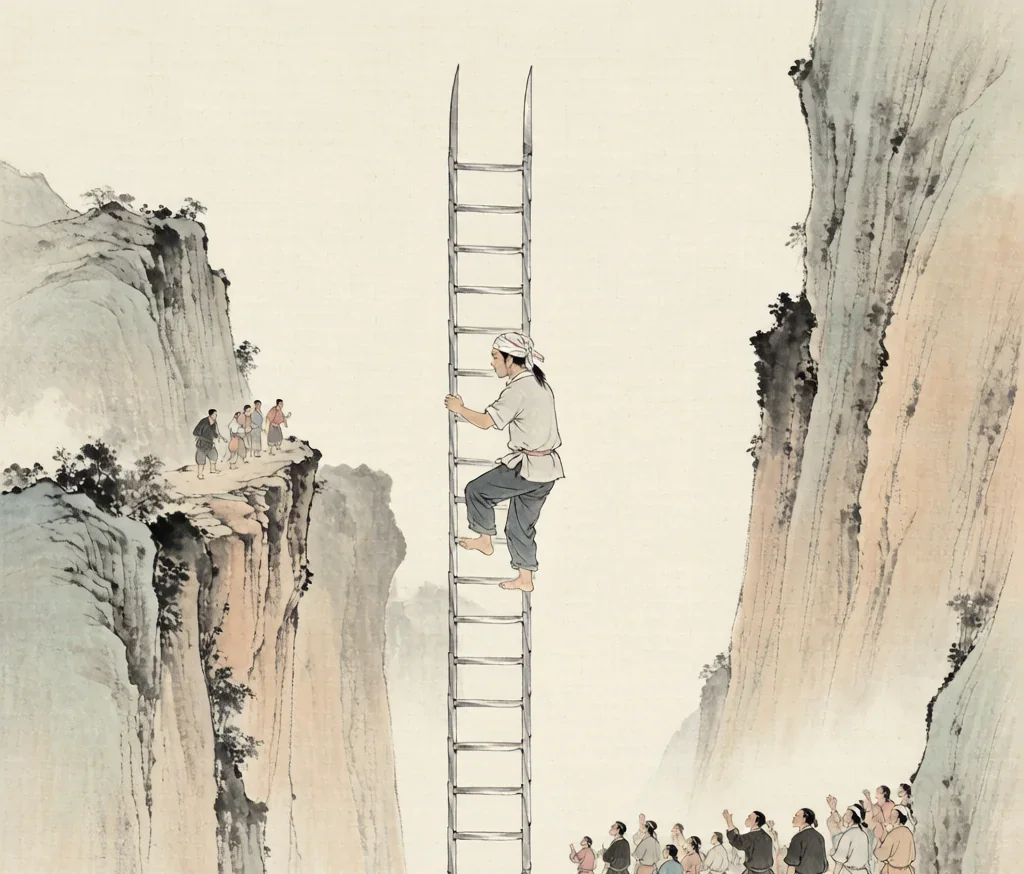
In the deep gorges of the Nujiang River in northwestern Yunnan, the Lisu people (傈僳族, Lì sù zú) maintain a culture of extraordinary vitality. With a population of approximately 763,000, the Lisu are known throughout China for the Knife Ladder Festival, where men climb ladders made of razor-sharp blades barefoot.
The Knife Ladder Festival
The Knife Ladder Festival (刀杆节, dāo gān jié) on the eighth day of the second lunar month commemorates a legendary Ming Dynasty general. The centerpiece is a tall pole with 36 razor-sharp blades lashed horizontally. Lisu ritual specialists (尼扒, ní bā) perform ceremonies invoking spiritual protection, then climbers ascend barefoot, stepping directly on the sharpened blades without being cut. The festival also features "walking through fire" (下火海, xià huǒ hǎi), where participants walk barefoot across beds of hot coals.
The Lisu New Year — Kuoshi Festival
The Kuoshi Festival (阔时节, kuò shí jié) is the Lisu New Year celebration. Communities gather for days of continuous celebration featuring traditional circle dances, singing, and archery competitions. The Lisu three-stringed lute (其奔, qí bēn) and bamboo mouth organ provide music. Young people use the festival for courtship through singing competitions.
Crossbow Culture
The Lisu are master crossbow makers and archers. The traditional Lisu crossbow (弩, nǔ) is made from laminated wood and bamboo, with arrows traditionally tipped with poison. Crossbow-making is a specialized craft passed through families, and the best crossbows are considered valuable heirlooms.
Language and Writing
The Lisu language uses the Fraser alphabet — a unique script of uppercase Latin letters, some inverted, developed by missionary James O. Fraser in the early 20th century for Bible translation. Christianity has had significant impact, with many Lisu identifying as Christian while maintaining elements of traditional animist beliefs.
More About This Ethnic Group
The ethnic minority groups of China represent an extraordinary tapestry of cultural diversity, stretching across the vast landscapes of this ancient land. With 55 officially recognized minority nationalities alongside the Han majority, each group contributes unique traditions, languages, and customs that have been carefully preserved and passed down through countless generations. These communities are primarily concentrated in the autonomous regions of Tibet, Xinjiang, Inner Mongolia, Ningxia, and Guangxi, as well as in the culturally rich provinces of Yunnan, Guizhou, Sichuan, and Qinghai, where some of the most diverse concentrations of ethnic cultures in the world can be found.
China's ethnic minority policies provide important protections for minority languages, cultural practices, and regional autonomy. Many minority communities have autonomous prefectures or counties where their languages are used in local government, education, and media. Traditional festivals, such as the Dai Water-Splashing Festival, the Yi Torch Festival, and the Mongolian Naadam, are celebrated with government support and draw visitors from around the world. These celebrations are not merely tourist attractions but living expressions of cultural identity that reinforce community bonds and transmit cultural knowledge to younger generations.
The cultural heritage of these communities extends to every aspect of daily life — from distinctive architectural styles adapted to local environments, to colorful traditional costumes that encode social information through their patterns and designs, to unique musical instruments and dance forms that express the community's relationship with nature and the cosmos. Embroidery, silverwork, textile weaving, paper-cutting, and countless other handicrafts continue to thrive in minority regions, with many recognized as national or even UNESCO Intangible Cultural Heritage. These crafts are not frozen museum pieces but living traditions that evolve while maintaining their essential character.
In recent decades, concerted efforts to document and preserve minority languages and oral traditions have intensified across China. Scholars and cultural workers collaborate with community elders to record epic poems, folk songs, creation myths, and traditional ecological knowledge before they fade from living memory. Many minority languages that once had no written form now have standardized writing systems, and bilingual education programs help ensure that children can learn both their mother tongue and Mandarin Chinese. Museums, cultural centers, and digital archives have been established to safeguard this heritage for future generations.
Tourism has also played a significant role in the revitalization of minority cultures, offering economic opportunities while raising awareness of the importance of cultural preservation. Ethnic tourism allows visitors to experience traditional architecture, sample distinctive cuisines, purchase handmade crafts directly from artisans, and participate in local festivals. When managed responsibly, this engagement provides income that supports the continuation of traditional practices and gives communities a stake in preserving their cultural heritage. For travelers and culture enthusiasts, visiting minority villages and participating in local festivals offers an authentic window into China's remarkable cultural mosaic and the enduring vitality of its ethnic traditions.
China's Ethnic Diversity
China is home to 56 officially recognized ethnic groups, including the Han majority and 55 minority nationalities. These minority communities are primarily concentrated in autonomous regions and provinces such as Yunnan, Guizhou, Sichuan, Guangxi, Xinjiang, Tibet, and Inner Mongolia. Each ethnic group has its own distinct language, customs, traditional costumes, and festivals, contributing to the rich cultural mosaic of the nation.
In recent decades, significant efforts have been made to document and preserve the languages, oral traditions, and cultural practices of China's ethnic minorities. Many traditional crafts, festivals, and art forms have been recognized as National Intangible Cultural Heritage, ensuring their protection and transmission to future generations. Through cultural tourism, academic research, and government support, these unique traditions continue to thrive and gain appreciation both within China and internationally.