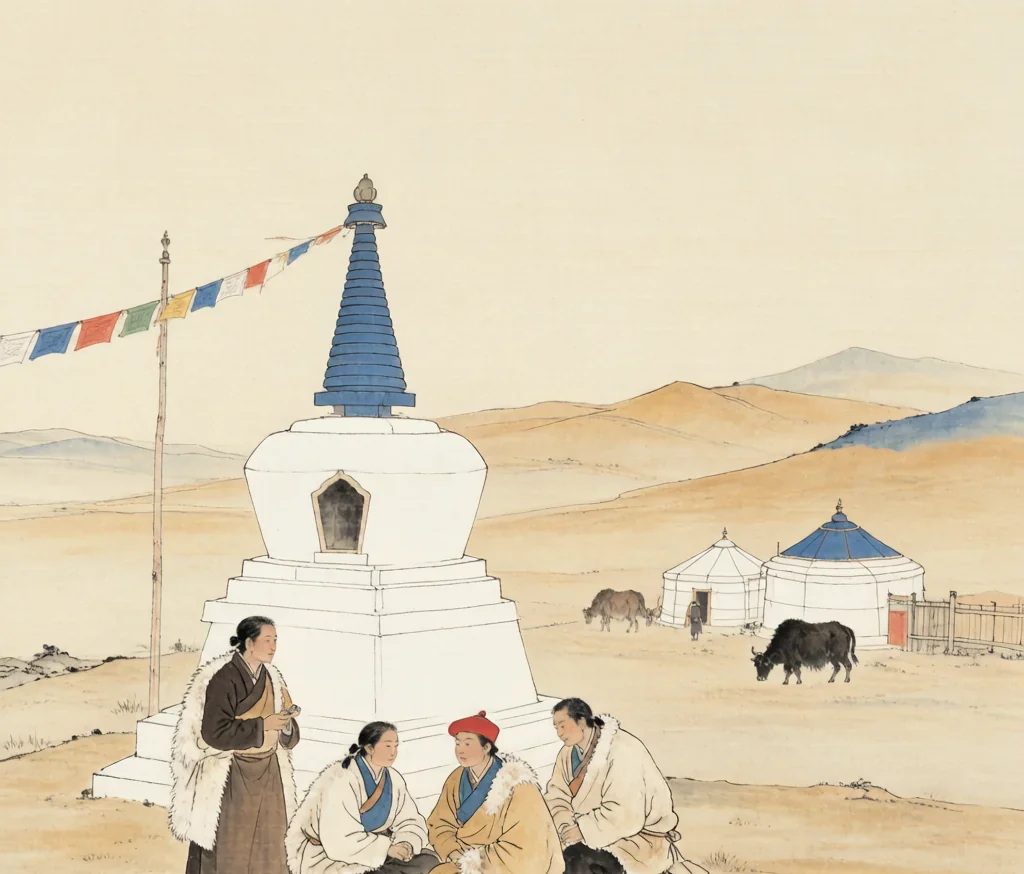
High on the Tibetan Plateau, at an average elevation exceeding four thousand meters above sea level, thrives one of the world's most distinctive cultures. The Tibetan people, known in Chinese as 藏族 (Zàng zú), have carved out a civilization on the "Roof of the World" that has endured for over a millennium. Their culture — a remarkable fusion of ancient indigenous traditions and Tibetan Buddhism — has produced some of humanity's most profound spiritual literature, most breathtaking architecture, and most resilient ways of life.
The Land That Shapes the People
Geography is destiny, and nowhere is this more true than on the Tibetan Plateau. The thin air, intense ultraviolet radiation, extreme temperature swings, and relative scarcity of oxygen have shaped every aspect of Tibetan life. The human body itself adapts to high-altitude living — Tibetans have genetic adaptations that allow more efficient oxygen utilization, a biological testament to thousands of years of life in this demanding environment.
The traditional Tibetan economy centers on nomadic pastoralism and high-altitude agriculture. The yak, that shaggy, magnificent bovine uniquely adapted to high altitudes, is the cornerstone of traditional Tibetan life. It provides meat, milk, butter, cheese, wool, leather, and fuel (in the form of dried dung). It serves as a beast of burden, carrying loads across mountain passes where wheeled vehicles cannot go. The relationship between Tibetan and yak is not merely economic but cultural and even spiritual — the yak appears in Tibetan mythology, art, and ritual as a symbol of strength, endurance, and the untamed power of the natural world.
Barley, particularly the hardy highland barley known as 青稞 (qīng kē), is the staple crop. Unlike rice or wheat, highland barley can mature in the short growing season at high altitudes, providing the grain that is roasted and ground into tsampa (糌粑, zán bā) — the roasted barley flour that has been the foundation of the Tibetan diet for centuries. Mixed with yak butter tea and kneaded into dough, tsampa provides concentrated energy perfectly suited to high-altitude living.
The Potala Palace: Heart of Tibetan Civilization
Rising from Red Hill in the center of Lhasa, the Potala Palace is perhaps the most iconic architectural achievement of Tibetan civilization. Built in the 17th century under the Fifth Dalai Lama, this thirteen-story structure contains over a thousand rooms, countless chapels, and the tombs of eight Dalai Lamas. Its white and red walls, visible from miles away, dominate the Lhasa skyline as they have for over three hundred years.
The Potala is not merely a building but a microcosm of the Tibetan Buddhist universe. Its architecture follows precise religious principles, with the White Palace representing secular authority and the Red Palace representing spiritual power. The building's orientation, proportions, and decorative program all reflect Buddhist cosmology. The murals that cover its interior walls depict not only religious subjects but also historical events, providing a visual record of Tibetan history that complements written sources.
Beneath the Potala's grandeur lies the Jokhang Temple, the spiritual heart of Tibetan Buddhism. Built in the 7th century by King Songtsen Gampo, the Jokhang houses the Jowo Rinpoche, a statue of the Buddha at age twelve that is the most revered object in Tibetan Buddhism. Pilgrims from across the Tibetan world travel to the Jokhang, many prostrating themselves every few steps along journeys that can take months or years, to circumambulate the temple and pay homage to this sacred image.
Prayer Flags and the Wind Horse
Among the most visible and beautiful expressions of Tibetan culture are the prayer flags that flutter from mountain passes, rooftops, and temple courtyards throughout the Tibetan world. These rectangular cloth flags, printed with mantras, prayers, and auspicious symbols, come in five colors representing the five elements: blue for sky, white for cloud, red for fire, green for water, and yellow for earth. The central image is often the Wind Horse (lung ta), carrying the Three Jewels of Buddhism on its back.
The flags are not prayers to a deity in the Western sense. Rather, they operate on the principle that the wind, passing over the printed prayers, carries their blessings to all beings. As the flags fade and fray in the mountain winds, the prayers are released into the world. This is a characteristically Tibetan understanding of spiritual practice — not confined to temples or meditation cushions but woven into the very fabric of the physical environment, carried by the wind that blows across the plateau.
The hanging of new prayer flags is a significant event, timed according to the Tibetan calendar to ensure maximum auspiciousness. Old flags are never thrown away but are burned, the smoke carrying the final residue of their blessings to the heavens. The cycle of raising, fading, and releasing mirrors the Buddhist understanding of impermanence — all things arise, abide, and pass away, and beauty is found in every stage of the process.
Thangka: Sacred Art on Silk
Thangka painting represents one of the great artistic traditions of Asia. These scroll paintings on cotton or silk, usually depicting Buddhist deities, mandalas, or the lives of saints, serve as aids to meditation and teaching tools. The creation of a thangka is itself a spiritual practice — artists must follow precise iconographic rules, recite mantras while working, and maintain a pure mind and body throughout the process that can take months for a single painting.
The materials used in thangka painting reflect the sacred nature of the art. Pigments are ground from precious and semi-precious minerals — lapis lazuli for blue, malachite for green, cinnabar for red, and gold for the halos and ornaments of deities. The resulting colors have a luminosity and depth that synthetic pigments cannot match, and thangkas centuries old retain their vibrancy. The gold used in particularly fine thangkas is applied in thin sheets and then burnished with agate tools, creating a shimmering surface that seems to glow from within.
Thangkas serve multiple functions in Tibetan religious life. Large thangkas are displayed at festivals, unrolled down the sides of buildings for public veneration. Smaller thangkas are used in private meditation, the practitioner visualizing the deity depicted until the image can be held in the mind without external support. Traveling lamas carry thangkas rolled in silk, using them to teach in villages that may not have permanent temples. In all these contexts, the thangka is not merely art but a window into the sacred, a bridge between the material world and the realms of enlightened beings.
Losar: The Tibetan New Year
Losar, the Tibetan New Year, is the most important festival in the Tibetan calendar. Its origins predate the arrival of Buddhism in Tibet, rooted in the ancient Bon religion's winter ceremonies. Today, Losar is a multi-day celebration that blends religious observance with family gatherings, feasting, and community festivities.
Preparations for Losar begin weeks in advance. Homes are thoroughly cleaned, symbolizing the removal of the old year's accumulated negativities. Special foods are prepared, including kapse (deep-fried pastries twisted into intricate shapes) and dresi (sweetened rice with butter and dried fruits). On the eve of Losar, families prepare guthuk, a noodle soup containing nine ingredients, one of which is a dough ball concealing a symbolic object — a piece of wool for kindness, a chili pepper for a sharp tongue, a piece of coal for a dark heart. The discovery of these objects prompts laughter and self-reflection.
The first day of Losar is devoted to family. New clothes are worn, and the eldest family members are honored with the serving of the first cups of chang (barley beer) and yak butter tea. The second day brings visits to monasteries and the hanging of new prayer flags. The third day features community celebrations with horse racing, archery competitions, and traditional dancing. Throughout, the spirit is one of renewal — of relationships, of spiritual commitments, and of hope for the year ahead.
Yak Butter Tea and Tibetan Cuisine
Tibetan cuisine has evolved to meet the extraordinary demands of high-altitude living. The foundation of the traditional diet is tsampa, supplemented by yak meat, dairy products, and whatever vegetables can be grown or traded for. The most distinctive Tibetan beverage is yak butter tea (酥油茶, sū yóu chá) — a mixture of brick tea, yak butter, and salt, churned together until emulsified into a rich, soup-like drink.
To the uninitiated palate, yak butter tea can be challenging — it is salty, greasy, and unlike any tea consumed elsewhere in the world. But its purpose is functional as much as gustatory. The high fat content provides essential calories for high-altitude living. The salt replaces electrolytes lost through the increased respiration that thin air demands. The tea itself, imported from China's tea-growing regions, provides vitamins and antioxidants otherwise scarce in the Tibetan diet. A thermos of butter tea is the constant companion of nomads and monks alike, sustaining them through long days of work or meditation.
Tibetan hospitality is legendary, and the serving of butter tea is its central ritual. A guest's cup is never allowed to remain empty — the host continuously tops it up, a gesture of care and respect. The proper response is to take small sips, never draining the cup completely unless one is ready to leave. This tea ritual, repeated countless times daily across the Tibetan world, weaves the fabric of social connection in a land where isolation is always a threat.
Tibetan culture, forged in one of the world's most demanding environments, stands as a testament to human adaptability and creativity. From the monumental architecture of the Potala to the intimate ritual of butter tea, from the soaring philosophy of Tibetan Buddhism to the practical wisdom of nomadic pastoralism, this culture has achieved a profound integration of the spiritual and the material, the eternal and the everyday. On the roof of the world, Tibetans continue to live a way of life that challenges and inspires the imagination of all who encounter it.
The Tibetan Script and Written Word
The Tibetan writing system was devised in the seventh century during the reign of King Songtsen Gampo, traditionally by the scholar Thonmi Sambhota, who modeled it on an Indic script. Its alphabet of thirty consonant letters and four vowels is written left to right and is phonetically precise, making it well suited to recording both the spoken language and the exact pronunciation of Sanskrit Buddhist texts. For more than a thousand years the script has carried Tibet's vast literary heritage, from classical poetry and histories to the enormous Buddhist canon known as the Kangyur and Tengyur. Monastic colleges trained generations of scribes to copy and illuminate these works by hand. Even today the same script unifies Tibetan communities across the plateau and in the diaspora, linking everyday literacy to one of Asia's great textual traditions.
Traditional Tibetan Medicine
Tibetan medicine, known as Sowa Rigpa or 'the science of healing,' is a holistic medical system practiced on the plateau for well over a thousand years. It rests on the Buddhist understanding that illness arises from an imbalance among the body's three humors — roughly analogous to wind, bile, and phlegm — together with diet, climate, and conduct. Practitioners diagnose through pulse-reading, urine analysis, and observation, then treat with herbal and mineral compounds, diet, external therapies, and behavioral guidance. Many remedies use plants gathered from the high meadows and minerals processed by lengthy traditional methods. Deeply intertwined with Buddhist philosophy, Sowa Rigpa views health as harmony between body, mind, and environment. Today it remains a living tradition, taught in dedicated colleges and clinics across the Tibetan regions alongside modern medicine.
❓ Frequently Asked Questions
The Tibetan people (藏族, Zàng zú) live mainly on the Tibetan Plateau, spanning the Tibet Autonomous Region and parts of Qinghai, Sichuan, Gansu, and Yunnan.
The Potala Palace in Lhasa is the most iconic Tibetan building, built in the 17th century. This 13-story structure contains over 1,000 rooms and the tombs of eight Dalai Lamas.
Yak butter tea (酥油茶) is the traditional Tibetan beverage, made from brick tea, yak butter, and salt. Its high fat content provides essential energy for high-altitude living.
Losar is the Tibetan New Year, the most important Tibetan festival, celebrated with family gatherings, special foods, monastery visits, and the hanging of new prayer flags.
Tibetans speak Tibetan, a member of the Tibeto-Burman language family, in many regional dialects. It is written in a distinctive script devised in the seventh century and based on an Indic writing system.
Monasteries have long been religious, educational, and economic centers of Tibetan communities, training monks, preserving texts, and hosting festivals, though their social role has changed considerably over time.
📝 Chinese Vocabulary
- 藏族 (Zàng zú) — The Tibetan ethnic group; literally "Tibetan people"
- 青稞 (qīng kē) — Highland barley; the staple grain of the Tibetan Plateau
- 糌粑 (zán bā) — Tsampa; roasted barley flour, the foundation of the Tibetan diet
- 酥油茶 (sū yóu chá) — Yak butter tea; the distinctive Tibetan beverage
- 唐卡 (táng kǎ) — Thangka; Tibetan Buddhist scroll painting on cotton or silk
🎉 Fun Facts
- Tibetans have a unique genetic adaptation — a variant of the EPAS1 gene inherited from Denisovans (an extinct human species) — that allows them to thrive at altitudes where most people would suffer from chronic mountain sickness.
- The Potala Palace contains the tomb of the Fifth Dalai Lama, which is covered in nearly four tons of gold — making it one of the most valuable single objects in the world.
- Traditional Tibetan sky burial, in which the deceased's body is offered to vultures, reflects the Buddhist value of non-attachment to the physical body and the practical reality that wood for cremation is scarce on the treeless plateau.
- Tibetan monks create colorful butter sculptures (torma) for festivals such as Monlam, working in cold conditions so the fragile carvings will not melt.
- Tibetan Buddhist monks build elaborate sand mandalas from colored grains and then deliberately dismantle them to teach the impermanence of all things.
- The Qinghai-Tibet Railway, opened in the 21st century, is the highest railway in the world, crossing the plateau at elevations above five thousand meters.