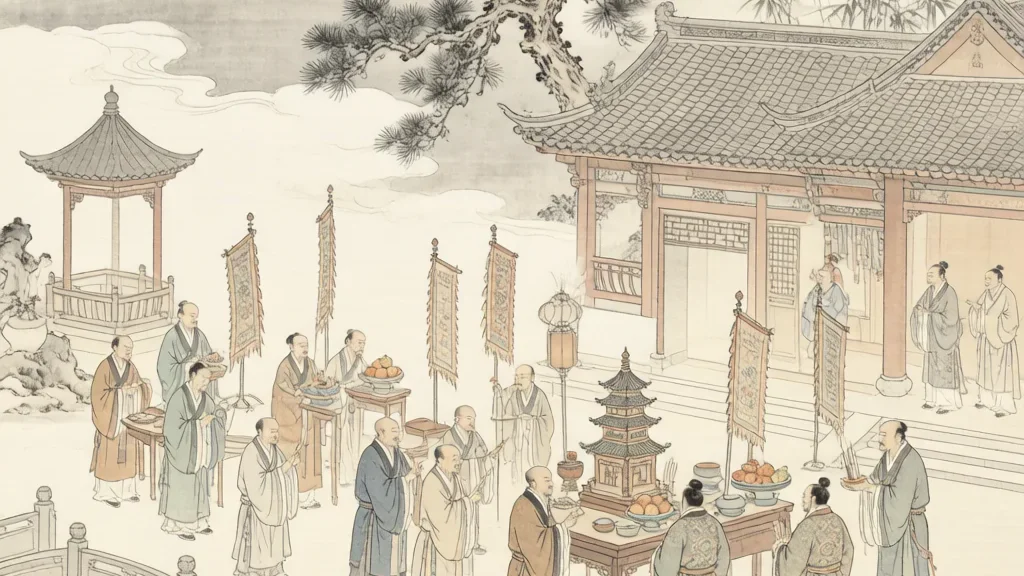
The Festival of a Hundred Gods (祭百神) is the village's great introduction — a day when the whole local pantheon is invited out for a walk. Wooden and paper images of the gods are lifted onto palanquins and carried through the streets so that every household can greet them, ask a favor, and send them home blessed. For northern Han communities this procession of many deities is less worship of one high god than a neighborhood meeting with all the powers that guard the fields, the hearth, and the year.
What "Hundred Gods" Means
In Chinese folk religion "hundred gods" (百神, bǎi shén) is not a precise count but a way of saying "all the spirits at once." A village's pantheon blends great state-decreed deities with intensely local ones — the god of the river bend, the lady of the well, the guardian of the bridge. To honor the hundred gods is to honor the whole web of place.
So a Festival of a Hundred Gods is really any communal rite that parades or feeds the multitude of local deities together. The same logic appears under many names — 迎神 (yíng shén, welcoming the gods), 赛神 (sài shén, thanking the gods), 游神 (yóu shén, touring the gods) — but the aim is constant: gather the neighborhood's protectors into one shared act of respect.
Ancient Roots
The habit is ancient. The classic La sacrifice (蜡祭, là jì), a Zhou-dynasty year-end thanksgiving recorded in the Liji (礼记, "Book of Rites") and the Shijing (诗经, "Book of Songs"), was offered expressly to the hundred spirits (百神) — the gods of soil, grain, field boundaries, waterways, and even the cats and tigers that protected the crops.
Village earth-altar rites (社祭, shè jì) and the imperial welcoming-the-gods ceremonies of later dynasties carried the custom forward for over two thousand years. What a modern northern village does with lanterns and opera is the descendant of a sacrifice the Zhou court performed to thank the spirits for the harvest — continuity measured in millennia.
The Procession of the Gods
The centerpiece is the procession (迎神赛会, yíng shén sài huì). At dawn the god-images are carried from the temple on ornate palanquins (神轿, shén jiào) shouldered by teams of young men, who jog and sway the litter to show the god's liveliness. Drums, gongs, and firecrackers clear the way; flags and umbrellas mark the god's rank as the column winds past every lane.
In southern cousins of the rite the custom is called 游神 (yóu shén, "touring the gods") and can last days, with images lodging overnight in different hamlets. The physical movement — god visiting people, not people visiting god — is the point, and a chief purpose is to pray for rain and a good harvest as the gods pass each gate.
The Pantheon Honored
A single Hundred Gods procession may carry a surprising roll call. The City God (城隍, chéng huáng) judges and protects the town; the Earth God (土地神, tǔ dì shén) guards fields and lanes; the Dragon King (龙王, lóng wáng) controls rain; the Kitchen God (灶神, zào shén) reports each family to heaven. Door Gods (门神, mén shén) guard thresholds, and the God of Wealth (财神, cái shén) brings fortune.
Layered on top come culture heroes and favored saints: Guandi (关帝, guān dì, god of loyalty and war), the Queen of Heaven Mazu (妈祖, mā zǔ) by the sea, the Medicine King for health, and local worthies raised to divinity after death. The hundred is the sum of all these needed powers — a spiritual directory for daily life.
Rituals and Offerings
Before and during the procession, priests or lay elders make offerings: incense, candles, and the three animals (三牲, sān shēng) of pig, sheep, and fowl, plus rice, fruit, and steamed cakes. Prayers are read aloud and talismans burned so the words reach the spirits, while households set out tables at their gates for the passing god to "eat" the aroma of the food.
Taoist or Buddhist clergy may be invited to chant scriptures that settle wandering ghosts and certify the blessing. The mood is festive but earnest: the gods are honored as guests of honor, fed and entertained, then respectfully seen off. The relationship is reciprocal, not one-sided.
Temple Fairs and Opera
A Hundred Gods festival rarely ends at the procession; it spills into a temple fair (庙会, miào huì). Stalls sell snacks, toys, and charms; storytellers and acrobats perform; and a stage is raised for opera (神戏, shén xì, "god's opera") played through the night because the gods are the chief audience. The most honored shows are offered directly before the temple.
In some places the gods themselves "ride" elaborate floats called 抬阁 (tái gé, "raised pavilions"), where costumed children pose as immortals atop stacked frames. The fair turns solemn worship into a communal carnival, and the commerce it draws has kept the festival alive when pure ritual alone might have faded.
Regional Variations
Northern Han villages keep the custom under local names and accents. In Hebei and Shanxi, 迎神赛会 often ties to the spring 庙会 and to rain-praying for the wheat. Along the canals of the northeast, processions honor river and bridge gods. The famous southern 游神 of Fujian, Guangdong, and Taiwan — including the exuberant Putian (莆田) rites — are cousins that carry the same logic south.
Where a village was founded by migrants, the pantheon travels with them, so a northern-style Hundred Gods fair can appear far from its origin. The variations are endless, yet the grammar is shared: carry the images, feed them, let the people feast, send them back. Local color changes; the structure holds.
Modern Survival
Like many folk rites, the Hundred Gods festival faded under twentieth-century upheaval, then partly returned as heritage and tourism. Some processions are now staged for cameras, with god-images carried by performers in costume. Yet in countless villages the old rhythm persists: the temple is swept, the litter polished, and the gods walked at the appointed time.
Officials sometimes recast the event as intangible cultural heritage or a local culture week, softening the religious edge while keeping the pageantry. For participants the meaning is little changed — a chance to honor the powers that guard home, and to gather the whole village in one street at once.
Cultural Meaning
The Festival of a Hundred Gods reveals how Han folk religion actually works: not as a creed but as a relationship, maintained deity by deity, household by household. To invite a hundred gods for a walk is to admit that life is governed by many forces — rain, soil, health, wealth, the dead — and that all of them deserve a greeting.
In an age of distant cities, the procession still does what it always did: it puts the whole neighborhood in one moving circle, reminds people who their local guardians are, and lets a village introduce itself to its own gods. To walk the hundred gods is to remember that a community is held together by more than walls — by the shared powers it chooses to honor.
❓ Frequently Asked Questions
📝 Chinese Vocabulary
百神 — : hundred gods; the full local pantheon.
祭百神 — : sacrifice to the hundred gods; the festival rite.
迎神赛会 — : welcoming-the-gods procession; the festival parade.
游神 — : touring the gods; southern cousin of the procession.
城隍 — : City God; protector and judge of the town.
土地神 — : Earth God; guardian of fields and lanes.
龙王 — : Dragon King; controller of rain.
灶神 — : Kitchen God; reports the family to heaven.
庙会 — : temple fair; the festival market and opera.
抬阁 — : raised pavilion; a float carrying costumed children.
🎉 Fun Facts
- The ancient La sacrifice (蜡祭) was offered to the hundred spirits and is recorded in the Liji (Book of Rites) and Shijing (Book of Songs).
- Hundred gods (百神) is figurative — it means all the local deities at once, not a literal number.
- The City God (城隍) and Earth God (土地) are among the most common deities carried in northern processions.
- The southern 游神 (touring-the-gods) rites of Fujian, Guangdong, and Taiwan are close cousins of the northern Hundred Gods fair.
- Temple fairs (庙会) grew around these processions, mixing worship with markets, opera, and acrobatics.
- The Kitchen God (灶神) is believed to report each family's behavior to heaven at year's end.
- Many villages now hold the festival as recognized intangible cultural heritage rather than only as worship.