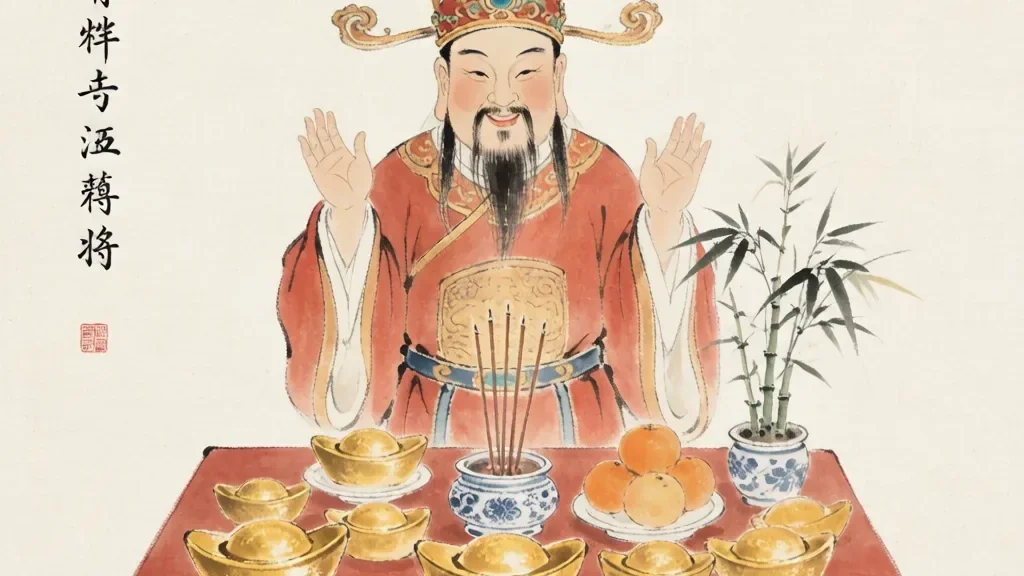
The God of Wealth's Birthday (财神诞, Caishen Dan) is one of the happiest days in the Chinese lunar calendar — a moment when families and businesses welcome prosperity with incense, offerings, and firecrackers. Most popularly kept on the fifth day of the first lunar month, it joins ancient folk belief with the very modern hope for a flourishing year of trade and income.
Who Is the God of Wealth?
Chinese folk religion knows not one but many Gods of Wealth. The most revered is Zhao Gongming (赵公明), a Taoist immortal who rides a black tiger and carries a golden whip; in the Ming novel Investiture of the Gods he is made marshal of the wealth spirits. Beside him stand Bi Gan (比干), the "civil" God of Wealth — a Shang minister whose heart was cut out, so he judges riches without favor — and Fan Li (范蠡), the merchant-sage of the Spring and Autumn period honored as patron of businessmen.
Other forms include Guan Yu (关羽), the red-faced general worshipped by traders as the "martial" God of Wealth, and the Five Road Gods of Wealth (五路财神), who bring fortune from east, south, west, north, and center. This crowding of deities expresses a practical faith: prosperity is best courted from every direction at once.
This rich pantheon also shows how Chinese folk religion localizes the divine. A family might keep a paper image of Zhao Gongming at home, bow to Tudigong at the neighborhood shrine, and still honor Guan Yu in the shop. Wealth, in this worldview, is less a single fortune than a web of relationships to be tended with regular respect.
The Fifth Day and the Breaking of Five
The great popular celebration falls on the fifth day of the first lunar month, Po Wu (破五, "Breaking of the Five"). During the New Year's first five days households keep taboos — no sweeping, no harsh words — and Po Wu is when they end. Families clean thoroughly, sweeping dust out the front door to drive off poverty, then turn to welcoming Caishen, believed to descend that night.
Because the fifth day also serves as Caishen's birthday in everyday custom, it matters greatly to merchants. Shops reopen with ceremony (开市, "opening the market"), and midnight firecrackers both greet the descending deity and scare away lingering misfortune.
The Po Wu taboos themselves reveal the day's logic. Sweeping was forbidden for five days so as not to brush luck out the door; once Po Wu arrived, the dust was swept firmly outward, carrying the old year's ills with it. The simple act of cleaning thus became an act of invitation.
Welcoming the God of Wealth at Midnight
At midnight between the fourth and fifth days, households light incense and set off firecrackers to welcome Caishen (迎财神). The first to offer incense is thought to gain the richest blessing, so temple yards fill before dawn. A paper image or tablet of the god is placed on the altar, and family members bow in order of age, voicing hopes for a profitable year.
City apartments have replaced courtyards, but the custom lives on in balconies and screens: people send digital greetings, light virtual incense, and share red-envelope animations. The core remains a shared, hopeful invitation for abundance to enter the home.
In the countryside the welcome could be elaborate. A family elder paced the courtyard with burning paper, "leading" the god inside, while children covered their ears against the crackers. The belief that Caishen enters through the door at the lucky hour made the threshold the most charged spot in the house that night.
Offerings and Lucky Foods
The altar bears foods chosen for lucky wordplay. Dumplings (饺子) are folded like yuanbao (元宝), the silver ingots of old, so eating them "bites into wealth." A whole fish (鱼) is served since its name sounds like surplus (余), and prosperity cake (发糕) is steamed to rise and split — a promise that fortune will climb in the year ahead.
Roast pork, fruit, and rice are set facing the year's wealth position (财位), a direction read from the lunar calendar. Incense and paper spirit-money are burned so the gift reaches the god; afterward the sacred foods are shared by the family, turning worship into a feast.
Beyond the table, shops sold Caishen prints and gold-foil "ingots" to paste on doors and ledgers. The visual language of wealth — red, gold, rounded shapes — turned the whole household into a small altar of prosperity, blurring the line between decoration and devotion.
Temples and the Wealth Position
Temples to Caishen draw devoted crowds. The deity's traditional homeland is Zhouzhi County in Shaanxi, where a large Zhao Gongming temple complex stands; major shrines also thrive in Beijing, Shanghai, and the southeast. On the birthday, worshippers queue for the first incense, and temple fairs (庙会) appear with fortune-tellers and sellers of gold-painted Caishen figures.
Devotees also consult the annual wealth direction, placing a statue or red envelope in the matching corner of home or shop. The idea that prosperity has a bearing gives the festival a tactile quality — wealth is something you position as carefully as furniture.
On the birthday the largest crowds gather before dawn, and temple managers auction the "first incense" (头香) to the highest bidder, the sum often given to charity. The custom shows how commerce, competition, and piety intertwine at a Caishen temple.
Business Rituals and the Opening of Accounts
Nowhere is the festival graver than in commerce. Traditional shops "open the accounts" (开账) on the fifth day, closing the old ledger and starting a new one with an auspicious entry. Lion and dragon dances parade past doorways, and the first customer of the year is often given a small gift to ensure a steady stream of patrons.
Old guilds staged grand Caishen processions through market towns. Today corporations hold morning rites, hang red banners reading "招财进宝" (summon wealth and treasure), and photograph staff bowing to a Caishen portrait before business begins.
Accountants treated the reopened ledger almost as a sacred object, writing the first line in red and never crossing it out. A clean, hopeful account was thought to please Caishen as much as any incense, linking honesty in bookkeeping directly to blessing.
Regional and Local Variations
Customs differ by region and trade. Northern cities prize the fifth-day firecracker welcome; in parts of the south, especially among Cantonese merchants, Caishen's birthday is also kept on the twenty-second of the seventh lunar month with temple rites of its own. Some trades revere a patron — Shanxi merchants favor Guan Yu, while ferrymen once honored Liu Hai (刘海) with his coin string and golden toad.
Overseas Chinese add local color. In Southeast Asia, Hokkien and Teochew associations host grand Caishen banquets; in Hong Kong, temple fairs at Cheung Chau and elsewhere blend the wealth cult with neighborhood custom.
In Taiwan and parts of Southeast Asia the birthday folds into the wider New Year calendar with parades and "fortune boats" (平安船) that carry away the year's ills. The festival thus travels with migrant communities, adapting its forms while keeping its central wish for security and surplus.
Modern Commercial Celebration
In the digital age the God of Wealth has moved online. E-commerce sites launch "Caishen sales" near the New Year, and payment apps shower users with animated red envelopes and "wealth cards." Live-streamers dress as Caishen to host shopping events, turning an old rite into a marketing occasion.
Yet warmth persists: offices pose by a Caishen poster, children get coins stamped with his face, and "恭喜发财" (may you prosper) travels door to door. Commerce and blessing have become one.
Brands now issue limited "Caishen" merchandise — coins, figurines, even red envelopes with QR codes — turning the deity into a seasonal mascot. Critics call it commercialization, but devotees see continuity: the god has always blessed trade, and trade now simply speaks digitally.
Cultural Meaning of Wealth
To outsiders, Caishen worship can look like greed, but within folk culture wealth is tied to family security, the duty to honor ancestors, and the obligation to share. The God of Wealth is less a fetish than a symbol of order and fair exchange — give offerings, keep honest books, and fortune will flow around.
So the birthday is a yearly moral reset: a resolve to trade justly, provide for kin, and welcome good luck for the community too. That is why the same figure guarding the cash drawer also guards the home altar.
Read against the lunar New Year as a whole, the birthday is its economic climax. After days of family reunion, attention turns outward to livelihood and exchange. Caishen thus closes the private holiday and opens the public year of work.
❓ Frequently Asked Questions
📝 Chinese Vocabulary
财神诞 — : Caishen Birthday; the God of Wealth festival.
赵公明 — : Zhao Gongming; the chief God of Wealth.
破五 — : "Breaking of the Five"; the fifth lunar day.
迎财神 — : welcoming the God of Wealth at midnight.
元宝 — : silver ingot; dumpling shape symbolizing wealth.
发糕 — : prosperity cake; rising steamed cake.
财位 — : wealth position; the lucky direction of the year.
五路财神 — : Five Road Gods of Wealth (five directions).
招财进宝 — : "summon wealth and treasure"; an auspicious phrase.
开市 — : opening the market; reopening shops after New Year.
🎉 Fun Facts
- Zhao Gongming's traditional temple complex stands in Zhouzhi County, Shaanxi, regarded as his homeland.
- The fifth-day midnight firecracker welcome is so loud in many cities that some local governments have restricted it for noise and safety.
- "恭喜发财" (may you prosper) is the festival's most common greeting, often paired with red packets.
- Guan Yu, the martial God of Wealth, is especially revered by Shanxi merchants and many shopkeepers.
- The Five Road Gods of Wealth correspond to the four cardinal directions plus the center.
- Digital red envelopes and "wealth cards" on payment apps have become a modern form of the old blessing.
- Bi Gan, the civil God of Wealth, is said to judge riches impartially because his heart was removed.