Long before Chang'an or Beijing, a capital rose on the banks of the Huan River in the heart of the Yellow River plain, and there the Chinese written language was born. Anyang (安阳, ān yáng) was the site of Yin (殷, Yīn), the late capital of the Shang dynasty (商, Shāng), and from its soil came the oracle bones — the earliest substantial Chinese writing we possess. Anyang is the capital that lets us read the thoughts of a Bronze Age court, and it is the threshold of recorded Chinese history.
Founding and the Shang at Yin
The Shang were the first Chinese dynasty attested both in later texts and by archaeology. Around 1300 BCE, the ruler Pan Geng moved the capital to a place later called Yin, near modern Anyang, and there the last nine Shang kings reigned for roughly two and a half centuries until the dynasty fell to the Zhou around 1046 BCE. The site, known to the Shang simply as the royal seat, was abandoned after the conquest and buried under fields for three thousand years, remembered only as a half-legendary name until the bones surfaced again.
Unlike the planned grids of later capitals, Yin was a sprawling, loosely organized complex of palace foundations, workshop areas, and elite tombs strung along the Huan River. Its power rested not on walls alone but on bronze, ancestor worship, and the labor of a stratified society that fed, armed, and divined for its kings.
The Role of a Bronze Age Capital
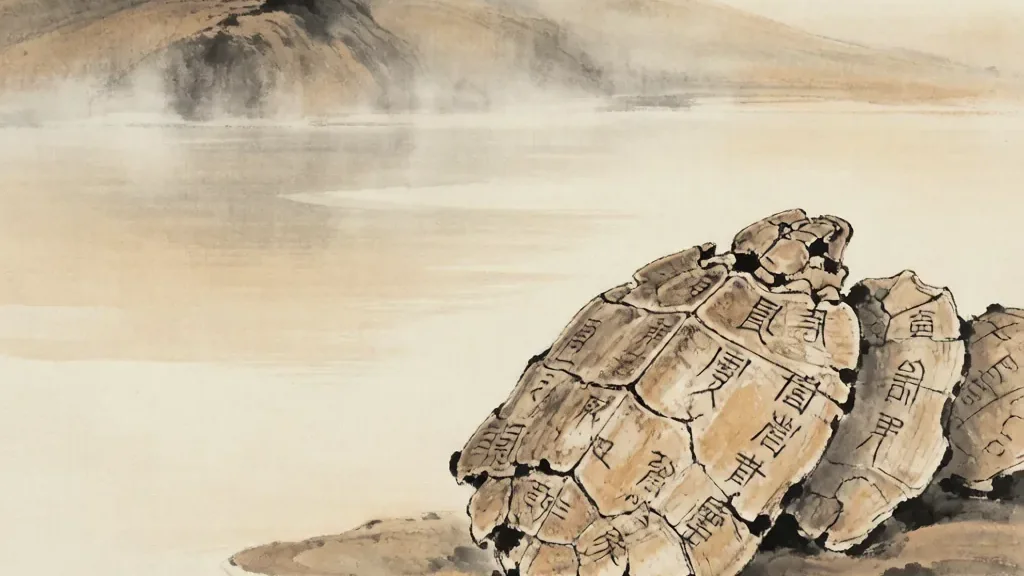
Anyang's role was that of a ritual and military center of the Shang world. The king led campaigns against neighboring peoples, received tribute, and above all communicated with ancestors through divination. At the heart of this was the practice of pyromancy: a diviner heated a bronze pin pressed to a socket on a prepared turtle plastron or ox scapula until it cracked, then read the crack as an answer from the spirit world. The question and often the verdict were carved into the bone itself — a practice that turned bureaucracy into the first archive of Chinese writing.
The capital also commanded skilled industry. Workshops at Anyang cast monumental bronze vessels — the ritual ding (鼎) cauldrons — using piece-mold techniques of astonishing precision, and crafted jade, bone, and lacquer. The royal cemetery at Xibeigang held enormous pit tombs with chariots, weapons, and human sacrifices, revealing a society in which the king's authority reached even into the afterlife.
Landmarks and Cultural Life
The central site is Xiaotun (小屯), the village where the palace foundations and the densest layers of oracle-bone deposits were found. Nearby, the pit tombs of the royal cemetery and the reconstructed foundations of the "Great City" give a sense of the capital's scale. The most moving finds are the bones themselves — tens of thousands of them — now held in museums in Anyang, Beijing, and Taipei, their minute inscriptions still legible after three millennia.
Anyang's cultural life was centered on the ancestral cult. The Shang calendar of ritual was a cycle of offerings to a long line of royal ancestors, each with his own day of sacrifice. The divination records show a court anxious about harvest, sickness, childbirth, and the favor of the high god Di (帝) — a portrait of a people whose world was governed by the watching dead. This religious grammar would echo through Chinese state ritual for the next three thousand years.
Why Anyang Mattered
Anyang mattered because it turned myth into history. For centuries the Shang were known only from the opening chapters of the Shiji (史记) and other texts that some scholars dismissed as legend. When the oracle bones surfaced in 1899 and were traced to Anyang, their inscriptions named Shang kings in exactly the order the histories gave — proving the dynasty real and giving archaeology a fixed point from which to reconstruct Bronze Age China.
Equally important, Anyang gave China its script. The characters on the bones are recognizable ancestors of modern Chinese writing; many of the signs for sun, moon, horse, and rain have changed little in form across thirty centuries. To read an oracle bone is to read the same language family that writes the newspaper today. Among all China's capitals, Anyang is the oldest and the most revolutionary: the place where the Chinese first wrote themselves into the record, and where the long continuity of Chinese civilization becomes, quite literally, legible.
Abandonment and Rediscovery
When the Zhou overthrew the Shang around 1046 BCE, the royal seat at Yin was abandoned and left to the fields. Unlike later capitals, Anyang was not continuously inhabited or rebuilt; it was simply forgotten, its name surviving only in old histories as a half-legendary place. For three thousand years the bones lay in the soil, occasionally turned up by ploughs, until a local healer or farmer might sell them as "dragon bones" to an apothecary, unaware they carried writing.
The modern rediscovery began in 1899, when the scholar Wang Yirong noticed characters on a "dragon bone" offered as medicine, and tracing the source to Xiaotun near Anyang. Systematic excavation followed: the Academia Sinica teams of the 1920s and 1930s uncovered the palace foundations, the royal tombs, and tens of thousands of inscribed bones, while the famous "Oracle Bone Academy" (甲骨学, jiǎ gǔ xué) grew into a discipline. In 2006 the Yinxu (殷墟) ruins were named a UNESCO World Heritage Site. Anyang's story is thus a double one — a capital that vanished, and a capital that was scientifically raised from the dead, giving the world its first direct voice from Bronze Age China.
Anyang's lessons reach far beyond archaeology. The oracle bones show a court obsessed with precedent and ancestry, and that obsession became a defining trait of Chinese political culture for three millennia: later rulers, too, governed by consulting the records and the rites of their forebears. The bones also prove the deep antiquity of Chinese writing and, with it, of Chinese historical consciousness — the habit of keeping accounts so that the present could be judged against the past. In this quiet way, the Shang capital at Anyang planted the seed of the vast documentary tradition that makes China's history the longest continuously recorded on earth.