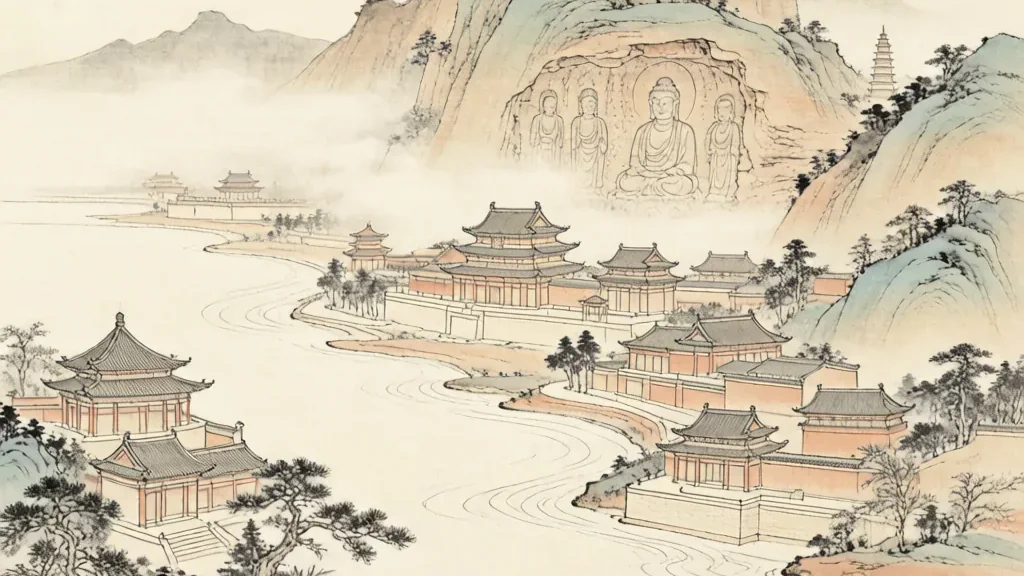
Where the Luo River (洛水, Luò Shuǐ) threads between the mountains of Henan, a city rose that would host more royal courts than almost any other place in China. Luoyang (洛阳, luò yáng) means "north of the Luo," and for over two thousand years it stood as the eastern anchor of Chinese civilization — the polished counterpart to Chang'an in the west, the cradle of Chinese Buddhism, and a treasury of stone-carved devotion. If Chang'an was the empire's solemn façade, Luoyang was its bustling heart.
Founding and the Nine Dynasties
Luoyang's imperial story begins early. The Zhou kings of the first millennium BCE established an eastern capital here to govern the central plains, and the sage-king lore of the Hetu Luoshu (河图洛书) — the cosmic diagrams said to have surfaced from the Luo and Yellow Rivers — rooted the site in myth. The Eastern Zhou (东周, Dōng Zhōu, 770–256 BCE) made it a royal seat, and the city grew through the Eastern Han, Cao Wei, Western Jin, and, most gloriously, the Northern Wei (北魏, Běi Wèi, 386–534 CE), who rebuilt it as a Buddhist showpiece. Later the Sui and Tang maintained it as their eastern capital, and the Later Tang of the Five Dynasties period ruled from it too. The conventional tally of "nine dynasties" understates a continuity of power unmatched except by its western rival.
Like Chang'an, Luoyang owed its life to geography. Set where the fertile plain meets the mountains, it commanded the roads between the Yellow and Yangtze basins and the granaries of the central plains. Rulers who could not hold the western capital often fell back to Luoyang, making it the natural second throne of a unified or divided realm.
The Cradle of Chinese Buddhism
No event shaped Luoyang more than the arrival of Buddhism. In 68 CE, so the traditional account runs, the Emperor Ming of Han dreamed of a golden figure and sent envoys west, who returned with scriptures and the monks Kasyapa Matanga and Dharmaratna. To house them, the court founded the White Horse Temple (白马寺, bái mǎ sì), said to be the first Buddhist monastery on Chinese soil. For centuries Luoyang was the religion's administrative and translation center, where the Kushan monk Dharmakshema and others turned Sanskrit sutra into Chinese.
The Northern Wei rulers poured this devotion into architecture. The Yongning Temple pagoda, a multi-storied wooden tower said to soar over forty meters, was described by the visiting monk Huilin as visible for miles and hung with bells that rang in the wind. Though it burned in 534, its fame fed Luoyang's reputation as a city of a thousand temples — a description the contemporary record Luoyang Qielan Ji (洛阳伽蓝记) preserves in vivid detail.
Landmarks and Cultural Splendor
The supreme monument of Luoyang is the Longmen Grottoes (龙门石窟, lóng mén shí kū), begun around 493 when the Northern Wei court moved south. Carvers cut caves into the limestone cliffs along the Yi River, filling them with tens of thousands of Buddha images, from the intimate to the colossal. The climax is the Vairocana Buddha of the Fengxian Cave, a serene figure more than seventeen meters tall whose face is traditionally linked to the Tang Empress Wu Zetian. Alongside the grottoes, the White Horse Temple and the ruins of the Han-Wei and Sui-Tang city walls trace a layered palimpsest of capitals.
Luoyang also shone as a cultural capital. It was here that the poet Cao Zhi is said to have met the goddess of the Luo River in his Luo Shen Fu (洛神赋), and here that later Tang emperors celebrated the city's eastern markets. The surrounding plains, watered by the Luo, fed a refined court society of scholars, monks, and artisans whose taste set standards for the age.
Why Luoyang Mattered
Luoyang mattered because it balanced Chang'an. Together the two formed the "eastern and western capitals" (两京, liǎng jīng) system that let a unified dynasty project power from the Wei valley to the central plains. When the Tang built the Grand Canal, Luoyang's position near the junction of routes made it the natural distribution hub for southern grain feeding the north — a logistical role that kept it indispensable even when political prestige lay elsewhere.
Above all, Luoyang mattered as the gate through which Buddhism entered and took root in Chinese life. From the White Horse Temple to the silent Buddhas of Longmen, the city turned a foreign faith into a Chinese one, and its grottoes remain among the most moving achievements of that synthesis. To stand before Longmen is to read, in stone, the story of how India and China met — and Luoyang was the place where that meeting was carved for eternity.
A Capital Reborn and Faded
Luoyang enjoyed one last imperial flowering. The Sui emperor Yangdi rebuilt it grandly in the seventh century as his eastern capital, digging the Grand Canal to its door so that southern rice could feed its court, and the early Tang maintained it as a favored seat. For a few decades under the Tang, Luoyang rivaled Chang'an in splendor, its palaces and markets drawing the court south when the western capital grew crowded. The Empress Wu Zetian favored it above all, commissioning the colossal Vairocana Buddha at Longmen as a monument to her reign.
After the Tang, however, Luoyang's political star declined. The wars of the late empire and the shift of the capital northward to Kaifeng and then Beijing left it a provincial city, though never an unimportant one. Successive floods of the Luo and Yellow Rivers buried older layers, so that today's visitor walks over a palmpsest of capitals — Han, Wei, Sui, and Tang streets stacked one above another. The Longmen Grottoes, continually added to for centuries, survived as the city's enduring voice, and in 2000 they were named a UNESCO World Heritage Site, securing Luoyang's place not as a living throne but as one of China's deepest archaeological treasures.
The city's layered past also made it a lasting cultural magnet. Tang poets who served at the eastern capital left verses celebrating its spring peony festivals — Luoyang's peonies (牡丹, mǔ dān) became so famous that the bloom drew visitors from across the realm, a tradition still honored in the city today. In this way Luoyang's cultural capital outlasted its political one: even after the throne moved north to Kaifeng and Beijing, the city remained a byword for elegance, flowers, and the solemn beauty of its cliff-carved Buddhas, a place where court memory and stone devotion met.