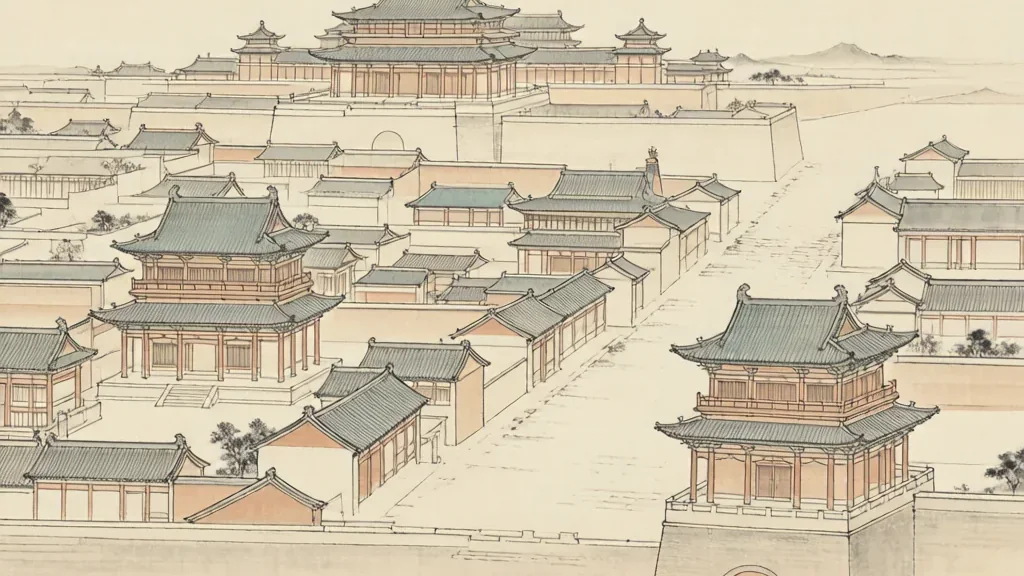
At the eastern end of the Silk Road, on the fertile Guanzhong plain where the Wei River meets the Loess Plateau, rose a city whose name became synonymous with imperial China itself. Chang'an (长安, cháng ān) means "Long Peace," and for more than a millennium it was the stage on which the great dynasties of the middle kingdom played out their grandest ambitions. The Han built it, the Sui rebuilt it, and the Tang made it the largest, most cosmopolitan city the world had ever seen — a metropolis of a million souls where Persian wine was poured in foreign taverns and Buddhist sutras were translated by the cartload.
A Capital Forged Across Dynasties
The site of Chang'an was chosen for defense and fertility. Ringed by mountains on three sides and fed by the Wei River, the Guanzhong basin was easy to fortify and rich to feed — the perfect seat for a统一 empire. The Western Han dynasty (西汉, Xī Hàn, 206 BCE–9 CE) founded its capital here in 202 BCE, calling it Chang'an, and the ambitious statesman Xiao He laid out palaces and a double-walled city that became the prototype for later imperial planning. When the Sui reunified China in the sixth century, the engineer Yuwen Kai designed an entirely new, geometrically perfect grid city just southeast of the Han ruins, and the early Tang inherited and expanded it into the capital we now picture when we say "Chang'an."
What the Tang builders achieved was not merely a city but a diagram of cosmic order. A ruler-straight central avenue, the Vermillion Bird Avenue (朱雀大街, zhū què dà jiē), ran for nearly five kilometers from the south gate to the palace, dividing the city into eastern and western halves. Around it marched a checkerboard of walled wards, each entered through locked gates at dusk. This was urban design as statecraft: order in the streets mirrored order in the realm.
The Role of a World Capital
Under the Tang (唐, Táng, 618–907 CE), Chang'an was the political, economic, and cultural heart of a polity that stretched from Korea to Central Asia. The emperor governed from the two great palace complexes in the north — the Palace City and the enclosed Forbidden Park — while the surrounding wards held the households of nobles, soldiers, monks, and laborers. Two vast market districts, the Eastern and Western Markets, anchored commercial life. The Western Market in particular was a carnival of the foreign: Sogdian merchants from Samarkand ran money-changing shops, while workshops produced the famous Tang tri-color glazed pottery that still delights museum visitors today.
Chang'an was also the empire's intellectual capital. The Hanlin Academy gathered the finest scholars, and the imperial examination (科举, kē jǔ) drew candidates from across the country to compete for office. The city's temples and monasteries — among them the great Wild Goose Pagoda (大雁塔, dà yàn tǎ), built to house sutras brought back from India — made it the Buddhist center of East Asia. When the monk Xuanzang returned from his sixteen-year pilgrimage, it was to Chang'an that he came, and there he spent the rest of his life translating the scriptures he had carried home.
Landmarks and Cultural Life
Two monuments above all define Tang Chang'an. The Daming Palace (大明宫, dà míng gōng), begun in the seventh century, was among the largest palace complexes ever built, its Hanyuan Hall raised on a vast terrace to receive ambassadors from across Asia. The Small and Large Wild Goose Pagodas still stand in modern Xi'an as survivors of that age. Beyond stone and brick, the city lived in its poetry: the entertainments of the pleasure quarters along the Ba River, the lantern festivals of the first lunar month when the wards threw open their gates at night, and the farewell poems composed at the eastern gate as friends set off on the road to the capital's rivals.
Daily life followed a strict rhythm. Drumbeats at dawn opened the ward gates; the evening drum sent citizens home before the curfew. Yet within that discipline flourished a culture of wine, music, and verse unmatched in its era. The poets Bai Juyi and Du Fu, among others, wandered these wards, and their lines let us hear the city's bells, markets, and mourning almost a thousand years later.
Why Chang'an Mattered
Chang'an mattered first as a model. Its axial plan, solemn northern palace, and rectangular ward grid were copied by every subsequent Chinese capital and, through them, by the planning traditions of Korea and Japan — the grids of Kyoto and Nara are direct descendants of Tang Chang'an. When the Ming rebuilt the capital that became Beijing, they were fulfilling a logic of urban order first perfected here.
Chang'an mattered, too, as a meeting point of civilizations. At a time when most of the world's great cities looked inward, Chang'an looked outward, absorbing Persian music, Indian religion, Central Asian fashion, and Nestorian Christianity alike, and sending Chinese silk, paper, and Buddhism flowing west in return. It was, for a shining century, the most connected city on earth. When the Tang faltered and the capital was sacked in the mid-ninth century, the center of gravity shifted east — but the ideal of Chang'an, the eternal capital of Long Peace, never quite left the Chinese imagination.
The Capital's Decline and Afterlife
Even at its height, Chang'an carried the seeds of its own fragility. Its greatness depended on the grain canal that linked it to the south, and when the Tang court weakened, that lifeline frayed. The cataclysm came in 755 with the An Lushan Rebellion (安史之乱, ān shǐ zhī luàn), a military mutiny that turned the capital into a battlefield and emptied its wards of perhaps two-thirds of their people. Though the Tang recovered the city, it never fully regained its luster. In the late ninth century the rebel Huang Chao sacked Chang'an again, and in 904 the warlord Zhu Quanzhong forced the court east to Luoyang, tearing down the palaces and hauling the timber downstream log by log.
What remained was a memory and a reduced town. The Ming dynasty, centuries later, built the walled city that still defines modern Xi'an — but on a fraction of the Tang footprint, its modest rectangle nestled in the northeast corner of the abandoned metropolis. Yet the idea of Chang'an outlived the stones. Poets of later ages wrote of it as a lost golden world, and archaeologists of the twentieth century, mapping the ghostly grid beneath the fields, confirmed that the Tang capital had been every bit as vast as the records claimed. To stand on the Xi'an city wall today is to stand inside the shrunken heart of a city that once held the world's largest urban population — a capital whose afterlife has been longer in memory than in masonry.