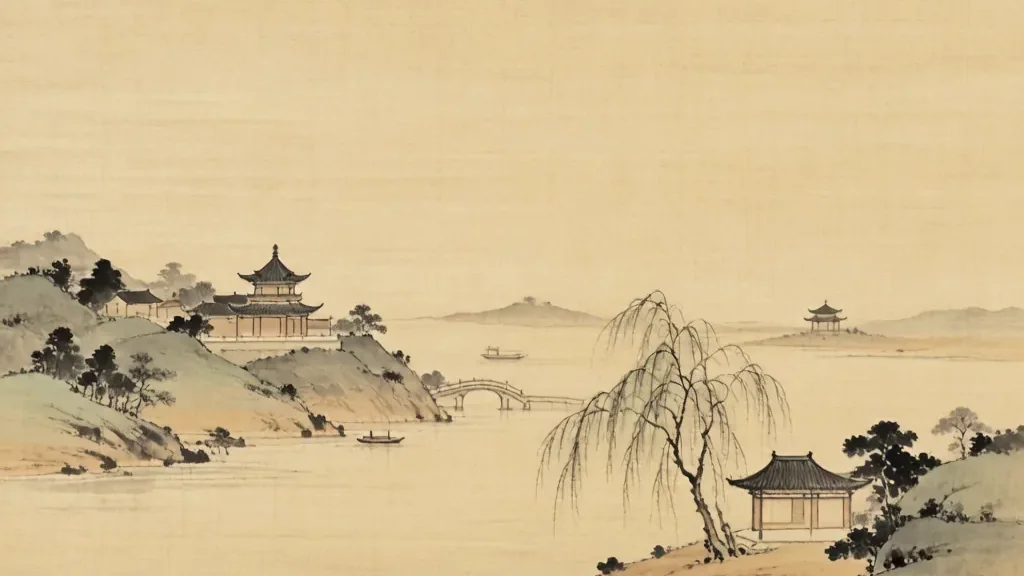
Jianye was the capital founded by the kingdom of Wu during the Three Kingdoms period, the city on the southern bank of the Yangtze that would grow into modern Nanjing. In the early third century, as the Han empire collapsed and China fractured into three contending states, the warlord Sun Quan consolidated power in the southeast and established his seat at Jianye, building a walled town above the river that became the political and military heart of the Wu state. Though the Wu kingdom eventually fell to the reunifying Jin in 280, Jianye set a precedent of enormous consequence: it was the first great southern capital in Chinese history, proving that the wealthy and populous Yangtze delta could rival the old centers of the north. The name would later change to Jiankang, and the city would serve successive southern dynasties, but the foundation laid by Wu gave Nanjing its enduring role as the alternative capital of a divided China.
The Collapse of Han and the Rise of Three Kingdoms
The late second century saw the Han dynasty hollowed out by court intrigue, rebellion, and the rise of regional warlords. By 220 the empire had split into three rival states: Cao Wei in the north, Shu Han in the west around Sichuan, and Eastern Wu in the southeast. This era, immortalized in the novel the Romance of the Three Kingdoms, was one of ceaseless warfare and shifting alliance, but also of statecraft and culture that later ages admired.
Wu controlled the lands south of the Yangtze, a region then less developed than the north but rich in grain, timber, and manpower once mobilized. Its rulers faced the task of governing a mixed population of native Yue peoples and northern refugees, and of defending the long river frontier against the stronger Wei to the north. The choice of a secure capital was therefore a matter of survival.
Sun Quan, the founder of Wu, inherited his position from his father Sun Jian and brother Sun Ce, who had carved out a base in the lower Yangtze. His decision to plant a permanent capital at Jianye marked the moment the southeast ceased to be a backwater and became a center of empire in its own right.
Sun Quan and the Founding of Jianye
Sun Quan, who ruled Wu for more than half a century, is remembered as a cautious, capable ruler who balanced generals and advisers and kept his state independent against greater odds. Around the year 211 he moved his headquarters from a site farther upstream to the strategic point on the Yangtze that became Jianye, and in 229, after proclaiming himself emperor, he made it his formal capital. The move anchored Wu's power along the river.
The new capital was a practical military settlement as much as a court. It guarded the crossing of the Yangtze, controlled the fertile plains behind it, and served as a base for the fleets that gave Wu its naval strength. Sun Quan understood that the Yangtze was both a barrier and a highway, and Jianye sat exactly where the river could be held and used.
Under Sun Quan the court attracted scholars, artists, and refugees from the war-torn north, beginning the long process by which the south accumulated the cultural weight that would later rival Luoyang and Chang'an. Jianye was thus the seed of a southern civilization.
The Stone City and the River Defense
The most famous fortification associated with early Jianye is the Stone City, a walled stronghold built on projecting bluffs along the river to the west of the main town. Its rocky cliffs made it nearly impossible to assault from the water, and it became the anchor of Wu's defense, a symbol of the regime's resolve to hold the south.
The geography of Jianye was its greatest asset. The Yangtze to the north, hills to the east, and marshy approaches on other sides made the site defensible, while the river gave access to the inland lake systems and the wealth of the delta. Wu invested heavily in ships and riverine forts, creating a navy that the northern states, rooted in cavalry, could not easily match.
This defensive geography explains why later dynasties also chose the site. Whoever held Jianye controlled the lower Yangtze and, with it, the richest agricultural region of the south, a fact that would shape Chinese politics for a thousand years.
Court Life and Southern Culture
The Wu court at Jianye was a cosmopolitan place. Northern emigres brought Confucian learning, calligraphy, and administrative skill, while local traditions of the Jiangnan region contributed a softer, more refined aesthetic that later defined southern Chinese culture. The court patronized literature and the arts as instruments of legitimacy.
Wu also pushed southward and westward, extending influence into what are now Fujian, Guangdong, and parts of Vietnam, and it maintained maritime contact with the peoples of the southeast coast and the islands beyond. These outward ties made Jianye a node not only of inland rivers but of the sea, a role Nanjing would keep in later centuries.
The luxury of the southern court, with its silk, its gardens, and its poetry, became a byword in later literature, even as the state struggled to fund the armies that protected it. The tension between cultural brilliance and military cost is a recurring theme of Jianye's history.
The Fall of Wu and the Reunification
The Wu kingdom endured for about sixty years before the Jin dynasty of the north, having conquered Shu earlier, turned its full strength against the south. In 280 a Jin army crossed the Yangtze in a massive fleet action and took Jianye, ending the Three Kingdoms and briefly reunifying the empire. The last Wu ruler surrendered, and the capital was absorbed into the new order.
The conquest was a watershed. It demonstrated that the natural barrier of the Yangtze, so long thought impassable by northern cavalry, could be overcome by a determined navy, and it taught later unifiers the lessons of river warfare. It also scattered the Wu elite, some of whom carried southern knowledge to the northern courts.
Yet the fall of Wu did not end the significance of its capital. Within a few decades the Jin itself collapsed and the court fled south to the same city, now renamed Jiankang, beginning the long sequence of southern dynasties that made Nanjing the eternal southern capital.
From Jianye to Jiankang
After the Wu period the city was renamed Jiankang and became the capital of the Eastern Jin and then the Southern Dynasties, a succession of regimes that ruled the south while the north was divided among nomad-founded states. Under these dynasties Jiankang grew into one of the largest cities in the world, a center of Buddhism, philosophy, and the arts.
The southern capital attracted monks and pilgrims, and the hills around it filled with temples and monasteries. The translation of Buddhist scripture flourished here, and the refined lifestyle of the Jiangnan elite set standards of taste that persist in Chinese culture. The foundation laid by Wu thus blossomed into a golden age of southern civilization.
This continuity means that any visit to Nanjing is in part a visit to Jianye. The Stone City remnant, the river, and the geographic logic of the place all descend from the decisions of Sun Quan and his generals in the third century.
Archaeology and the Physical Remains
Excavation in and around modern Nanjing has recovered traces of the Wu and later southern capital: sections of rammed-earth wall, tile ends bearing official marks, pottery, and the foundations of large buildings. These finds confirm the scale of the early city and its continuity with the later metropolis.
The most evocative survival is the Stone City terrain along the river bluffs, where the rocky outcrop known as the Stone City cliff still recalls the fortress that guarded Wu. Though much has eroded or been built over, the轮廓 of the ancient defenses can still be traced by archaeologists and imagined by visitors.
Such remains are precious because the wooden architecture of the time has almost entirely vanished. The earthworks and ceramics are therefore the primary witnesses to a capital that existed more than seventeen hundred years ago and shaped the destiny of a region.
Jianye in Memory and Literature
The Three Kingdoms period, and Jianye within it, occupies a unique place in Chinese popular memory. The Romance of the Three Kingdoms turned Sun Quan, Zhuge Liang, and Zhou Yu into household names, and the rivalry of the three states became a perennial parable of strategy, loyalty, and fate. Jianye appears in poetry as a place of both glory and melancholy.
Tang and later poets wrote of the former Wu capital with nostalgia, lamenting the vanished palaces and the inexorable fall of even the mightiest courts. The phrase that the Yangtze still flows as it did in the time of the kingdoms became a standard image of historical transience, linking the physical river to the memory of Jianye.
This literary afterlife ensured that the city's founding by Wu was never forgotten. Long after the walls crumbled, the story of Sun Quan's capital lived on in verse, drama, and now film, making Jianye one of the most storied foundations in the Chinese imaginary.
The Legacy of the First Southern Capital
The deepest importance of Jianye is geopolitical. Before Wu, Chinese unity and high culture were conceived as northern, centered on the Yellow River plains. Wu proved that the Yangtze south could sustain an independent, prosperous, and culturally rich state, and that the south could be a capital region, not a frontier.
This precedent made possible every later southern regime, from the Eastern Jin to the Ming founder who also chose Nanjing, and it balanced Chinese history between two great river systems. The division of the country into northern and southern spheres, so central to its political rhythm, begins in crucial part with the decision to build Jianye.
For the modern visitor to Nanjing, understanding Jianye is the key to understanding the city itself. Its parks, its river, and its self-image as an alternative seat of empire all descend from a third-century kingdom that dared to rule China from the south.
❓ Frequently Asked Questions
What was Jianye?
Jianye was the capital founded by the kingdom of Wu during the Three Kingdoms period on the site of modern Nanjing, the first major southern capital in Chinese history.
Who founded Jianye?
The warlord and later emperor Sun Quan established Jianye as his seat in the early third century, making it the political heart of the Wu state.
Why was the site strategically important?
It sat above the Yangtze, controlling a key river crossing and the fertile delta behind it, with hills and marshes that made it naturally defensible.
What happened to Jianye after Wu fell?
It was renamed Jiankang and became the capital of the Eastern Jin and Southern Dynasties, growing into a great center of Buddhism and the arts.
What is the Stone City?
The Stone City was a cliffside fortress built west of the town to guard the river, and its rocky remains are the most evocative survival of the Wu capital.
How did Jianye shape later China?
By proving the south could sustain an independent empire, it established the pattern of northern and southern capitals that defined Chinese politics for centuries.