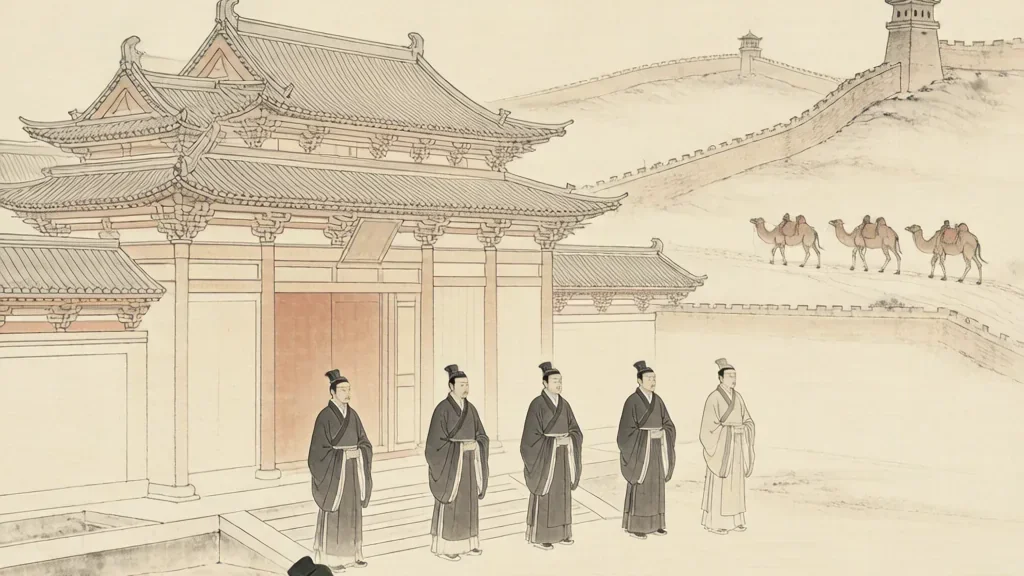
When people today speak of "Han Chinese" (汉族, Hànzú) — the ethnic majority that makes up more than ninety percent of China's population — they are naming a dynasty. The Han (汉, Hàn, 206 BCE–220 CE) ruled for over four centuries and gave the civilization its enduring identity: a written culture, a Confucian state, a trade route to the West, and a confidence that "Han" meant civilized. Split into the Western Han (with its capital at Chang'an) and the Eastern Han (at Luoyang), the dynasty turned Qin's brief unification into a lasting civilization.
Liu Bang and the Founders
The Han rose from the ashes of the Qin. Liu Bang (刘邦, 256–195 BCE) was an unlikely founder — a minor local official from a peasant family, later mythologized as a charismatic, rough-edged pragmatist. He joined the rebellions against the Qin, outlasted rivals, and in a decisive contest defeated the noble warrior Xiang Yu (项羽) at the Battle of Gaixia (垓下, 202 BCE), declaring himself Emperor Gaozu (汉高祖).
Gaozu learned from the Qin's fatal harshness. He preserved the centralized commandery-county administration but cut taxes, relaxed the severe Legalist laws, and rewarded his allies with semi-autonomous kingdoms (a compromise that later emperors had to rein in). The dynasty stabilized under the statesman-emperor Han Wudi's predecessors, who practiced "yellow Lao" quietism — governing lightly to let the people recover.
The Western Han reached its height under Emperor Wu (汉武帝, Wǔdì, r. 141–87 BCE), a vigorous expansionist who centralized power, filled the treasury, and set the dynasty's lasting cultural course. After a brief interruption by the usurper Wang Mang (王莽, 9–23 CE), the Liu family restored the line as the Eastern Han, ruling from Luoyang until 220 CE.
The Silk Road Opens
Emperor Wu's desire to break the Xiongnu (匈奴) nomads led him to send the envoy Zhang Qian (张骞) on two westward missions, beginning about 138 BCE. Though Zhang Qian's military alliance fell through, he returned with priceless geographic knowledge of Central Asia, the Ferghana horses, and the peoples west of the Pamirs.
Out of these contacts grew the Silk Road (丝绸之路, Sīchóu Zhī Lù), a network of caravan routes linking Chang'an to Central Asia, Persia, India, and eventually the Roman Mediterranean. Chinese silk became a luxury prized in Rome; in return came horses, jade from Khotan, grapes, alfalfa, and — most consequentially — Buddhism, which entered China via these routes in the first centuries CE.
The Han also pushed south into what is now Vietnam and opened maritime contact with Southeast Asia. The dynasty's embassies, recorded as far as Parthia and even (by Roman sources) a Han mission to the court of Marcus Aurelius, made China a recognized player in the Eurasian world for the first time.
Confucianism as State Creed
Where the Qin had burned the classics, the Han embraced them. The scholar Dong Zhongshu (董仲舒) persuaded Emperor Wu to elevate Confucianism (儒家, Rújiā) as the state ideology, synthesizing it with cosmological ideas of yin-yang and the Five Phases. The emperor founded the Imperial University (太学, Tàixué) to train officials in the Confucian classics, and from then on government service meant classical learning.
This created the pattern of the "scholar-official" (士大夫, shìdàfū): men who governed not by noble birth but by mastery of Confucian texts, selected through examinations. The ideal fused political authority with moral cultivation — the ruler as a paternal, virtuous father; the subject as a filial, loyal son. It gave the dynasty a legitimacy deeper than force.
Confucianism under the Han also absorbed and tamed rival schools. Legalist methods remained in administration, but the public philosophy was Confucian harmony. This synthesis proved so durable that later dynasties, including conquest dynasties, all claimed the Confucian mantle.
Invention and Expansion
The Han was an age of practical genius. The court official Cai Lun (蔡伦) is credited with perfecting paper (纸, zhǐ) around 105 CE from bark, hemp, and rags — a cheap writing material that would transform human communication. The astronomer and engineer Zhang Heng (张衡, 78–139 CE) built a water-powered armillary sphere and an earthquake-detecting seismograph (地动仪).
Agriculture surged with the widespread use of the iron plow, the seed drill, and the collar harness that let horses pull efficiently. The state organized vast granaries and waterways, and coined the durable "wu zhu" (五铢) currency that stabilized the economy. In medicine, practitioners like Zhang Zhongjing (张仲景) systematized herbal and diagnostic knowledge still honored today.
Militarily, the Han pushed the Xiongnu back, secured the Hexi Corridor, and extended influence into Korea, Manchuria, and the Tarim Basin. The empire at its peak stretched from the Pacific deep into Central Asia — the geographical frame of "China" that later dynasties inherited.
"Han" as Identity
Perhaps the Han's greatest legacy is naming. Subjects of the dynasty came to call themselves "people of Han" (汉人, Hànrén), and the written language "Han characters" (汉字, Hànzì). When later conquest dynasties ruled, the majority still identified as Han — a cultural, not racial, label based on shared script, ritual, and custom.
The Han also set the template of "Chinese greatness" that later rulers invoked. To "revive the Han" or surpass the Han and Tang became the standard ambition of emperors from the Sui to the Qing. Its four centuries of (mostly) stable, centralized, Confucian rule became the remembered golden mean.
When the Eastern Han finally fractured in 220 CE, the empire split into the Three Kingdoms — but the idea of a unified Han civilization never died. It was precisely because the Han had made "China" mean a single cultural world that later ages kept trying to reassemble it. The Han legal tradition, distilled into the later Tang Code (唐律), influenced East Asian law for millennia, and the dynasty's mix of central power with Confucian legitimacy became the template every successor tried to match. Even its fall was instructive: the warlord Cao Cao (曹操) and the poet-emperor Liu Bei became stock characters of loyalty and ambition in the novel Romance of the Three Kingdoms. The Han ended, but "Han" as the name of a people and a civilization had only just begun.