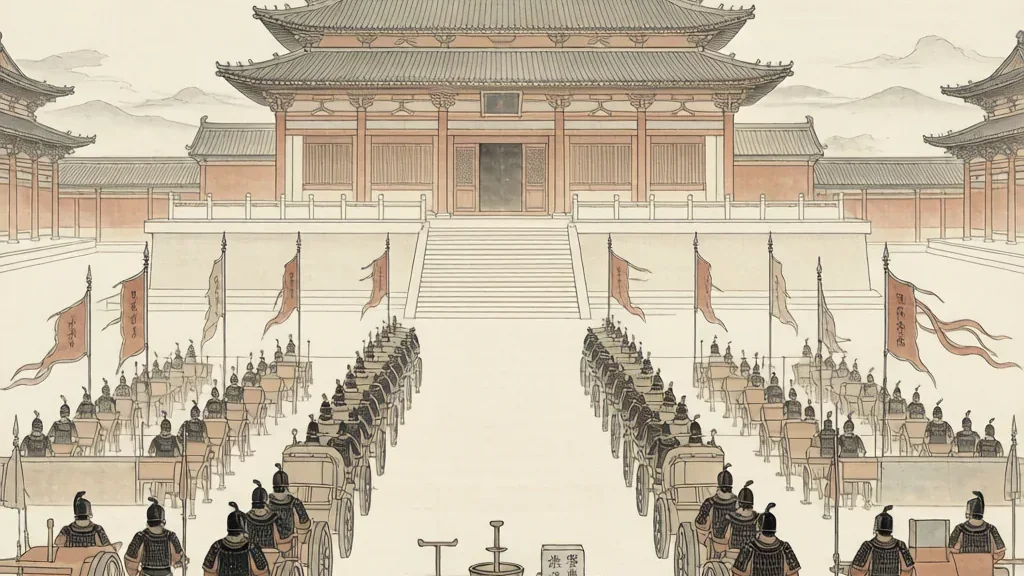
In 221 BCE, after centuries of the Warring States' chaos, the state of Qin (秦, Qín) crushed its last rivals and for the first time unified the Chinese cultural core under one ruler. That king, Ying Zheng, took a title no Chinese had borne before — huángdì (皇帝), "emperor" — and called himself Qin Shi Huang (秦始皇), the First Emperor. The Qin dynasty lasted only fifteen years, yet it stamped China's political DNA: a centralized bureaucracy, a uniform script, standardized measures, and the very idea of a single Chinese empire. To understand imperial China, you must start with the fiery brevity of the Qin.
Ying Zheng, the First Emperor
Ying Zheng (嬴政, 259–210 BCE) inherited the Qin throne at thirteen. The western state of Qin had spent generations building a meritocratic, Legalist (法家, Fǎjiā) war machine: fertile fields rewarded, military merit promoted, and a ruthless administration that tolerated no private power. Under advisers like Lü Buwei and the reformer Li Si (李斯, Lǐ Sī), Ying Zheng turned this apparatus on his neighbors.
Between 230 and 221 BCE he conquered the six rival states — Han, Zhao, Wei, Chu, Yan, and Qi — in a methodical campaign. In 221 BCE he declared himself Shǐ Huángdì (始皇帝), "First Emperor," expecting his heirs to rule as "Second Emperor," "Third Emperor," down to ten thousand generations. The name "Qin" itself, through Sanskrit "Cīna" and Persian "Chīn," is the root of the Western word "China."
The First Emperor was a workaholic administrator who personally reviewed 120 pounds of documents daily and traveled constantly to assert control. He feared assassination — surviving multiple plots — and sought immortality through alchemists, a quest that likely contributed to his death from mercury-laced "elixirs" in 210 BCE.
Unification in 221 BCE
Having won the sword, the Qin set about winning the peace through uniformity. The most revolutionary act was abolishing the old Zhou feudal order: the emperor replaced hereditary lords with appointed officials who governed commanderies (郡, jùn) and counties (县, xiàn) directly accountable to the center. This county system became the administrative backbone of China for two millennia.
The Qin also physically knit the realm together. They linked and extended regional walls into a forerunner of the Great Wall to block northern nomads, built a network of straight " imperial roads" radiating from the capital Xianyang, and connected waterways. To prevent revolt, they confiscated weapons, moved noble families to the capital under watch, and burned privately held classical texts to suppress dissenting thought.
In law, the Qin applied Legalism uncompromisingly: a clear code of rewards and harsh punishments, collective responsibility through the "mutual surveillance" (连坐, liánzuò) system, where groups were punished for one member's crime. Order was achieved, but at a human cost that bred deep resentment.
Standardization
The Qin's quiet genius was standardization. The realm had used many local scripts; the emperor imposed the small-seal script (小篆, xiǎozhuàn), later simplified to clerical script (隶书, lìshū), so a clerk in the south could read a memorial from the north. They minted a single currency, the round coin with a square hole (半两, bànliǎng), replacing the knives, spades, and cowrie shells of various states.
Weights, measures, and even the chi (尺) unit of length were fixed by imperial decree, and axle widths of carts were standardized so vehicles fit the same ruts in the roads — a seemingly minor rule that eased transport across the new empire.统一 (tǒngyī, "unification") became not just a political fact but a cultural habit: one script, one coin, one law.
These reforms outlived the dynasty. The Han who followed kept Qin administration almost intact, and the unified written language ensured that, despite centuries of division and many spoken dialects, China would always have a common medium of governance and literature.
The Great Wall and Terra-cotta Army
Two monuments capture the Qin's scale and cost. To defend the northern frontier against the Xiongnu (匈奴) nomads, hundreds of thousands of conscripts linked existing walls into a continuous barrier — the first version of the Great Wall (长城, Chángchéng). The labor, often penal, killed countless workers whose bodies were said to be built into the ramparts.
For the afterlife, the emperor commissioned the Terracotta Army (兵马俑, bīngmǎyǒng) near his mausoleum at Lintong. An estimated 8,000 life-sized clay warriors, each with an individual face, stand in battle formation with chariots and horses, meant to protect him forever. Discovered in 1974 by farmers digging a well, the army reveals the Qin's capacity for mass, organized production: heads, torsos, and limbs were made in molds, then assembled and painted.
Together, wall and army symbolize the Qin ideal — total mobilization of the realm's people and resources toward a single will. They also reveal its fatal flaw: that will depended on terror, and terror does not survive the man who wields it.
Why It Fell So Fast
Qin Shi Huang died in 210 BCE during a tour of the east, and his chief eunuch Zhao Gao and Li Si hid the death to manipulate the succession, installing the pliable Second Emperor (胡亥, Hùhài). The new reign was even more brutal and incompetent, executing loyal officials and piling on corvée labor for palaces and the tomb.
By 209 BCE, the burden broke. The Dazexiang Uprising (大泽乡起义) of Chen Sheng and Wu Guang showed the regime's fragility, and within years a dozen rebel armies rose. Two former Qin officers, Liu Bang and Xiang Yu, led the foremost coalition. Liu Bang entered the capital in 206 BCE; the last Qin ruler surrendered, and the dynasty ended after just fifteen years.
The Han founder Liu Bang learned the lesson precisely: keep the Qin's institutions but soften its rule with Confucian benevolence. The Qin thus failed as a dynasty yet succeeded as a blueprint — the "short dynasty, lasting system" that made every later empire possible. Almost every later founder — from the Sui's Wen Di to the Ming's Hongwu — studied Qin Shi Huang's mistakes, balancing centralization against the risk of revolt. The Qin's county administration, uniform law code, and centralized monarchy became the permanent scaffolding of imperial China, proving that a dynasty's true life span is measured not merely in years on the throne but in the institutions it bequeaths to those who follow.