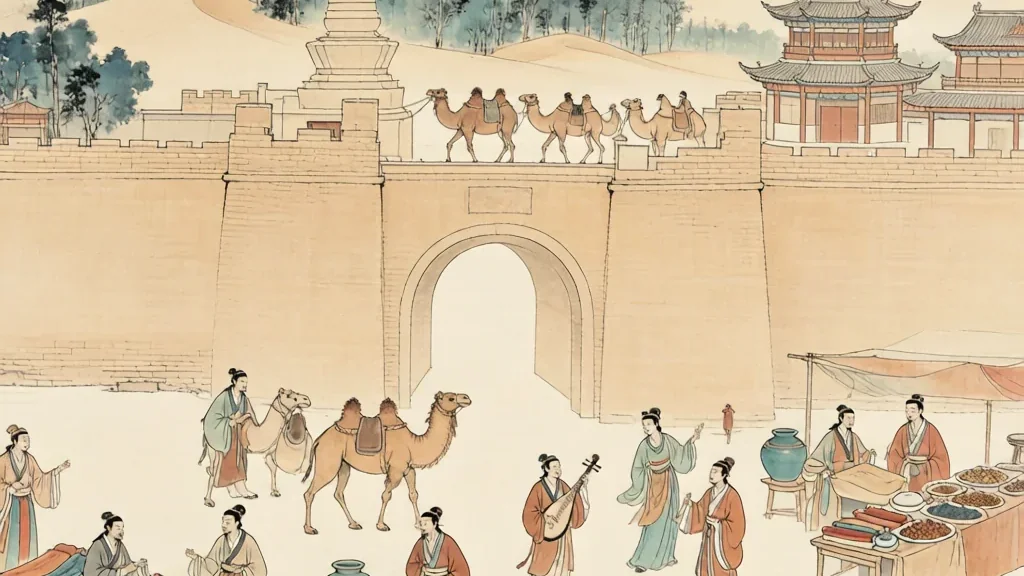
The Silk Road (丝绸之路, Sīchóu zhī lù) was never a single road but a sprawling, ever-shifting network of caravan routes that stretched over 6,400 kilometers, linking the great civilizations of China, India, Persia, Arabia, and the Mediterranean world. For over 1,500 years, from roughly 130 BCE to the 15th century, these routes carried not only silk, spices, and precious stones but also ideas, technologies, religions, and artistic traditions. At the heart of this vast web were its cities — cosmopolitan urban centers where merchants from distant lands mingled, where Buddhist monks met Nestorian priests, and where the cultural and intellectual wealth of the ancient world converged. These cities were the beating hearts of the Silk Road, and their stories illuminate the extraordinary human capacity for exchange across seemingly insurmountable distances.
Chang'an: The Eastern Gateway to the World
Chang'an (长安), known today as Xi'an, was the eastern terminus of the Silk Road and one of the largest and most magnificent cities of the ancient world. During the Tang Dynasty (618–907 CE), when it served as the imperial capital, Chang'an was home to over one million residents, making it the most populous city on earth. Its design was a masterpiece of urban planning: a vast rectangle laid out on a precise grid pattern, with wide boulevards dividing the city into 108 walled wards, each functioning like a self-contained neighborhood with its own gates that closed at night.
The city's two great marketplaces — the Eastern Market and the Western Market — pulsed with commercial energy. The Western Market was particularly famous as the hub of international trade. Here, Persian merchants sold glassware and silver, Central Asian traders offered fine horses and jade, and Indian vendors displayed spices and Buddhist scriptures. The city's cosmopolitan character was legendary: Tang Dynasty records describe communities of Persians, Sogdians, Turks, Indians, Koreans, and Japanese living in Chang'an, along with Zoroastrian fire temples, Nestorian Christian churches, and Muslim mosques alongside Buddhist and Daoist temples. A special office, the Bureau of Foreign Relations (鸿胪寺, Hónglú Sì), handled diplomatic missions from across Asia. Chang'an was not just China's window to the world — it was the world's window to China.
Dunhuang: The Oasis of a Thousand Buddhas
If Chang'an was the Silk Road's gateway, Dunhuang (敦煌) was its spiritual heart. Located at the edge of the Taklamakan Desert in present-day Gansu Province, Dunhuang was the last major Chinese oasis before travelers faced the perilous desert crossing. Its strategic position made it an essential resupply point where caravans rested, traded, and prepared for the dangerous journey ahead. But Dunhuang's true significance lies in its extraordinary artistic and religious legacy.
Just outside Dunhuang lie the Mogao Caves (莫高窟, Mògāo Kū), also known as the Caves of the Thousand Buddhas — one of the world's greatest repositories of Buddhist art. Over a period of nearly a thousand years, from the 4th to the 14th centuries, monks and artisans carved 492 decorated caves into the cliff face, filling them with over 45,000 square meters of murals and more than 2,000 painted sculptures. The murals depict not only Buddhist deities and paradises but also vivid scenes of Silk Road life: merchants leading Bactrian camels, Central Asian musicians playing exotic instruments, and donors from various ethnic groups in their distinctive dress. In 1900, a Daoist monk named Wang Yuanlu made one of the most consequential archaeological discoveries in history: a sealed cave containing over 50,000 manuscripts in multiple languages — Chinese, Tibetan, Sanskrit, Sogdian, Uyghur, and Hebrew — representing an unparalleled window into Silk Road culture, commerce, and religion. The Diamond Sutra, printed in 868 CE and found among these documents, is the world's oldest known printed book.
Samarkand: The Jewel of Central Asia
Halfway between China and the Mediterranean, Samarkand (撒马尔罕, Sāmǎ'ěrhǎn) in modern-day Uzbekistan was for centuries one of the most important cities on the Silk Road. Founded around 700 BCE, Samarkand reached its first zenith under Sogdian rule, when it served as the capital of a vast trading network. The Sogdians were the Silk Road's quintessential middlemen — master merchants who spoke multiple languages, maintained trading colonies across Asia, and controlled much of the overland commerce between China and Persia. Chinese sources describe Sogdian traders as exceptionally shrewd, and Sogdian mercantile families accumulated immense wealth.
Samarkand's greatest glory came under the Turco-Mongol conqueror Timur (帖木儿, also known as Tamerlane), who made it the capital of his vast empire in the late 14th century. Determined to make his capital the most beautiful city in the world, Timur imported architects, artists, and craftsmen from across his conquered territories — Persia, India, Syria, and beyond. The result was a city of breathtaking splendor, dominated by the colossal Registan Square with its three magnificent madrasas (Islamic schools), the turquoise-domed Gur-e-Amir mausoleum, and the monumental Bibi-Khanym Mosque, one of the largest in the Islamic world. Samarkand's architecture blended Persian, Indian, and Central Asian traditions into a distinctive style characterized by soaring domes, intricate tilework, and brilliant blue ceramics. Timur's grandson, the astronomer-king Ulugh Beg, built one of the medieval world's greatest observatories here, producing astronomical tables that were used throughout the Islamic world and beyond for centuries.
Baghdad: The Round City of Wisdom
At the western end of the Silk Road's overland routes stood Baghdad (巴格达), the Abbasid Caliphate's magnificent capital and arguably the intellectual center of the medieval world. Founded in 762 CE by Caliph Al-Mansur as a perfectly circular city — the "Round City" (Madinat al-Salam, "City of Peace") — Baghdad was designed to symbolize the caliphate's universal aspirations. At its center stood the caliph's palace and the great mosque, surrounded by concentric rings of walls, with four main gates oriented to the cardinal directions, each leading toward a different part of the known world.
Baghdad's House of Wisdom (Bayt al-Hikma), established in the late 8th century, became the world's preeminent center of scholarship and translation. Here, scholars fluent in Arabic, Persian, Greek, Syriac, and Sanskrit worked to translate the intellectual heritage of antiquity — Greek philosophy, Indian mathematics, Persian astronomy — into Arabic, preserving and building upon knowledge that might otherwise have been lost. Chinese inventions like papermaking, which arrived via Silk Road travelers, transformed Baghdad's intellectual culture by making books vastly more affordable. Baghdad's markets overflowed with Chinese silk and porcelain, Indian spices, Central Asian lapis lazuli, and African ivory. The city's population swelled to over a million, making it a rival to Chang'an as the world's largest urban center. The Abbasid caliphs' patronage of learning and the arts created a golden age that would profoundly influence the European Renaissance centuries later.
The Exchange of Faiths: Religion on the Silk Road
Perhaps no aspect of Silk Road history is more remarkable than its role in the spread of the world's great religions. Buddhism traveled from its birthplace in India through Central Asia to China, Korea, and Japan — a journey made possible by monks who accompanied merchant caravans and by the patronage of rulers along the route. The Mogao Caves at Dunhuang and the colossal Buddhas of Bamiyan in Afghanistan (tragically destroyed in 2001) stand as monuments to Buddhism's extraordinary journey along the Silk Road.
Nestorian Christianity (景教, Jǐngjiào), an early branch of Christianity that differed from Roman orthodoxy, reached China by 635 CE, when the Nestorian monk Alopen was received at the Tang court. The famous Nestorian Stele, erected in Chang'an in 781 CE, records the history of the Christian community in China. Islam spread rapidly along the Silk Road after the 7th century, carried by Arab merchants and later by the military expansion of Islamic empires. Central Asian cities like Samarkand and Bukhara became renowned centers of Islamic learning, and by the 10th century, significant Muslim communities had emerged in Chinese port cities. Zoroastrianism, the ancient Persian faith, maintained communities along the route, and Manichaeism, a syncretic religion founded by the Persian prophet Mani, briefly flourished before being suppressed. The Silk Road was, in a very real sense, the world's first multicultural and multi-religious superhighway.
Kashgar: Gateway to the Pamirs
At the western edge of the Tarim Basin stood Kashgar, the meeting point of the northern and southern routes around the Taklamakan Desert. Caravans from China converged there before the hard climb over the Pamir Mountains, known as the Roof of the World, toward Samarkand and beyond. The city was a bazaar of the world, where Chinese silk met Central Asian horses, Persian carpets, and Indian spices under one roof. Its Sunday market, still famous today, is the descendant of a trade gathering that has run for more than a thousand years. For travelers, Kashgar was the last great taste of the oasis world before the mountains, a place to restock, hire guides, and brace for cold and thin air. Few cities owed more to their location, and few have worn the title of crossroads with more right.
The Oasis Economy
Silk Road cities were not isolated gems but links in a chain of oases where water, not wealth, set the limit on life. Each town grew where a spring or river broke the desert, and its markets lived by serving the caravans that passed through. Farmers in the oases grew melons, grapes, and grain to feed travelers; artisans turned local wool, jade, and metal into goods worth carrying; and innkeepers and money changers profited from the steady stream of strangers. The cities competed and cooperated at once, since a safe, well-watered town helped the next one down the line. This economy of relay and rest is why the route functioned at all: no single oasis could cross the desert alone, but together they stitched a continent into a single market of ideas and goods.
Crafts and Arts of the Cities
Beyond trade, the Silk Road cities were workshops of remarkable art. Samarkand and Bukhara perfected tilework and tile-mosaic domes; Dunhuang and Kizil filled cliff temples with murals blending Indian, Persian, and Chinese styles; and Chang'an's workshops turned out fine silks and lacquer. Cities exchanged not only finished goods but techniques: glassmaking, metalworking, and textile patterns moved as freely as merchants. The result was a visual culture no single civilization could have produced alone, visible still in the blue ceramics of Central Asia and the Buddhist cave paintings of China. These arts were the quiet proof of the road's real achievement, which was not merely moving objects but mixing the hands and eyes of many peoples into something new, a shared Eurasian aesthetic that outlasted every empire that built it.
❓ Frequently Asked Questions
📝 Chinese Vocabulary
丝绸之路 — — The Silk Road; the ancient network of trade routes connecting East and West
长安 — — The ancient capital during the Han and Tang Dynasties; modern-day Xi'an
敦煌 — — The oasis city famous for the Mogao Caves and Buddhist art
莫高窟 — — The Mogao Caves; the "Caves of the Thousand Buddhas"
景教 — — Nestorian Christianity; literally "luminous teaching"
撒马尔罕 — : Samarkand, the great trading and cultural city of Central Asia.
粟特 — : Sogdiana or Sogdian, the merchant people who dominated overland trade.
巴格达 — : Baghdad, the Abbasid capital and a center of translation and learning.
🎉 Fun Facts
- The Silk Road got its name from the German geographer Ferdinand von Richthofen in 1877 — the Chinese never called it by that name; they simply referred to the routes by their destinations.
- Paper money may have originated from Silk Road trade: Tang Dynasty merchants, tired of carrying heavy copper coins across dangerous terrain, began using paper receipts called "flying money" (飞钱, fēiqián), which evolved into the world's first paper currency.
- The bubonic plague that caused the Black Death in 14th-century Europe likely traveled along Silk Road trade routes, carried by fleas on rats that infested merchant caravans.
- Sogdian merchants left behind business letters and contracts in their own script, discovered in the dry deserts of western China, that reveal how they ran a commercial network across continents.
- Bukhara, near Samarkand, grew into a leading center of Islamic scholarship, its madrasas training religious and scientific thinkers for centuries.
- Because the route crossed some of the driest land on earth, many of its cities survived only through clever desert waterworks, including underground channels that carried meltwater to the fields.